
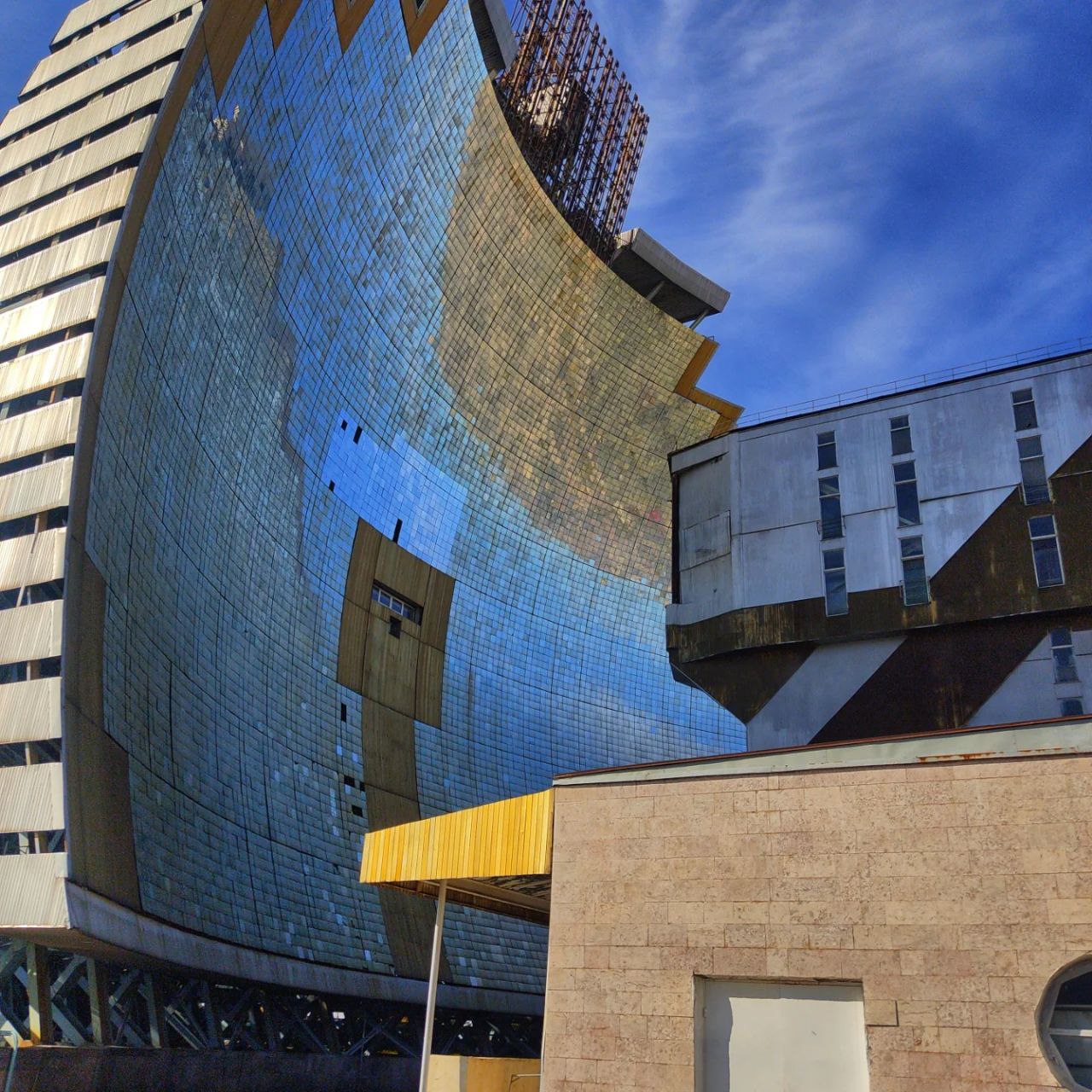
Sun Heliocomplex "Solntse" (Big Solar Furnace)
Всемирное наследие ЮНЕСКОAbout the Object
NPO "Physics-Sun", Academy of Sciences of the UzSSR (design team not established)
1987
Modernism
Changihisarak, Parkent District, Tashkent Region
Other
Gallery (6)

Heliocomplex "Solnce": The Installation That Melts with Light
The "Solnce" (Sun) heliocomplex, also known as the Big Solar Furnace, stands 45 kilometers east of Tashkent, above the village of Changihisarak in the Parkent District, at an altitude of 1,050 meters. It is neither a monument nor a public building, but an active scientific facility: a testing ground for the Institute of Materials Science and the Physico-Technical Institute of the Academy of Sciences, united under the "Physics-Sun" Research and Production Association. Built between 1981 and 1987, it was launched in 1987 and remains operational to this day. The furnace is structured into two parts distributed along the slope. At the bottom is a field of 62 heliostats-movable mirrors that track the sun throughout the day. Each heliostat is assembled from thousands of identical square mirrors, totaling about twelve thousand, with a total reflective area of 3,022 square meters. Each has its own optical sensor to maintain alignment. The heliostats throw the collected light upward, onto a concave parabolic mirror 54 meters high and 47 meters wide. The concentrator focuses all this light onto a single point on the technological tower. In a matter of seconds, temperatures exceeding 3,000 degrees are reached at the focus, and the thermal power of the installation is one megawatt. Such temperatures are needed to melt and test refractory materials for aviation, space, and electronics, and in clean conditions: heating is done by light, without fuel or electrodes that would introduce impurities into the sample. The location was chosen for three independent reasons, and all of them can be read directly in the structure. There are 250-270 sunny days a year here. The air at an altitude of one kilometer is rarefied and clean, scattering less light. And most importantly, the entire complex is set upon a single rock massif: in a seismic region, any ground shift would disrupt the alignment of the mirrors, and alignment here is measured in arcminutes. The engineering requirement for precision dictated the choice of the mountain. Architecturally, this is a rare instance where the form of a structure is entirely dictated by physics, yet the result is a spectacle. The mirror parabola faces the slope like a screen, the staircases of the heliostat field follow the contours horizontally, and the white technological tower stands at the focus. The heliocomplex is among the largest solar furnaces in the world and remains one of the last major scientific structures built in the USSR. In 2025, "Solnce" became the protagonist of the Uzbekistan pavilion at the 19th Architecture Biennale in Venice: the exhibition "A Matter of Radiance" in the Arsenale, curators Ekaterina Golovatyuk and Giacomo Cantoni from the GRACE bureau, commissioned by the Art and Culture Development Foundation of Uzbekistan. And on July 26, 2026, the heliocomplex was inscribed on the UNESCO World Heritage List as part of the nomination "Tashkent Modernist Architecture: Modernity and Tradition in Central Asia." How to get there. The complex is open for tours, and they are led by the researchers themselves, so you can ask questions of any complexity. The excursion fee is small, around five euros, but it is best to check the price and schedule in advance: this is a working institute, not a museum with fixed hours. There is no public transport here; visitors arrive by car or with a tour, and the drive from Tashkent takes about an hour. It is worth going on a clear day and in the first half of the day: the furnace is shown in operation, which requires the sun.
AI translation · 🇬🇧 EN
Rate this review:
About the Object
NPO "Physics-Sun", Academy of Sciences of the UzSSR (design team not established)
1987
Modernism
Changihisarak, Parkent District, Tashkent Region
Other
54 m
Visitor Information
~5 € · экскурсия с научным сотрудником
Morning
