
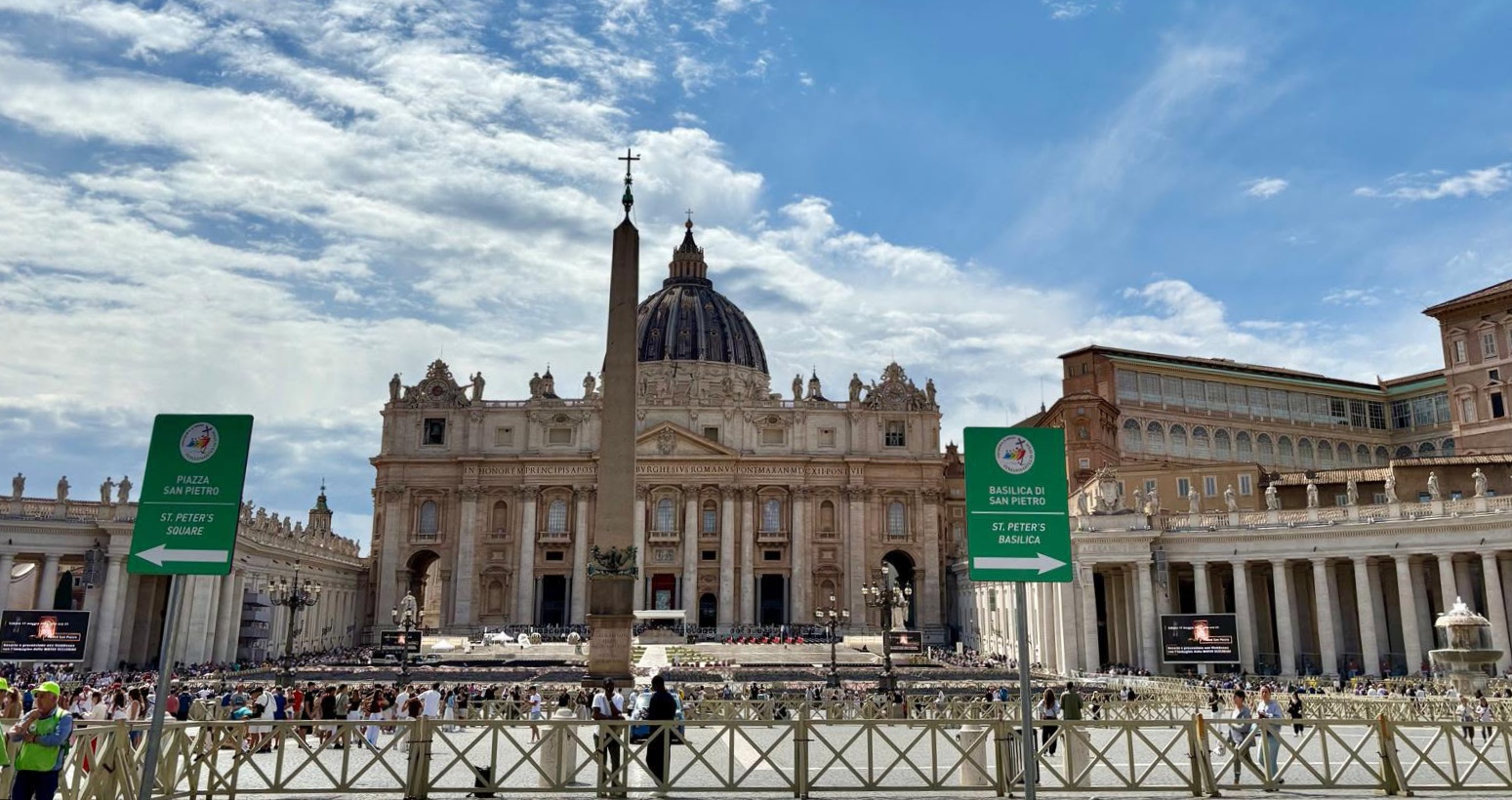
St Peter's Basilica (Basilica di San Pietro in Vaticano)
Всемирное наследие ЮНЕСКОAbout the Object
Bramante, Raphael, Michelangelo, Giacomo della Porta, Carlo Maderno, Gian Lorenzo Bernini
1626
Renaissance
Piazza San Pietro, Città del Vaticano
Religious Structure
Gallery (1)

One Hundred and Twenty Years of Construction That Divided Europe
Let's start with what is no longer here. Before 1506, another church stood on this spot: a basilica built by Emperor Constantine in the 320s over the place where, according to tradition, the Apostle Peter was buried. A contemporary of the Lateran, massive, featuring columns salvaged from ancient buildings, papal tombs, imperial sepulchers, and centuries-old mosaics. Twelve hundred years of continuous life. By the fifteenth century, it had fallen into disrepair-the popes had spent nearly a century in Avignon, and there was no one to look after it. And in 1505, Pope Julius II made a decision that left his contemporaries breathless: to demolish it and rebuild from scratch. Just think about it. They weren't tearing down an old shed, but the primary shrine of Western Christianity, a building from the time of Constantine. One of the Romans wrote at the time that not even barbarians would have done such a thing. The first stone of the new basilica was laid on April 18, 1506. Then begins something that never fits within the span of a single human life: a construction project lasting one hundred and twenty years. Just count the architects. Bramante conceived a vast Greek cross with a dome inspired by the Pantheon-not on solid walls, but on four colossal piers. Bramante dies. Raphael steps in, then Antonio da Сангалло (Antonio da Sangallo), each with their own plan. In 1547, when the construction has been treading water for forty years, Michelangelo takes over the work-he is seventy-two years old. He leads it until his death in 1564. After him come Vignola, Della Porta, Domenico Fontana, Carlo Maderno, and Bernini handles the interior decoration. The cathedral was consecrated on November 18, 1626. Over twenty popes, six great architects, one hundred and twenty years. And now, for what they won't tell you inside the cathedral itself. The construction cost monstrous amounts of money, and funds were sought wherever possible. Under Pope Leo X, around 1516, the sale of indulgences-certificates granting the remission of sins-was launched to finance the building. In Germany, they were sold by the Dominican Johann Tetzel, and the scheme was as follows: half of the collection went to the Fugger banking house to pay off the debts of the local archbishop, and half went to Rome, toward this very construction. In October 1517, the monk Martin Luther wrote ninety-five theses against the trade in indulgences. So the building you are standing in has a byproduct that changed the history of Europe more than the building itself: the Reformation. The dome, for the sake of which the forgiveness of sins was sold, split the very church it was built to glorify.
AI translation · 🇬🇧 EN
Rate this review:
The Dome: How Michelangelo Finished the Conversation Started by the Pantheon
The main thing here is the height under the dome. From the floor to the top of the cross, it is one hundred thirty-six and a half meters. This is the highest dome in the world, and to this day no one has built a higher one. To understand what you are seeing, you need to remember two buildings. The first is the Pantheon, a twenty-minute walk from here. The Romans cast a concrete dome there with a diameter of forty-three meters and closed the subject for fifteen hundred years: no one else could. The second is the Florence Cathedral, where in the 1420s Brunelleschi spanned an octagon without having scaffolding of such a height or ready-made methods. He built the dome with a double shell: the inner one bears the load, the outer one protects, and between them is a void and a staircase. In his youth, Michelangelo saw the Florentine dome. Having taken over the construction at seventy-two years old, he did the same thing here, only larger: a double shell, ribs, rings, and a form stretched upward more strongly than the Florentine one. Another detail about these seventy-two years. Ascanio Condivi, who wrote Michelangelo's biography during his lifetime, recounts that he refused payment for this work, undertaking it, in his own words, only for God and in honor of the apostle. He returned the project to Bramante's vision - to a centric, symmetric church under a single dome. He did not live to see its completion: the dome was finished by Giacomo della Porta and Domenico Fontana after his death. And now about what was done with this dome later, and this is the only part of the cathedral that is still debated to this day. Michelangelo and Bramante wanted a centric building: you enter - and immediately find yourself under the dome. At the beginning of the seventeenth century, the popes decided that processions and crowds needed a long nave, and Carlo Maderno added an elongated part and facade to the front. The cathedral became a Latin cross, accommodated twice as many people - and lost its main view. From the square, the dome slips behind the facade and almost disappears. To see it as intended, you have to walk far away, best of all to the Janiculum Hill or the Vatican Gardens. So before you is a building where function triumphed over design, and this is visible from the first step on the square. Whether to regret it is for you to decide: the cathedral holds sixty thousand people standing, and on days when it is full, arguing about views somehow feels wrong.
AI translation · 🇬🇧 EN
Rate this review:
The square that embraces you, and the bronze stripped from the Pantheon
The square in front of the cathedral is a story in its own right. It was built by Gian Lorenzo Bernini between 1656 and 1667, and it is arguably the best urban planning decision in the city's history. Two hundred and eighty-four columns in four rows, one hundred and forty statues of saints along the top, and all of this curved into two semicircles. Bernini explained his concept simply: the colonnade represents the arms of the church, flung open to welcome those arriving. In the middle of the square, you can feel this physically - the space embraces you and turns you toward the facade. There is also a trick: find the circular slabs on the pavement between the obelisk and each fountain. From any of them, the four rows of columns line up into one. 鳧 The obelisk in the center is older than anything around it. It was brought from Egypt and placed in Nero's Circus - the very one where, according to tradition, the Apostle Peter was executed. That means this stone is possibly the sole witness to the event for which everything here stands. In 1586, Pope Sixtus V ordered it moved here, and the work was carried out by Domenico Fontana. Speaking of Fontana. You have already met him three times: he built the Sistine Chapel in Santa Maria Maggiore, in 1587 he dismantled the early Christian altar screen in Santa Sabina, and he also finished the dome of this cathedral. One man, working under a single pope, left his mark on half the sights you are looking at here. And finally - inside, to the altar. Above it stands Bernini's baldachin: twisted bronze columns as tall as an eight-story building, made between 1624 and 1633 under Pope Urban VIII of the Barberini family. Bronze for the cathedral's construction was taken from everywhere, and in 1625 it was stripped from the portico of the Pantheon. The Romans responded to this with what they always responded with - a wicked joke glued to the talking statue of Pasquino: "What the barbarians didn't do, the Barberini did." Historians still debate whether the Pantheon's bronze went into this very baldachin or into the cannons for Castel Sant'Angelo; but that it was stripped and that the Romans never forgave it is a fact. And beneath the altar, under the floor, beneath all the layers - that is what the early Christians came here for: the place revered as the tomb of the Apostle Peter. Between 1939 and 1949, excavations were carried out here by order of Pope Pius XII, and sanctuaries from various eras were found at different levels, and inside them - bones wrapped in expensive cloth. In 1950, the pope announced the discovery on the radio, making the reservation that it is impossible to establish with certainty whose bones they are. And so it remains: the cathedral, for which Constantine's basilica was demolished, stands over a tomb about which it is honestly stated that it is possibly the very one.
AI translation · 🇬🇧 EN
Rate this review:
Routes with this object
About the Object
Bramante, Raphael, Michelangelo, Giacomo della Porta, Carlo Maderno, Gian Lorenzo Bernini
1626
Renaissance
Piazza San Pietro, Città del Vaticano
Religious Structure