
Amir Temur Square (Konstantinovsky Square)
About the Object
N. F. Ulyanov (1883 layout); monuments by N. Shleyfer, D. Ryabichev, I. Dzhabbarov and others
1913
Other
Сквер Амира Темура, Ташкент
Sculpture / Monument
Gallery (1)

One pedestal, seven figures: a hundred years in the center of Tashkent
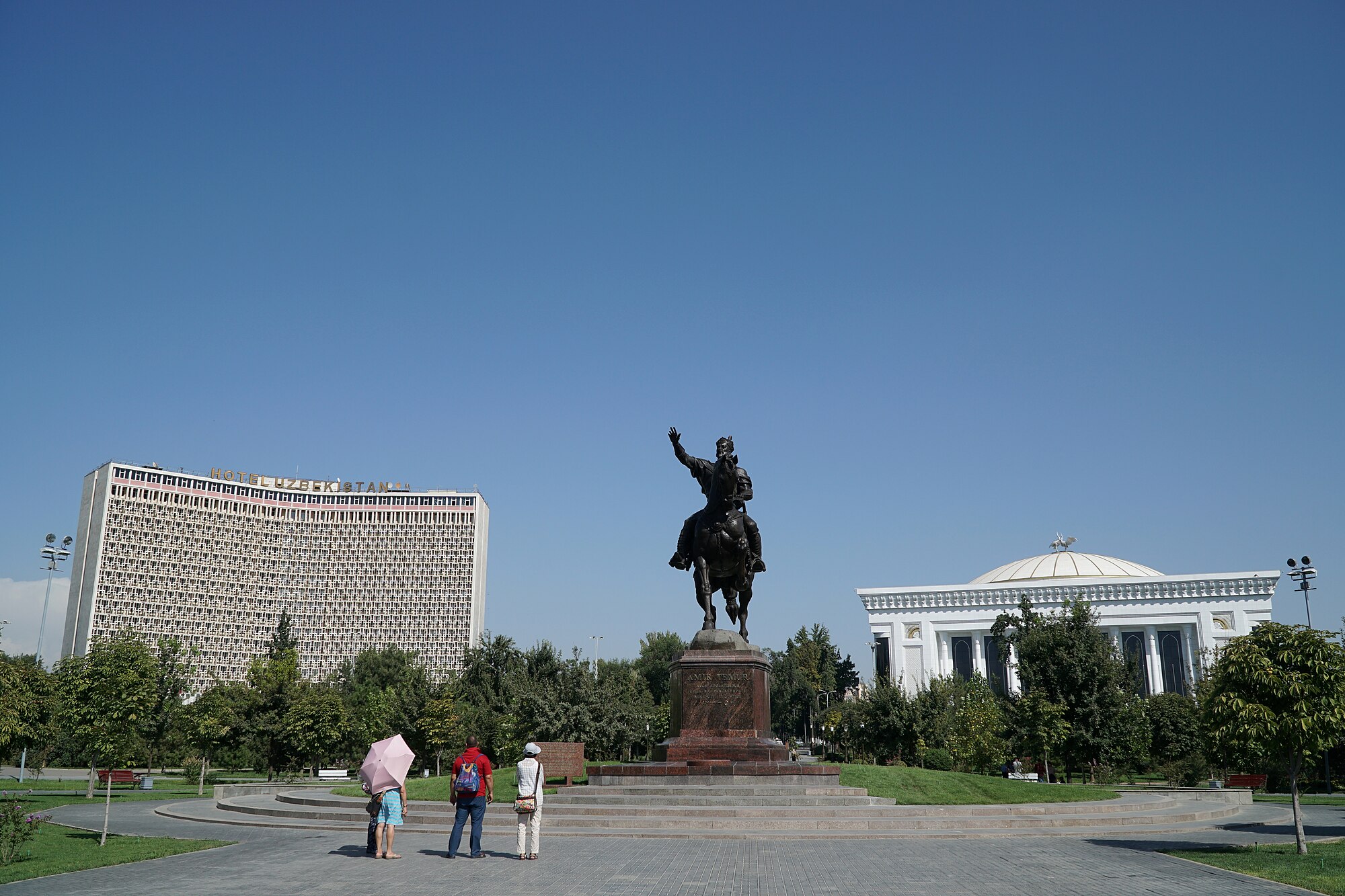
You are standing in the geometric center of the square, in front of a horseman. This is Amir Timur, and he has been here only recently. But the spot beneath him is the most changeable in the place: over a hundred years, seven different monuments have succeeded one another here, and almost every time the new figure was placed on the previous pedestal. Let us begin with the fact that at first, there was no square. In Makarov's master plan of the 1870s, a radial plaza with a church in the middle was intended here. The church was not built, but starting from the west, six high school buildings began to be erected, and the square acquired a horseshoe-shaped appearance that it has retained to this day. Since 1883, it became a public square: N. F. Ulyanov replanned it and planted trees. 1913. In the center stood the largest monument of the Turkestan region, dedicated to General Konstantin von Kaufman and the troops who conquered Central Asia. Designed by military engineer Schleifer and built by Svarichevsky. On a high concrete pedestal stylized as a semi-ruined tower of an old fortress stood three bronze figures: the general himself with a saber in a victorious pose, a soldier raising a banner, and a bugler sounding the retreat. Below, an eagle was tearing a snake apart. At the same time, the square changed its name and became Kaufman Square. 1918. A decree was issued on the removal of monuments erected in honor of tsars and their servants. The general was removed, but the pedestal was not touched: a banner was hoisted upon it, and cannons, the trophies of the revolution, were arranged around it. Thus began the main feature of this place - the figures change, the base remains. Following this, a monument to Liberated Labor appeared on the same pedestal: a hammer and sickle assembled from wood and plywood. A laconic composition made according to Lenin's plan of monumental propaganda - the first such in Tashkent. It also functioned as a tribune: demonstrations marched past, and speeches were delivered from it. 1927. The plywood was replaced by stone. The new obelisk was called the Beacon of Revolution, and in it, as they wrote at the time, "some reflection of the motifs of Uzbek national architecture was found." Inscriptions were made in two languages at once, in Russian and Uzbek. 1930. A short and most unexpected episode. For the May holidays, the square was decorated in a constructivist spirit: posters, tribunes, cantilever structures, an artificial wave-like wall in the manner of Meyerhold's theatrical explorations, and in the middle of all this stood a sculpture of Lenin with decrees in his hand by Vera Mukhina, future author of Worker and Kolkhoz Woman. This was not a permanent monument: after the holidays, the decoration was dismantled. 1952. A monument to Stalin was unveiled in the center of the square. It stood for nine years: in 1961 the figure was removed, but the pedestal was left, following the established custom. And then the strangest thing in all this history happened - for several years in the middle of the main city square stood a pedestal without a figure, and instead of a monument, there was text on it. In Russian: peace, labor, freedom, equality, brotherhood, happiness. And the same in Uzbek. 1968. The void was filled by Karl Marx, the work of sculptor Dmitry Ryabichev, with architects Leon Adamov and Yuri Miroshnichenko. Eight years later, that same Ryabichev will create the Tashkent Courage Monument. Marx lasted the longest - twenty-five years. Mid-nineties. Marx was dismantled, and Amir Timur took his place: sculptor Ilkhom Jabbarov, architects F. Ashrafi and B. Usmanov, a 1995 project. Here the tradition was finally broken - a new pedestal was erected for the horseman, round, made of red polished stone. Timur's own words are carved on it: "Power is in justice." Now look around, because the buildings surrounding you are no younger than this history. The western side is held by the high schools, male and female, begun in 1878 and 1879 according to the design of military engineer Yanchevsky. A street ran between them to the cathedral, and the two blocks functioned as gates to it. In 1920, the newly established Turkestan University moved in here, and in the thirties, the buildings were raised with a third floor and connected by inserts, so their current appearance is no longer that of high schools. By the way, the new university complex in 1921 was designed by Fyodor Shekhtel, that very Moscow one. It was not built. On the northern side is the State Bank of 1895, one of the best works of V. Heintzelman: a single-story building with a basement, Baroque facades with semicolumns and pilasters, details cast in plaster and lying in a light pattern over the brickwork. And the chimes stand on the site of a palace that never happened. Here they intended to build the house of the military governor of the Syr-Darya region according to the design of A. Benois from 1878 - and did not build it, as money was not found. Instead of the palace, a clock tower rose in 1947, and its clock is a trophy. At the end of the war in Prussian Allenstein, an emergency tower above the town hall was being dismantled, and Sergeant Eisenstein, a Tashkent native from a family of hereditary clockmakers, reported to the commandant: the mechanism is intact, it might come in handy, and my city has no town clock. The command issued a paper stating that the clock is a gift from the regiment to Tashkent. The ganch carving on the tower was done by Usta Shirin Muradov, and Eisenstein was later elected an honorary citizen of the city and appointed chief caretaker of the chimes. So, standing here, you see a square where almost nothing has remained itself: the high schools have been raised, the clocks came from East Prussia, and seven figures have changed on the pedestal. The only thing that has not changed over a hundred and fifty years is the horseshoe-shaped plan inherited from the church that was never built.
AI translation · 🇬🇧 EN
Rate this review:
Nearby and related
By the same architect
Close by in Tashkent
About the Object
N. F. Ulyanov (1883 layout); monuments by N. Shleyfer, D. Ryabichev, I. Dzhabbarov and others
1913
Other
Сквер Амира Темура, Ташкент
Sculpture / Monument