
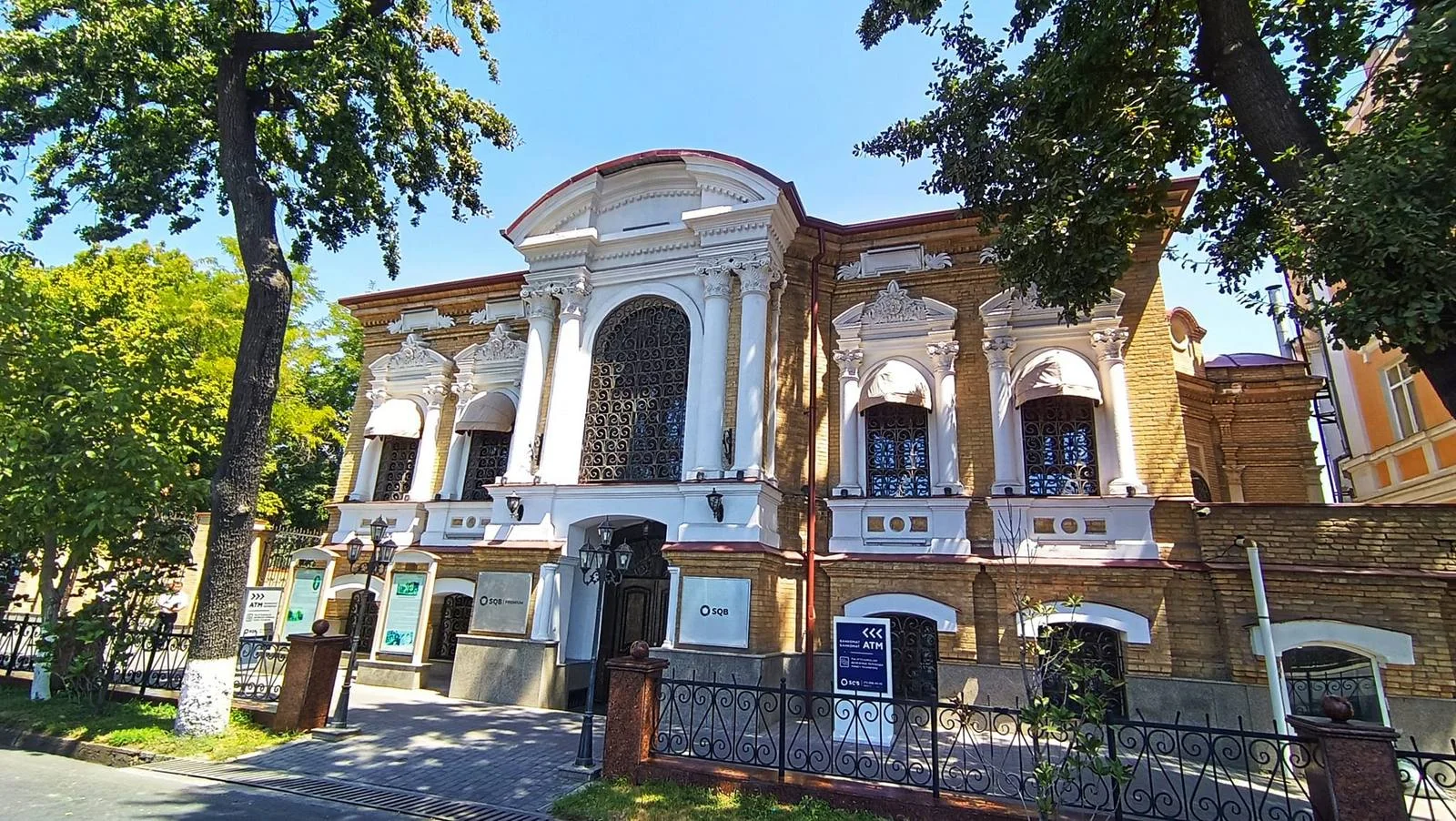
State Bank Building
About the Object
V. Heinzelmann
1895
Other
Сквер Амира Темура, северная сторона, Ташкент
Public Building
Gallery (1)

The Bank That Started the Grand Side of the Square
This building was the first of the large ones to appear here. Until 1895, the square was surrounded mostly by unremarkable single-story houses, and only with the construction of the State Bank did its northern side become, as they said back then, representative. Everything that stands around it today grew up after it. The bank was built by Heintzelman, and this is considered one of his best works. The building is arranged simply and logically: one main floor plus a basement, the trading floors upstairs, a straight staircase leading to them from the entrance, and utility rooms downstairs. No unnecessary corridors - the layout is instantly legible. Yet the facades were crafted with pleasure. This is Baroque: semi-columns, pilasters, window frames, complex cornice breaks. A technique worth coming closer for - all these details are cast in plaster and set against exposed brickwork. A light molded pattern on red brick, without plaster that usually hides all of this. For Tashkent at the end of the 19th century, this was an expensive and striking technique. Researchers have noted that public buildings around Konstantinovskiy Square are architecturally stronger than the administrative development of Bolshoy Prospekt. The bank is the prime proof of this.
AI translation · 🇬🇧 EN
Rate this review:
Tunnel under the storehouse
The Tashkent branch of the State Bank opened on May 10, 1875 - twenty years before it got this building. For the first two decades, the bank rented someone else's house, and it was there that an incident occurred after which having its own walls looked not like a luxury, but a necessity. On Sunday, April 25, 1893, the yard keeper of the house occupied by the bank noticed a crack plugged with a rag in the earthen floor of the shed. He pulled out the rag and discovered that a sizable hole went deep down. They figured it out: from the back yard, someone was digging a tunnel under the storehouse that stood in the middle of the courtyard. The passage had been dug about six sazhen, which is about thirteen meters, and about as much remained to be dug. Inside, they found a kerosene lamp, a crowbar, a drill, a small shovel, a pickaxe, a sack, and three bottles. The branch was managed at the time by Collegiate Councillor Prince Nikolai Petrovich Dolgorukov. Judging by Dobrosmyslov's book, from which all this is known, the matter was not seen through to the end - he does not name the culprits. Two years later, the bank moved into its own building. You cannot directly connect one with the other: there is no evidence that the building was constructed specifically because of the tunnel. But the storehouse in the middle of the yard, which could be reached from below through the neighbor's shed, is a more weighty argument in favor of construction than any talk of representativeness. How much money was kept here is evident from the figures of the early century. By 1910, the branch's savings box had about twelve thousand depositors and a turnover of up to four and a half million rubles; on January 1, 1911, two million in cash lay in the box, and another eight hundred and fifty thousand in interest-bearing securities left by depositors for safekeeping. This money was transported around the city, and twice this ended badly. On July 18, 1905, treasury cashier I. S. Leontiev was carrying one hundred and thirty-five thousand rubles from the bank branch to the treasury, accompanied by four sworn guards. At the corner of Salarsky Avenue and Khivinskaya Street, they were attacked and ten thousand five hundred were taken. And a year and a half later, the same Leontiev pulled off the deed himself. On November 17, 1906, he received the money and sent away the companions: he ordered one to buy seven hundred rubles of state rent for the governor-general's chancery, and another to take the bag downstairs and go to the post office for supposedly forgotten transfers. Left alone, the cashier took the bag out to the street, got into a pre-arranged cab, and disappeared. He was found and convicted, but, as Dobrosmyslov dryly writes, some of his accomplices and some of the money have not been found to this day - that is, until 1912, when the book was published. All this happened around a building that is looked at today as a monument: stucco molding on exposed brick, pilasters, broken pediments of cornices. It is useful to remember that beauty was not the primary concern for the customer. He needed walls, a storehouse, and the confidence that a man with a pickaxe and a kerosene lamp would not break into the neighboring shed.
AI translation · 🇬🇧 EN
Rate this review:
Nearby and related
Close by in Tashkent
About the Object
V. Heinzelmann
1895
Other
Сквер Амира Темура, северная сторона, Ташкент
Public Building