
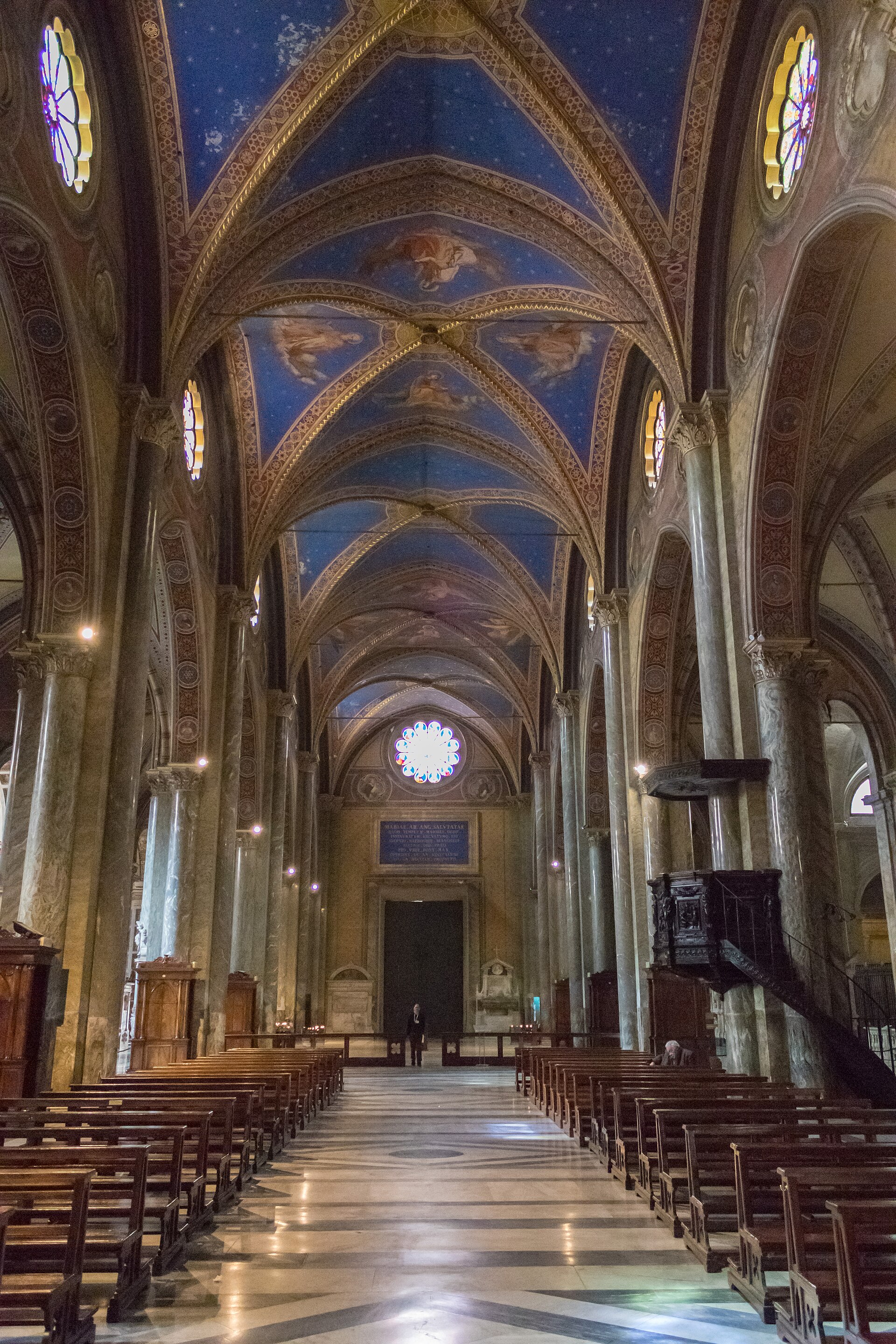
Basilica di Santa Maria sopra Minerva
Всемирное наследие ЮНЕСКОAbout the Object
Dominican Order, architects not named; neo-Gothic alterations by Girolamo Bianchedi, 1848–1855
1280
Gothic
Piazza della Minerva 42, Roma
Religious Structure
Gallery (3)

Rome's only Gothic church, and even that was redone in the 19th century
Rome is a city without Gothic architecture. While half of Europe was building pointed arches and stretching buttresses upward, Rome was finishing up basilicas and waiting for the Renaissance. There are virtually no Gothic churches here, and the only one that has survived to our day stands in a small square behind the Pantheon. From the outside, you would never recognize it: a simple light facade without a single spire. But to the left of the door, there is a detail. Old wooden boards with inscriptions and a line are nailed there. These are marks of the Tiber's water level: before the river was confined within embankments in the late 19th century, it regularly flooded the center, and the water rose right up here, to human height and higher. Inside, everything is different. Pointed arches, ribbed vaults, a blue ceiling dotted with golden stars. The church was begun by the Dominicans in 1280 following the model of their own Santa Maria Novella in Florence, and the decoration was finished only in 1453. And here an honest caveat is needed, without which this review would be a lie. The blue vaults with stars, which is why everyone comes here, were painted in the 19th century. Between 1848 and 1855, the restorer Girolamo Bianchedi removed the Baroque layers and painted the bare walls with a Neo-Gothic pattern. What you see is genuine Gothic construction and a later idea of what Gothic should look like. One inside the other. The church's name is also imprecise. Sopra Minerva means above Minerva, and for centuries it was believed to stand on a temple dedicated to that goddess. In reality, beneath it are the remains of a sanctuary to the Egyptian goddess Isis, and Minerva was attributed by mistake. Now, for the reason to step inside on its own. To the left of the altar steps stands a full-length marble Christ by Michelangelo, holding a cross. This statue has a double. Michelangelo abandoned the first version around 1516 because a black vein appeared in the white marble running right across the face. He carved a second one anew and sent it to Rome to be finished by his pupils, but they managed to damage the statue, and a third master had to finish it. The bronze loincloth appeared even later, in 1546, and has nothing to do with the author's original intent. The first, abandoned version was considered lost and was found only in 2000 in the sacristy of a church in a small town near Viterbo, with that very same black vein on the face. Two more things that happened here. Under the floor lies Fra Angelico, a monk of this monastery and one of the finest painters of the Quattrocento. And in 1633, in the monastery hall attached to this church, Galileo knelt and recanted his belief that the Earth moves.
AI translation · 🇬🇧 EN
Rate this review:
Nearby and related
Close by in Rome
Routes with this object
About the Object
Dominican Order, architects not named; neo-Gothic alterations by Girolamo Bianchedi, 1848–1855
1280
Gothic
Piazza della Minerva 42, Roma
Religious Structure