
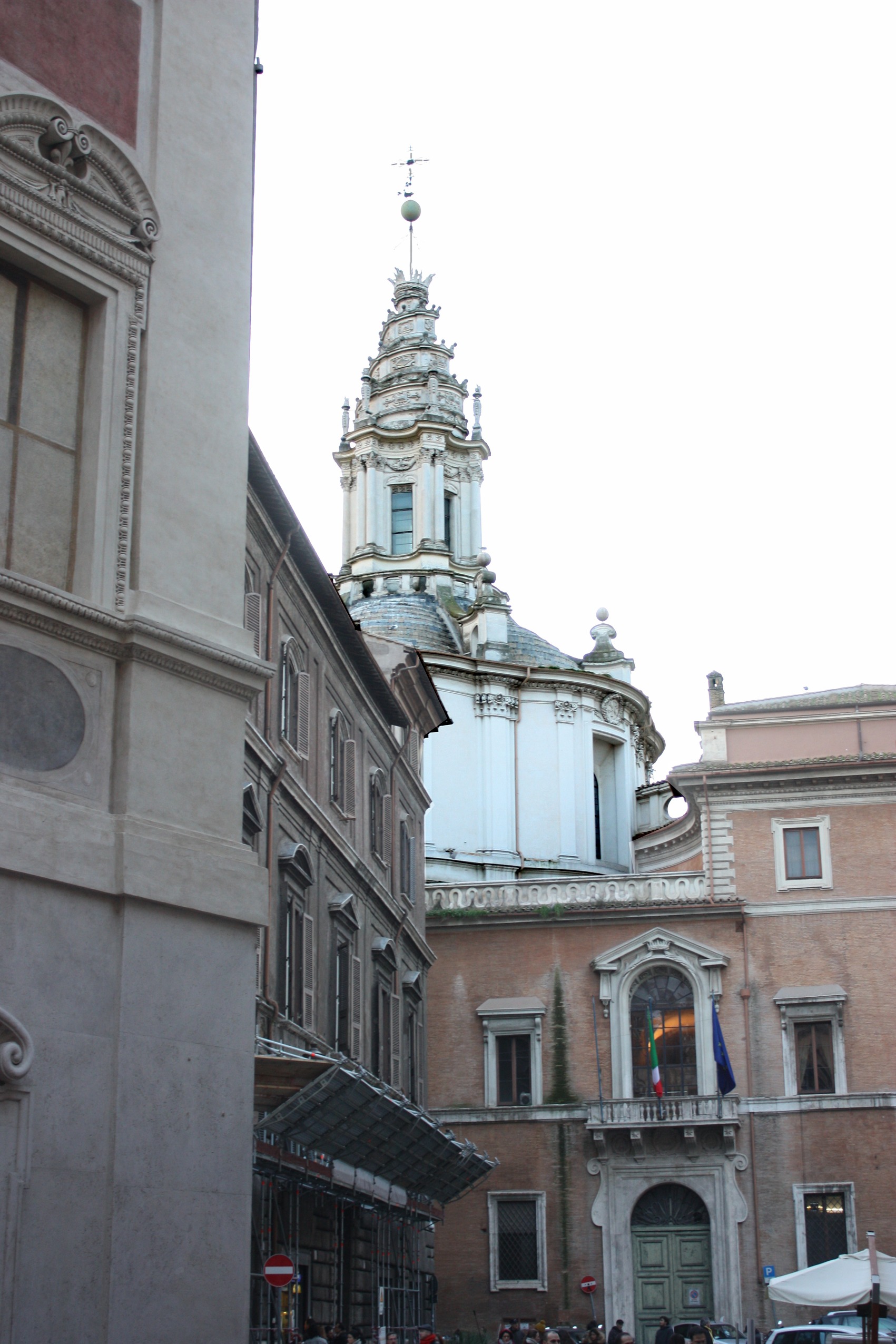
Sant'Ivo alla Sapienza
Всемирное наследие ЮНЕСКОAbout the Object
Francesco Borromini
1660
Baroque
Corso del Rinascimento 40, Roma
Religious Structure
Gallery (1)

A spiral above the roofs and a floor plan that demands deciphering
First, find it. This is harder than it seems: the church stands not on the street, but in a courtyard - in the courtyard of the Palazzo della Sapienza, which housed the University of Rome from the 15th century until 1935. Walk under the arch, and the courtyard will open up: long arcades on two sides, and at the end - a concave facade, integrated into them as if it were part of the courtyard rather than a separate building. Raise your eyes to the dome, or more precisely to what is on top of it. There is neither a spire nor a cross on a ball, but a spiral - a stone curl screwing into the sky, with a cross at the end. The silhouette is instantly memorable: the spiral is visible from the city roofs, and it cannot be confused with anything else. What this curl means is still debated: a Babylonian ziggurat, a seashell, a bee stinger, and the ascent of thought to heaven. Borromini left no explanations. A hundred years later, this silhouette would be repeated in Copenhagen, on the tower of the Church of Our Saviour - the idea proved contagious. Inside, the main thing is the floor plan and the vault. The plan of this church is not a circle, not an oval, and not a cross. It is a six-pointed star: two overlapping triangles with truncated corners, with semicircles inserted between the sides. In the 17th century, such a figure was read as the Star of Solomon - a sign of wisdom. For a university church dedicated to Saint Ivo, the patron saint of lawyers, nothing could be better: the building itself communicates why it is here. And here is the main reason to come inside. This plan does not end at floor level. The walls go up without changing the pattern and transition into the dome in such a way that the star continues within it all the way to the lantern. Usually, a dome is a separate story placed on top of the walls; here, it does not exist as a separate thing. A single figure, carried from the floor to the light. Borromini built this for nearly twenty years, from 1642 to 1660, under three successive popes. The first patron was Urban VIII of the Barberini family, and their coat of arms - a bee - sits in the lantern. Spotting it is a separate pleasure; and at the same time, this is the second time during the walk that you encounter the Barberini: the first is the bronze stripped from the Pantheon for the canopy in Saint Peter's Basilica. If you have already been to San Carlino, compare your impressions. There, Borromini wrestled with cramped space and an awkward plot. Here, he was given a regular courtyard and time - and he built not an effect, but a proof: geometry carried all the way through, from the floor plan to the lantern, without a single concession.
AI translation · 🇬🇧 EN
Rate this review:
Nearby and related
By the same architect
Close by in Rome
About the Object
Francesco Borromini
1660
Baroque
Corso del Rinascimento 40, Roma
Religious Structure