
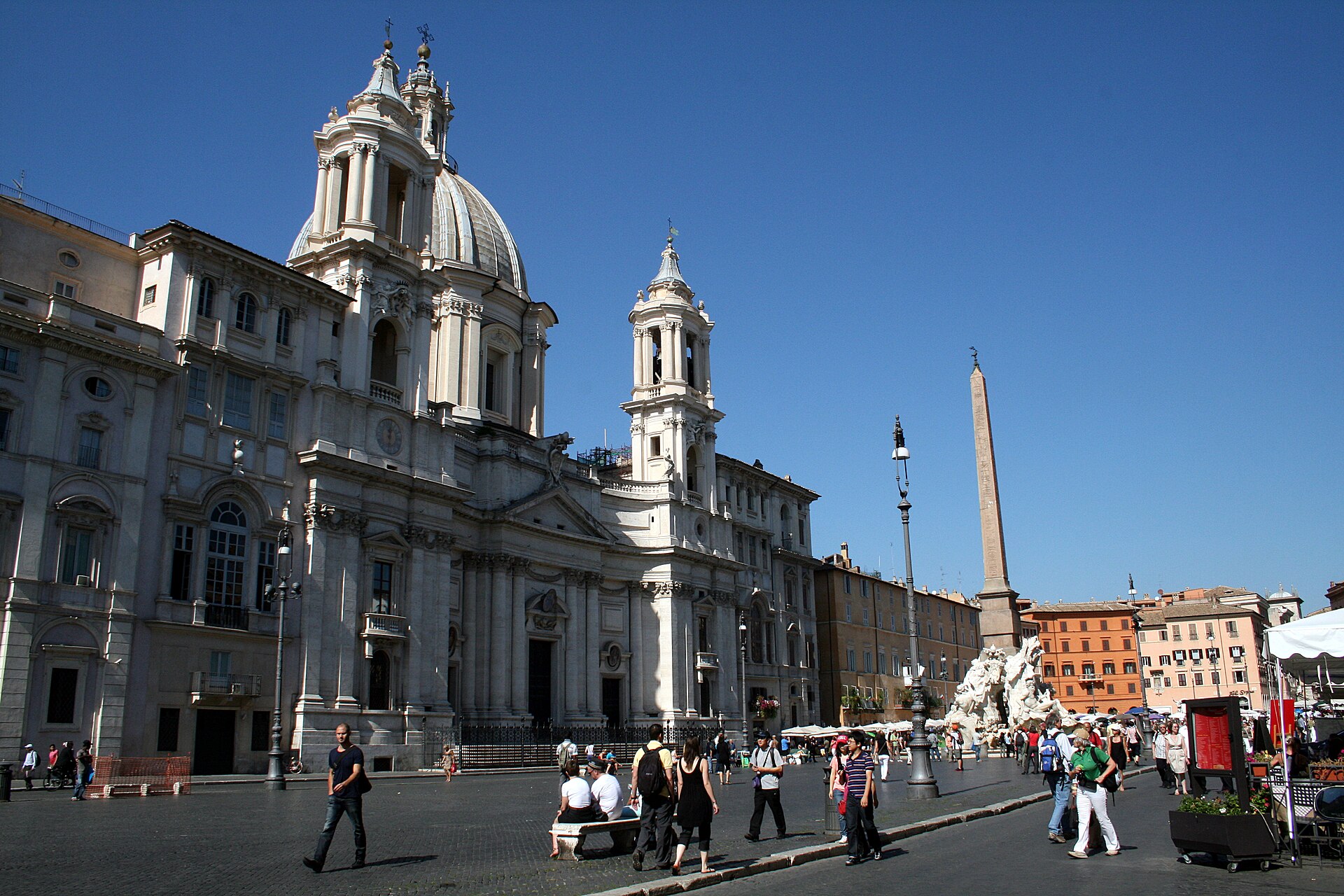
Sant'Agnese in Agone
Всемирное наследие ЮНЕСКОAbout the Object
Girolamo and Carlo Rainaldi, Francesco Borromini
1657
Baroque
Piazza Navona, Roma
Religious Structure
Gallery (1)

The church that made Borromini walk off the construction site
It stands in the middle of the western side of the square, right opposite the Fountain of the Four Rivers, and you have surely looked at it already without knowing its name: a concave facade, two towers on the edges, a dome between them. Let us start with the name, because it is deceptive. "In Agone" is not "in agony," as almost everyone thinks. Agone comes from the Greek "agon," a contest: that was what the place where games were held was called. That is, the church is named after the Stadium of Domitian, on which the square stands. The word has preserved the memory of the running track for fifteen hundred years longer than the track itself. Right here, according to legend, is what the church was built for: in this place, among the structures of the stadium, the young Christian Agnes was martyred. The temple was commissioned by Pope Innocent X - the same one who commissioned Bernini for the fountain opposite. And he commissioned not just a church: his Palazzo Pamphili stands right next to it, and the church was conceived as a family chapel. An opening was made in the drum of the dome so that the family could participate in the service directly from the palace, without going out into the street. Construction began in 1652 by Girolamo Rainaldi and his son Carlo. A year later they were replaced - Francesco Borromini took over the work. And this is where it is worth stopping, because this is the very Borromini whose tiny church on the Quirinal you may have already seen, and the very one about whom the anecdote with the Nile is told. He changed the main thing. Rainaldi's facade was flat - Borromini made it concave, receding inward, so that the dome, which was lost on the flat facade, became visible from the square in its entirety. He lowered the steps to the pavement in a semicircle. He reworked the towers on the edges and the drum. What you see today as a single image is his composition. And he did not finish it himself. In 1655 Innocent X died, his nephew showed no interest in the construction, and in 1657 Borromini left without finishing the work. Others finished it, including Carlo Rainaldi, whom he had once replaced, and Bernini. Now about the anecdote - since you are standing right between the fountain and the facade. You will be told that the figure of the Nile in the fountain is covering its face so as not to see the rival church. Check the dates, standing on the spot: the fountain was unveiled in June 1651, construction of the church began in 1652, and Borromini took over the facade in 1653. When Bernini was finishing the fountain, this church did not even exist in the project, and that facade which the Nile supposedly does not want to look at did not exist for another two years. History lies. But it has lasted for centuries, and I understand why: the two best architects of the era really did work on the same square, facing each other, and did not like each other. The city had enough of that.
AI translation · 🇬🇧 EN
Rate this review:
Nearby and related
By the same architect
Close by in Rome
Routes with this object
About the Object
Girolamo and Carlo Rainaldi, Francesco Borromini
1657
Baroque
Piazza Navona, Roma
Religious Structure