
Archbasilica of St John Lateran
Всемирное наследие ЮНЕСКОAbout the Object
Francesco Borromini (interior, 1646-1650); Alessandro Galilei (facade, 1735)
324
Baroque
Piazza di San Giovanni in Laterano 4, Roma
Religious Structure
Gallery (1)

The First Church of Rome Stands on the Barracks of the Defeated Guard
Ask anyone which church in Rome is the main one, and they will tell you: St. Peter's Basilica. The answer is wrong. The cathedral of Rome, meaning the church where the bishop's seat of the Roman bishop is located - and the Roman bishop is indeed the pope - is here, on the other side of the city, by the ancient walls. St. Peter's is a Vatican basilica. And the cathedra is here. This is written directly above the entrance, and the inscription is not lacking in modesty: the most holy Lateran Church - mother and head of all churches of the city and the world. Now about where it came from, because that is the best part of the story. In 312, Constantine defeated Maxentius at the Milvian Bridge - that very battle you have already encountered in the card of the Basilica of Maxentius, whose construction the victor calmly finished and claimed as his own. Maxentius had a mounted guard, an elite unit quartered in barracks here on the Caelian Hill. The victor dealt with it simply: he disbanded the guard and demolished the barracks. And in their place, he gave the land to the Christian community - the very one that his predecessors had recently persecuted. Just think about what this means on the ground. The first large Christian church in Rome was built not on a wasteland or a cemetery, but on the foundations of the defeated guard's barracks. The building with which the state religion begins stands on the wreckage of the losing army, and this is not a metaphor, but archaeology: the remains of the barracks lie beneath the floor. The church was consecrated in 324. Everything you have seen further in this city begins with it: both Santa Sabina on the Aventine and Santa Maria Maggiore on the Esquiline are its younger relatives. And one more thing worth seeing separately is the baptistery next to the basilica. A small octagonal structure with a font in the middle. The octagon was not chosen for beauty: the eighth day, the day after Saturday, meant a new life to early Christians, and the shape of the building repeated the meaning of the rite. Adults were baptized by immersion back then, so in the middle there is not a bowl, but a pool you have to step down into. This building became a model. All the octagonal baptisteries of Italy, including the famous Florentine one, are descendants of this one. The building where it was invented what the place of baptism should look like stands here and is open from seven in the morning.
AI translation · 🇬🇧 EN
Rate this review:
Sixteen Centuries of Disasters and Borromini’s Baroque Shirt
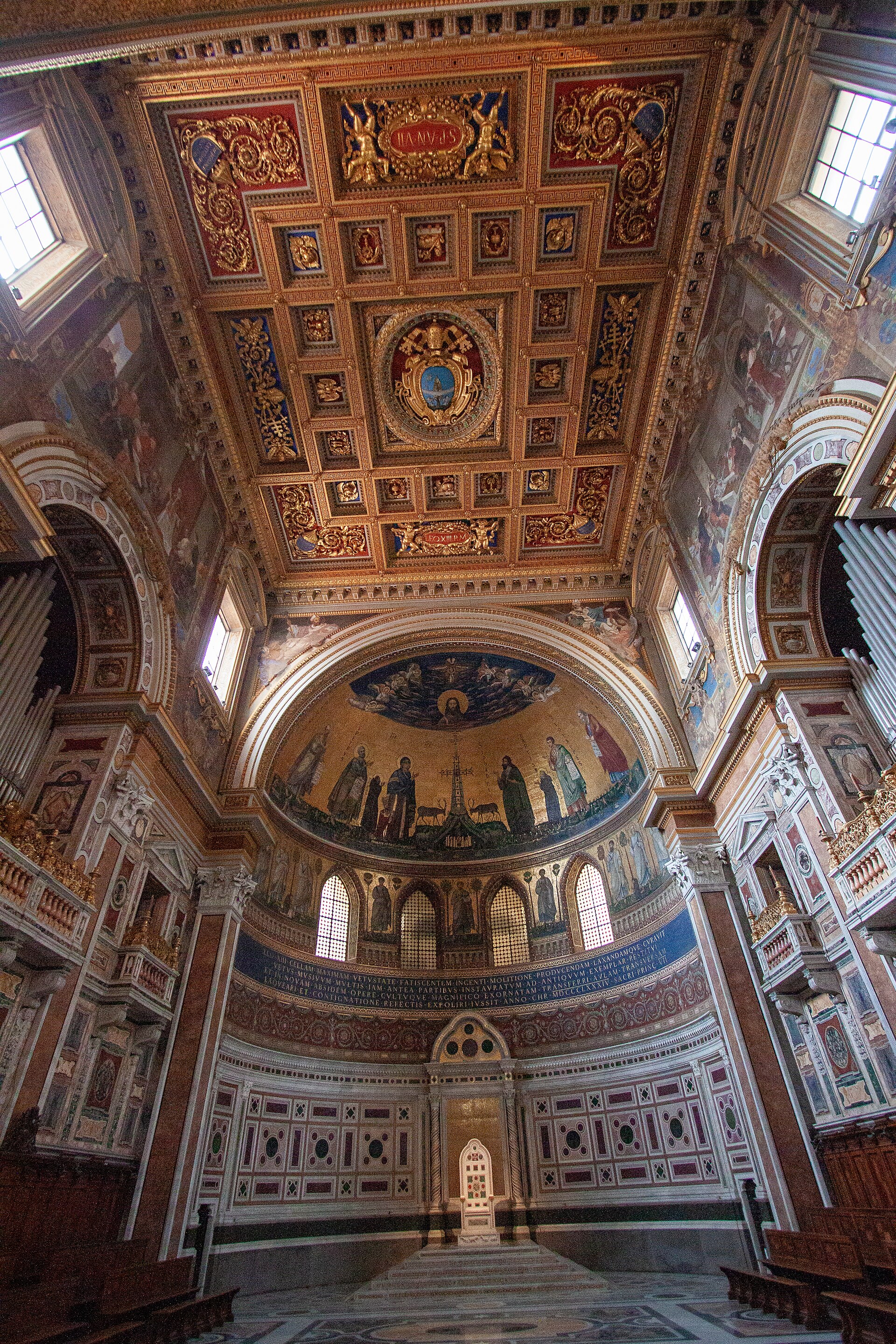
Rome’s first church has barely survived. Let’s be honest about that right away: what you see inside is seventeenth-century work. But the story of how one thing turned into another is more interesting than the building itself. Count along with me. Year 455 - Rome is sacked by the Vandals, the basilica is stripped down to its bare walls. Year 897 - an earthquake, and a chronicler records a terrifying phrase: the church collapsed “from the altar to the doors.” That same year of 897, in the neighboring Lateran Palace, an event occurred that has no equal in church history for sheer grimness: Pope Stephen VI ordered the exhumation of the corpse of his predecessor Formosus, had it seated on a throne, and put on trial. The dead man was found guilty, his right hand was chopped off, and his body was thrown into the Tiber. The earthquake and the trial of the corpse happened in the exact same year, and contemporaries naturally connected the two-even though we have no grounds for doing so. Next come two fires, in 1308 and 1361, each followed by reconstruction. By this time, the popes had already moved to Avignon, and the Lateran, an abandoned palace, burned without a master. And then in 1646, Pope Innocent X commissions Francesco Borromini to remodel it for the Jubilee of 1650. The task was an awkward one: the building was ancient and revered, it could not be destroyed, yet after centuries of repairs it looked pitiful. Borromini played it smart. He didn’t throw out the ancient nave columns-he enclosed them in massive white piers, and cut twelve large niches into those piers, where colossal statues of the apostles were later placed. From the outside, it looks like a completely new Baroque space, and only if you know can you guess that the old is hidden inside the piers. People’s attitudes toward this vary. Some will say Borromini preserved antiquity by enclosing it in a case; others will say he buried it alive. I lean toward the former: in a century that demolished things without a second thought, a man found a way not to demolish. The facade you saw from the square is even later: 1735, Alessandro Galilei, winner of the competition. Giant columns, a balustrade, statues along the top-the grand entrance to a building that by then was fourteen centuries old. What survived from the past, apart from the hidden columns? A Gothic ciborium over the papal altar with fourteenth-century frescoes-the altar where, by rule, only the pope may officiate. A thirteenth-century cloister by the Vassaletto family: a small courtyard with twisted columns encrusted with colored smalt-the best place in the complex to sit down and remember that you are in the oldest Christian building in the city. And finally, return to the thought we started with. The Roman basilica was a courtroom. In the Lateran, this hall received the cathedra of the bishop of Rome-and with it, power comparable to that once held by the magistrate who sat in the basilica. The form outlived the empire that invented it, and it outlived everyone who subsequently remodeled it.
AI translation · 🇬🇧 EN
Rate this review:
Nearby and related
By the same architect
Close by in Rome
About the Object
Francesco Borromini (interior, 1646-1650); Alessandro Galilei (facade, 1735)
324
Baroque
Piazza di San Giovanni in Laterano 4, Roma
Religious Structure