
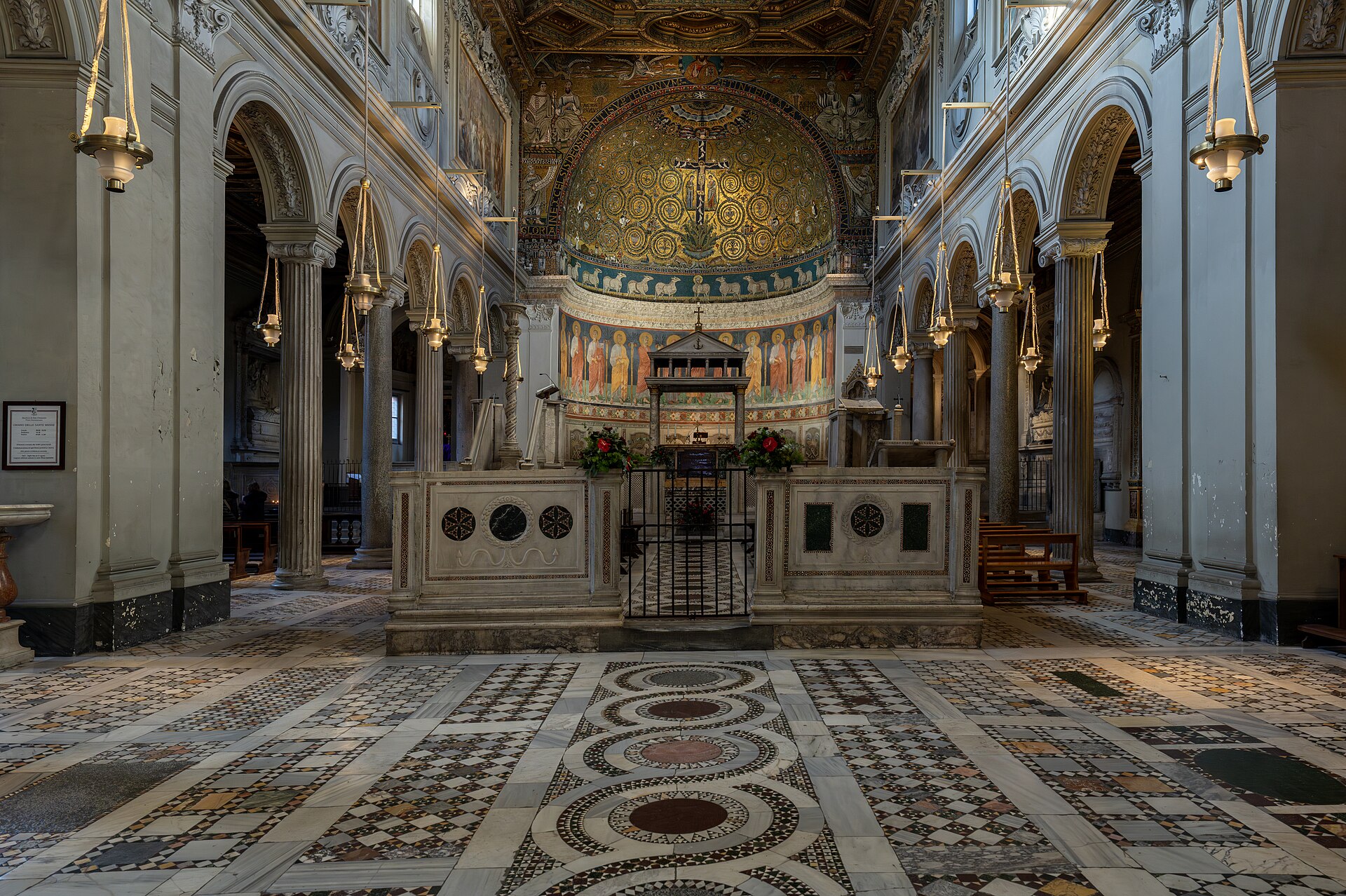
Basilica of San Clemente al Laterano
Всемирное наследие ЮНЕСКОAbout the Object
Unknown (rebuilt under Cardinal Anastasius)
1120
Romanesque
Via Labicana 95, Roma
Religious Structure
Gallery (1)

House, mithraeum, church, church - four floors of history under one roof
Five minutes from the Colosseum, behind an unassuming fence, stands a church people travel to Rome specifically to see. From the outside, it is completely unremarkable. Everything begins when you buy a ticket and head down. First is what sits at street level. A basilica from the early 12th century: columns, a marble choir screen, apse mosaics. It is beautiful, and we will talk about it in the second review. But for now, find the stairs and go down. The first descent and you are in a 4th-century church. The very same early Christian one: a hall divided by columns, only now it is crushed from above and turned into a basement. On the walls are 9th to 11th century frescoes, darkened and peeling in places. This is not a ruin; it is an entire church that was once abandoned and filled in to build a new one on top. The second descent and you are in the 1st century. Here are the walls of a Roman house, 1st-century masonry, narrow corridors, the cold. And right here is the mithraeum - a sanctuary of the god Mithras, set up in the 2nd century. This place is worth lingering in. An oblong hall, stone benches along the walls, an altar in the middle. Carved on the altar is the very thing it was all made for: Mithras slaying the bull. The cult was male-only, closed, with initiations and trials, and in the 3rd century it was a direct competitor to Christianity: it also promised salvation, also required initiation, also gathered the community for a shared meal. People lay and ate on these benches. Not many mithraea are known in Rome, and this is the best preserved one. This is why it is worth coming here. At Santa Sabina, you see that a Christian temple grew out of a Roman basilica. Here, you see how it happened physically: the victorious community stood on the house of the defeated one. It did not demolish it - it filled it in and built on top. And a thousand years later, it turned out that what was buried is more intact than what stood in plain sight. And the last thing you need to do on the lower level: be quiet and listen. You will hear water. A stream flows beneath the church - part of the ancient drainage system, still working to this day. There is nothing more Roman than a working nineteen-century-old drain in this city. How all this was found is also a story. In 1857, the prior of the local Irish Dominican monastery, Father Joseph Mullooly, started digging under the floor of his church because he suspected something was beneath it. He turned out to be right. The excavations are not finished to this day, and the order has owned this place since 1667.
AI translation · 🇬🇧 EN
Rate this review:
The mosaic where the cross sprouted, and the first recorded Italian phrase: a curse word
Now, about what is on the walls. Start with the apse of the upper church. There is a mosaic from around 1200 there called the "Triumph of the Cross," and it is one of those things for which it is worth throwing your head back and standing still. The cross with the crucified Christ does not stand on barren gold: a giant acanthus scroll, green and gold, emanates from its base, filling the entire semi-circular surface. Birds, deer, monks, and peasants crawl, fly, and graze along the scrolls; somewhere in there, a place was also found for domestic scenes. The meaning is direct: the cross is the tree of life, and all living things grow from it. The Middle Ages knew how to express complex things very visually. In the side chapel are the frescoes by Masolino da Panicale, dating from 1428-1431, depicting the life of Saint Catherine of Alexandria. This is already almost the Renaissance: volume, perspective, serene faces. And now go back down to the 4th-century church and find the late 11th-century fresco there with the story of Sisinnius. The plot is as follows. The noble Roman Sisinnius suspected that his wife was going to listen to the Christian preacher Clement, became angry, and ordered his servants to seize and bind him. But according to the legend, instead of Clement, the servants, struck blind, tied ropes around a stone column and dragged it, straining themselves. Sisinnius urges them on. The artist inscribed who says what, and recorded it the way these people actually spoke. Sisinnius's line to the servants is not written in Latin, but in the living vernacular, and it sounds roughly like this: "Pull, you sons of bitches!" And Clement's response above him is in proper Latin, stating that because of the hardness of their hearts, they were given the task of dragging the stone. This is the earliest known recorded phrase in the Italian language-and it is a curse word, and it is on a church wall. Eleventh century, Latin was still the language of all writing, but the artist, in giving a character direct speech, involuntarily recorded what he heard on the street. That is usually how a new language appears in history: not by decree, but because someone needed to convey how a man yells at his servants. There is one final correction that, most likely, no guidebook will tell you. Almost everywhere it is written that the lower church was burned by the Normans of Robert Guiscard in 1084, and that the upper one was built to replace the burnt one. It sounds nice, but no traces of fire were found in the lower church. Today this version is considered outdated: the church, apparently, did not burn, but was deliberately filled in and turned into a foundation when they decided to rebuild on top. The difference is important. It is one thing to have a disaster, and another to have a calm decision by builders: the old becomes the foundation of the new. This is precisely what happened at San Clemente three times in a row.
AI translation · 🇬🇧 EN
Rate this review:
Nearby and related
By the same architect
Close by in Rome
About the Object
Unknown (rebuilt under Cardinal Anastasius)
1120
Romanesque
Via Labicana 95, Roma
Religious Structure