
Castel Sant'Angelo (Mausoleum of Hadrian)
Всемирное наследие ЮНЕСКОAbout the Object
Unknown (the conception is attributed to Hadrian himself)
139
Ancient Roman
Lungotevere Castello 50, Roma
Museum
Gallery (1)

The Tomb the City Would Not Let Go
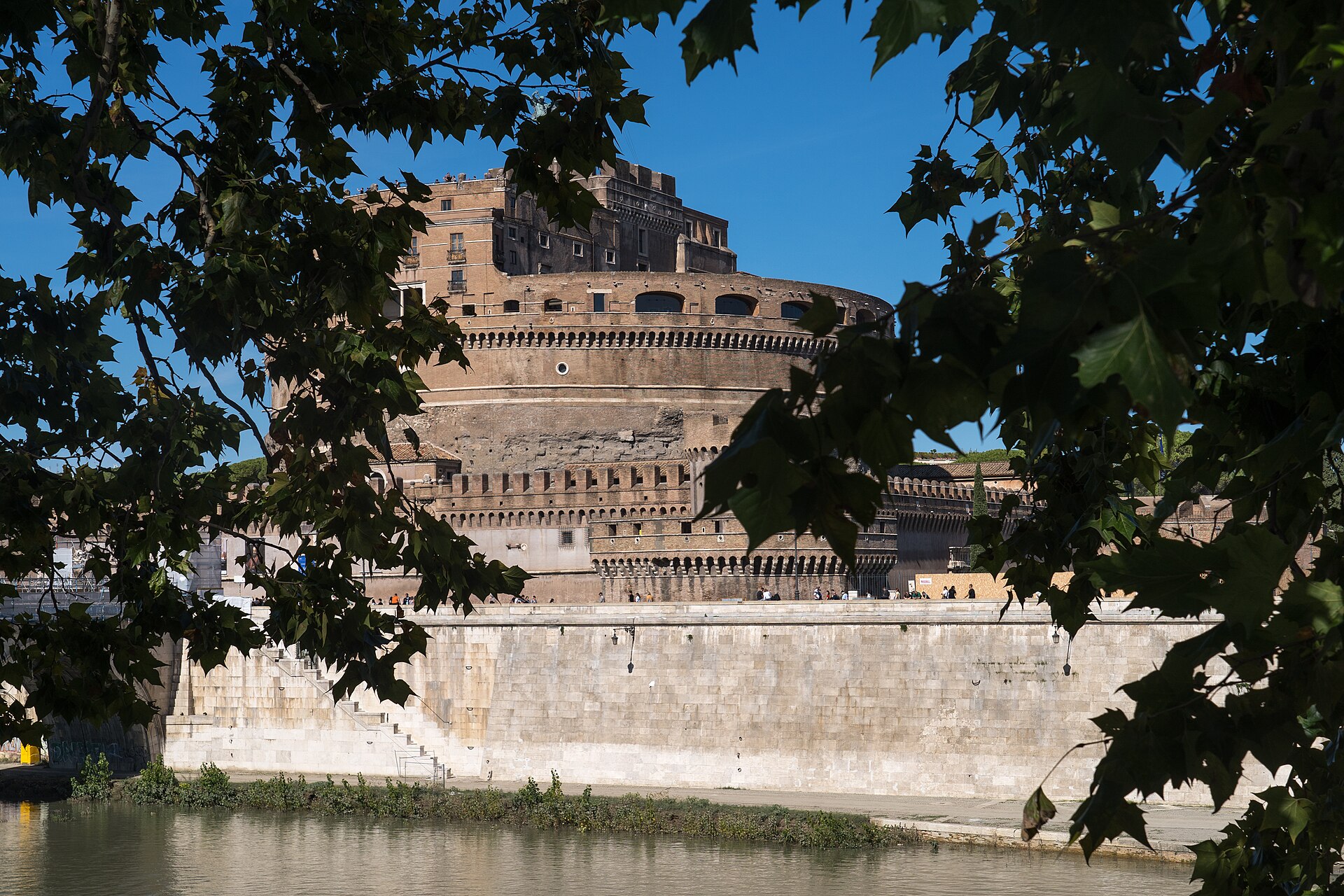
The best approach to it is from the bridge. The bridge is also worth it: on the sides are ten angels, each with an instrument of Christ's passion, the work of Bernini's workshop. And at the end of the bridge is a huge brick drum on a square base, heavy and dull. It does not look like a palace, nor like a church. It is neither the one nor the other. This is a tomb. Emperor Hadrian began building it around 123 for himself and his family; it was finished in 139, a year after his death. Here they laid the ashes of Hadrian himself, his wife Sabina, his adopted son Lucius Aelius, and later emperors were buried here for almost another hundred years, until Caracalla. Imagine what it looked like back then. The cylinder was faced with marble, statues stood in a circle, and at the top was a gilded chariot, driven by Hadrian himself in the guise of a sun god. None of this is left. The marble was stripped off, the statues disappeared, the chariot disappeared. Only the brick core remains - and it survived everything. Next begins the reason why this site is worth coming to see. In the 270s Rome grew afraid. The empire was cracking, Germanic tribes were approaching the city, and Emperor Aurelian girded Rome with a wall - the very one you saw by the Pyramid of Cestius. Hadrian's tomb stood on the bank, by the bridge, right where the wall approached the river. And the city dealt with it simply: included it in the defense. In 401 under Emperor Honorius it was finally rebuilt into a fortress. From this moment on, the mausoleum ceases to be a mausoleum. In 410 Alaric takes Rome, and the Visigoths shake out the urns and scatter the ashes of the emperors. In 537 the Goths besiege the city, and the defenders, when their ammunition ran out, threw bronze and marble statues from the tomb itself down onto the besiegers. Think about this picture: decorations of the imperial sepulcher flying at the heads of enemies because there is nothing else left to throw. The name came in 590. There was a plague in Rome. Pope Gregory the Great led a penitential procession through the city, and over the top of the old tomb the Archangel Michael appeared to him, sheathing his sword - a sign that the pestilence had ended. Since then it has been Castel Sant'Angelo, and an angel stands on top: first marble, since 1753 bronze. And the last thing that closes the circle. The marble stripped from the tomb did not disappear. Giorgio Vasari testifies that material from Hadrian's tomb was taken to, as he puts it, ennoble and decorate St. Peter's Basilica. The very one that stands ten minutes from here. So if you go there afterwards, know: you have already seen part of this building there. The emperor's tomb became a wall, the wall a fortress, the fortress gave its name to the angel, and the facing went into the main cathedral of the Christian world. In Rome nothing is lost, but nothing stays itself.
AI translation · 🇬🇧 EN
Rate this review:
Escape corridor, cells, and the terrace where Tosca jumps
Our second review is about the thousand years when this building was not a monument, but a working tool of power. Start with the corridor. Look at the wall running from the Vatican to the castle: low, long, with a walkway on top. This is the Passetto - a covered passage about eight hundred meters long, built in 1277 by Pope Nicholas III. It has only one purpose: if things get dangerous in the Vatican, the Pope escapes along it into the fortress without descending to the street. It came in handy. In 1527, the army of Emperor Charles V, left without pay, captured Rome and sacked it so severely that the city did not recover for decades. Pope Clement VII fled along this corridor and sat out the siege in the castle; the fortress withstood the siege. Eight hundred meters of wall built just in case, two hundred and fifty years prior, saved his life. Now, inside. Down below are the cells, damp and cramped. People whose names the whole world knows were held here: both Benvenuto Cellini, the jeweler and braggart who left brilliant and not entirely truthful memoirs about this imprisonment, and Giordano Bruno - he was kept here before his execution. Executions took place in the inner courtyard. And higher up, spiraling, begin the papal apartments. Here everything is the opposite: light, stucco molding, frescoes. The best hall is the Paolina, made for Pope Paul III in the 1540s, painted by Perino del Vaga and Pellegrino Tibaldi. The painting is deceptive, a trompe l'oeil: painted doors, painted niches, painted openings that you want to walk into. All this luxury is arranged inside a tomb, on top of the cells - in one building, on different floors. After 1870, when Rome became the capital of a united Italy, the castle was given to the army: barracks and a military prison. It was removed from the military department in 1901, and became a museum in 1933. Today it is fifty-eight rooms where you can get lost, and guidebooks honestly warn that getting lost is part of the pleasure. Highest of all is the upper terrace with the angel. From there the city is visible in all directions: Saint Peter's dome, the bend of the Tiber, the bridges. It is from this very terrace in the final act of Puccini's opera that Tosca throws herself down - and for this reason people come here who have never been interested in Hadrian or the Aurelian Wall. Let them come. A building that in nineteen centuries has managed to be a tomb, a wall, a fortress, a refuge, a prison, a barracks, and a museum can well afford to be an opera stage as well.
AI translation · 🇬🇧 EN
Rate this review:
Nearby and related
By the same architect
Close by in Rome
About the Object
Unknown (the conception is attributed to Hadrian himself)
139
Ancient Roman
Lungotevere Castello 50, Roma
Museum