
Pasquino
Всемирное наследие ЮНЕСКОAbout the Object
Unknown author; Hellenistic sculptural group
1501
Ancient Roman
Piazza di Pasquino, Roma
Sculpture / Monument
Gallery (1)

The fragment that gave Rome a voice
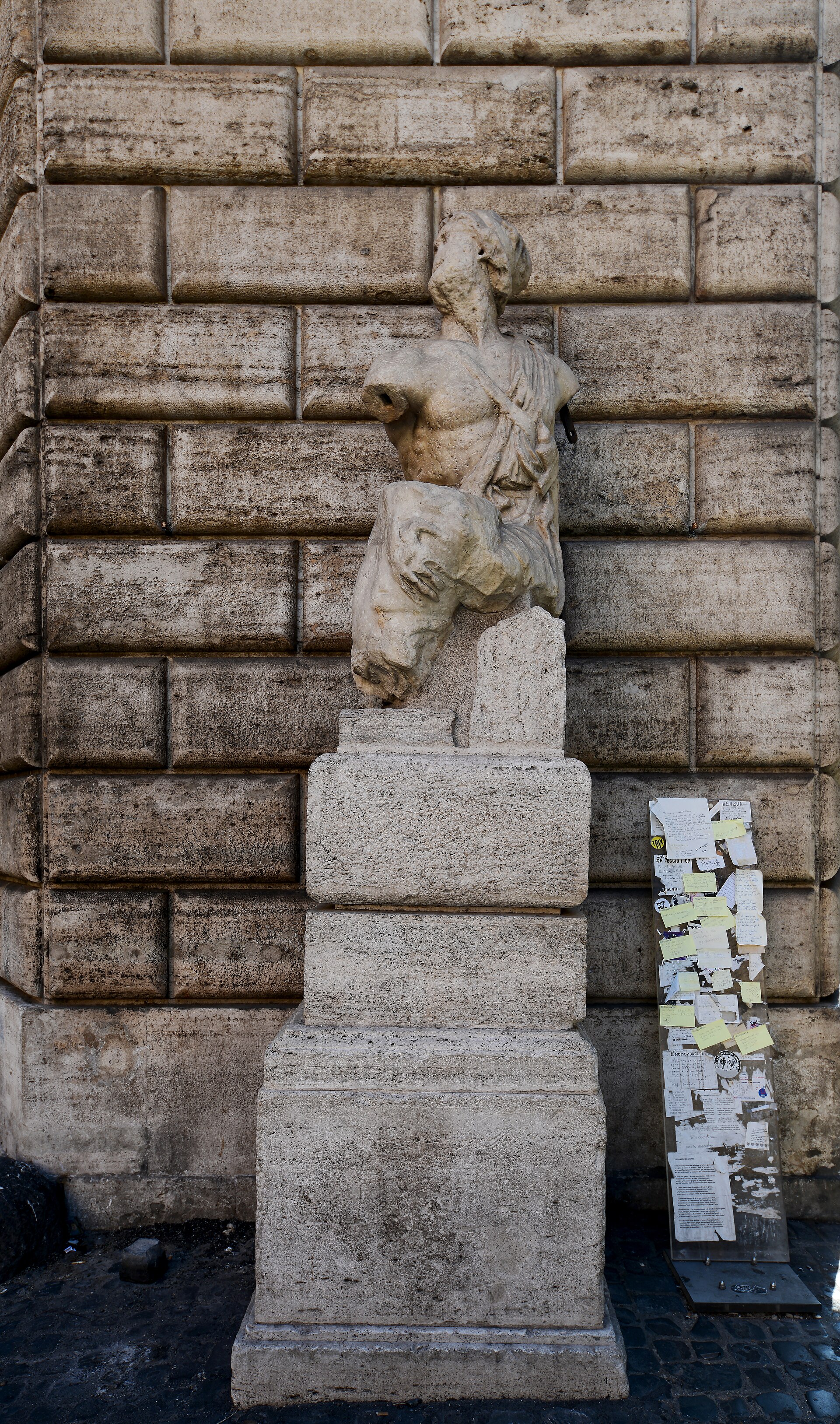
A minute's walk from Navona, at the corner of the Palazzo Braschi, a piece of marble leans against the wall. It is hard to recognize it as a sculpture: no head, no arms, the surface eaten away by rain to the state of a melted candle. This is the most politically influential stone in history of the city. First, about what it once was. This is the remains of a Hellenistic group, and most likely, it depicted a scene from the Iliad: Menelaus shielding the body of the slain Patroclus. For several centuries the fragment lay in the mud of a medieval street, serving as something like a stepping stone to cross a puddle. In 1501, it was lifted and placed on this corner. Then the actual history begins. Nearby was the shop of a cobbler named Pasquino, a man, judging by all accounts, sharp of tongue. In papal Rome, speaking out loud about power was unsafe, and the cobbler came up with a workaround: he wrote his remarks on city affairs on paper and glued them to the statue. Neighbors caught on. Notes were hung at night so as not to get caught, and by morning an edition of an anonymous newspaper hung on the corner, which no one signed and for which there was no one to punish. Statues got the name of the cobbler and the nickname -speaking-. The authorities were angry, but could do little: the stone has no author. The custom lasted until the 19th century, and the word -pasquinade- in Russian is a direct descendant of the Roman Pasquino. A couple of examples to make the genre clear. When Pope Urban VIII from the Barberini family removed ancient bronze from the Pantheon, a line appeared on Pasquino: Quod non fecerunt barbari, fecerunt Barberini, -what the barbarians did not do, the Barberini did-. And Pope Innocent X's daughter-in-law, Olimpia Maidalchini, who managed everything under him, Pasquino renamed to Olim-Pia, which in Latin reads as -once pious-. It still works today. Next to the pedestal stands a shield, and on it hang papers stuck on yesterday. Honestly, there is nothing to look at here: a meter and a half of erased marble. But this is the case when an object is most interesting precisely for what is not visible in it. Practical. Piazza di Pasquino, behind the Palazzo Braschi, a minute from the southern edge of Navona. Outdoors, free of time restrictions. It falls into our morning route -Pantheon, little elephant, Navona-.
AI translation · 🇬🇧 EN
Rate this review:
Nearby and related
By the same architect
Close by in Rome
About the Object
Unknown author; Hellenistic sculptural group
1501
Ancient Roman
Piazza di Pasquino, Roma
Sculpture / Monument