
Biblioteca Angelica
Всемирное наследие ЮНЕСКОAbout the Object
Luigi Vanvitelli (hall, 1765); previously - Francesco Borromini (not preserved)
1765
Classicism
Piazza di Sant'Agostino 8, Roma
Public Building
Gallery (1)

The Library That Was Open to Everyone from the Very Beginning
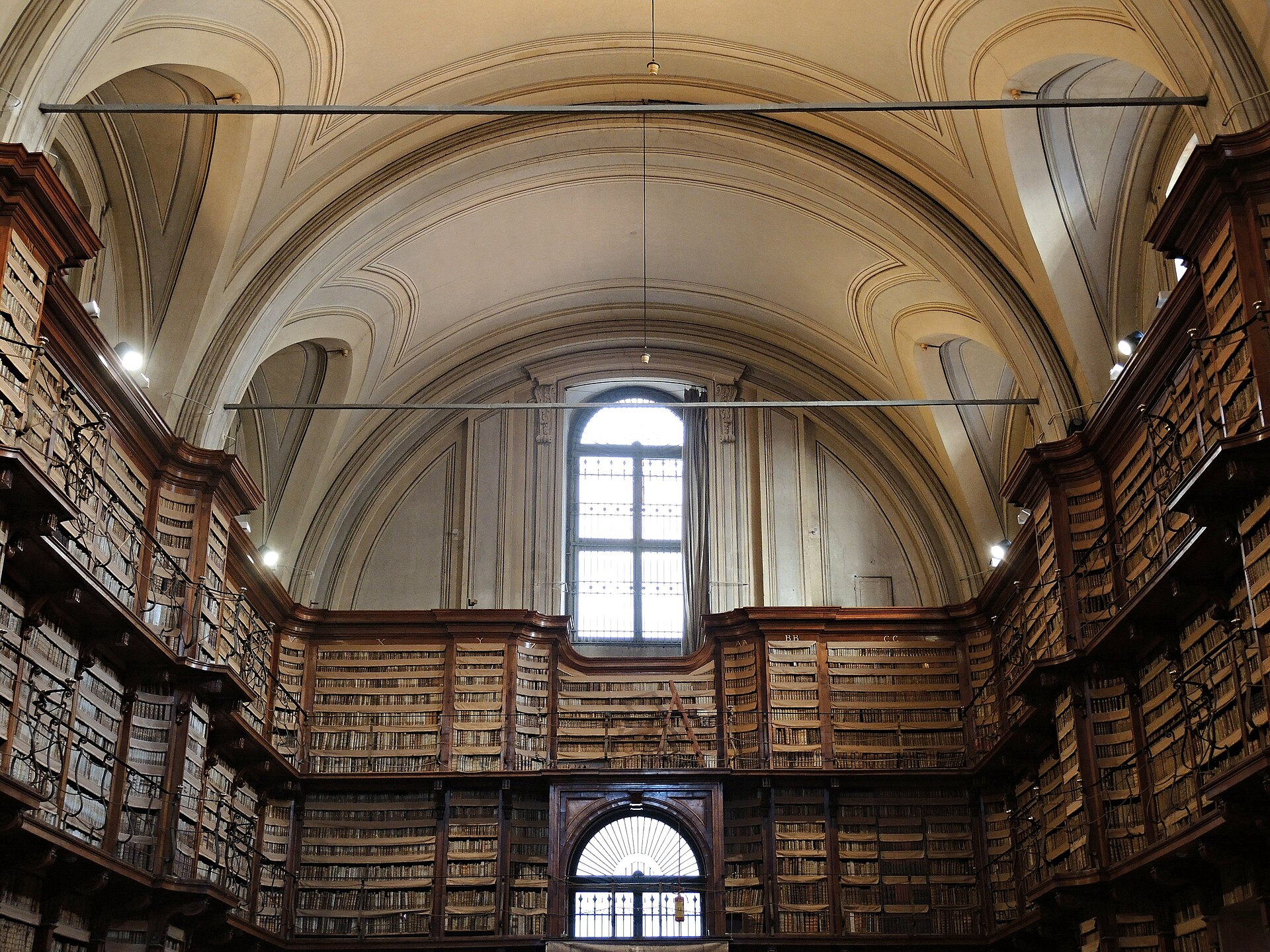
A stone's throw from Piazza Navona lies a quiet square where tourists rarely turn. To the left is the church of Sant'Agostino, to the right a simple door without a sign. Behind the door is a hall well worth stepping inside for. This is the Angelica, and it begins not with a building, but with a condition. In 1604, the Augustinian monk and Bishop Angelo Rocca donated his collection of about twenty thousand volumes to the Sant'Agostino monastery. He didn't just hand them over: he stipulated that the library must be open to everyone, regardless of rank and wealth, and have its own premises, its own income, and its own charter. For those times, this was a strange idea. Book collections were private, and you could only access them through connections or status. How rare this was can be seen from a single phrase. In 1644, the French librarian Gabriel Naude wrote that throughout all of Europe there were only three libraries where a scholar could come and work: the Bodleian in Oxford, the Ambrosiana in Milan, and the Angelica in Rome. Three for the whole of Europe. Now about the hall. The first library hall here was built in the mid-17th century, and the name of Francesco Borromini, the creator of San Carlino and Sant'Ivo, is mentioned. Nothing remains of that hall. In 1748, the library was closed for remodeling, and the monks called upon Luigi Vanvitelli, the very same who built the Royal Palace of Caserta. He finished the hall in 1765. Inside, everything is a single hall. A two-story rectangular hall with a barrel vault, and along the entire perimeter, from floor to ceiling, wooden shelving with a gallery. The books here are not arranged in a room, the books here are the walls. Because of its shape, the hall was nicknamed the Vanvitelli Vase. And the library reopened only in 1786, when the catalog of printed books was finally completed. Thirty-eight years of closed doors for the sake of one remodeling and one catalog. Today, the Angelica holds about two hundred thousand volumes, including about three thousand manuscripts and a thousand incunabula, that is, books printed in the first half-century of printing. Angelo Rocca's condition is still in effect today: admission is free, and to enter, you don't need to be anyone special.
AI translation · 🇬🇧 EN
Rate this review:
Nearby and related
By the same architect
Close by in Rome
About the Object
Luigi Vanvitelli (hall, 1765); previously - Francesco Borromini (not preserved)
1765
Classicism
Piazza di Sant'Agostino 8, Roma
Public Building