
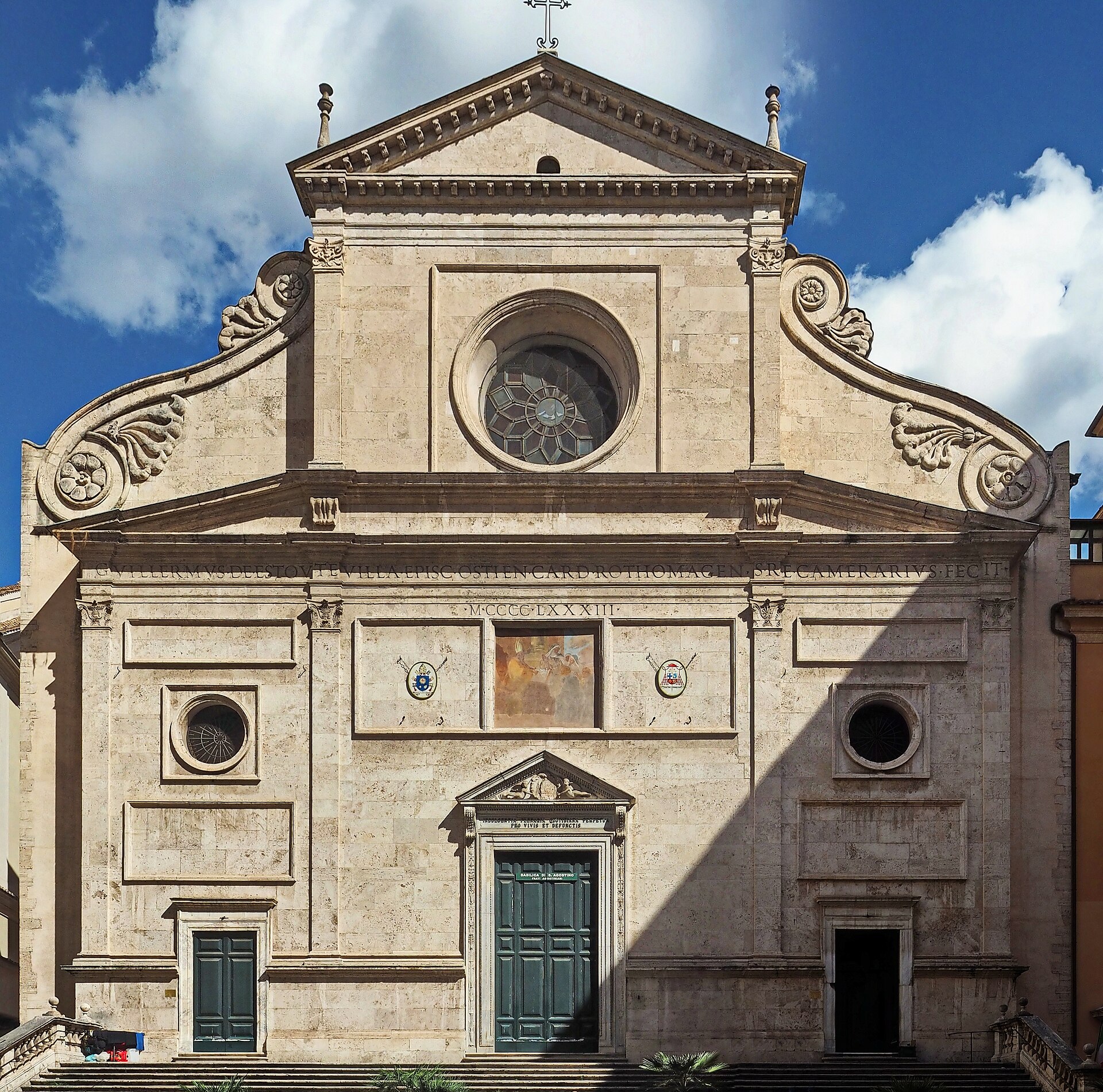
Basilica di Sant'Agostino in Campo Marzio
Всемирное наследие ЮНЕСКОAbout the Object
Baccio Pontelli; facade - Giacomo di Pietrasanta
1483
Renaissance
Piazza di Sant'Agostino 80, Roma
Religious Structure
Gallery (1)

A facade of Colosseum stone, a Madonna with dirty fingernails, and the church of Roman courtesans
One of the first Renaissance churches in Rome, built between 1479 and 1483 by order of Pope Sixtus IV with funds from Cardinal Guillaume d'Estouteville. Designed by Baccino Pontelli, the facade was executed by Giacomo di Pietrasanta. Let us start with the facade, because it explains how building was actually done in Rome. Its travertine was taken from the Colosseum. Not "in the antique style" or "inspired by": literally stone carted out of the amphitheater, which had already been serving the city as a quarry for a thousand and a half years. Antiquity here is not a role model, but a building supply warehouse. Inside are three things for which people come here. Caravaggio's "Madonna of Loreto", 1606, first chapel on the left. A barefoot Madonna with child stands in a doorway, two pilgrims have come to her and knelt down. The pilgrims' feet are dirty, painted large and right at the viewer; the Madonna's own toenails are not clean either. Contemporaries were outraged: the holy family is portrayed like neighborhood neighbors. That was the whole point. Jacopo Sansovino's "Madonna del Parto", 1521, in a niche to the right of the entrance. A marble Madonna with child, visited by pregnant women for centuries: it is believed she helps with childbirth. Art historians note that the classical features and heavy folds of drapery give away the prototype - an antique statue of Juno Lucina, the Roman goddess of childbirth. That is, people continue to visit the statue, which grew out of a pagan goddess of childbearing, for the exact same purpose. Rome entirely in a single figure. Raphael's fresco "Prophet Isaiah", 1512, on the third pier of the left nave. Small, easy to walk right past, yet this is Raphael in the year when the Sistine Chapel was being finished nearby. And one piece of everyday history, without which it is hard to understand the church. In the 16th century, Sant'Agostino was the church of the Roman courtesans. For them, appearing in a "secular" church in full regalia was a matter of professional necessity: fine outfits, jewelry, bleached and curled hair. Young men gathered at the entrance to watch them arrive. The local priest heard their confessions. One of them, Beatrice Ferrarese, wrote to her patron Lorenzo de' Medici: just think, Your Excellency, how many interesting things he must have heard. Practical info. Admission is free. Opening hours are split into morning and evening slots, with a long break in the middle of the day - check before heading out. The church is located two minutes from San Luigi dei Francescis, so both Caravaggio locations can be hit in one go.
AI translation · 🇬🇧 EN
Rate this review:
Nearby and related
Close by in Rome
About the Object
Baccio Pontelli; facade - Giacomo di Pietrasanta
1483
Renaissance
Piazza di Sant'Agostino 80, Roma
Religious Structure