
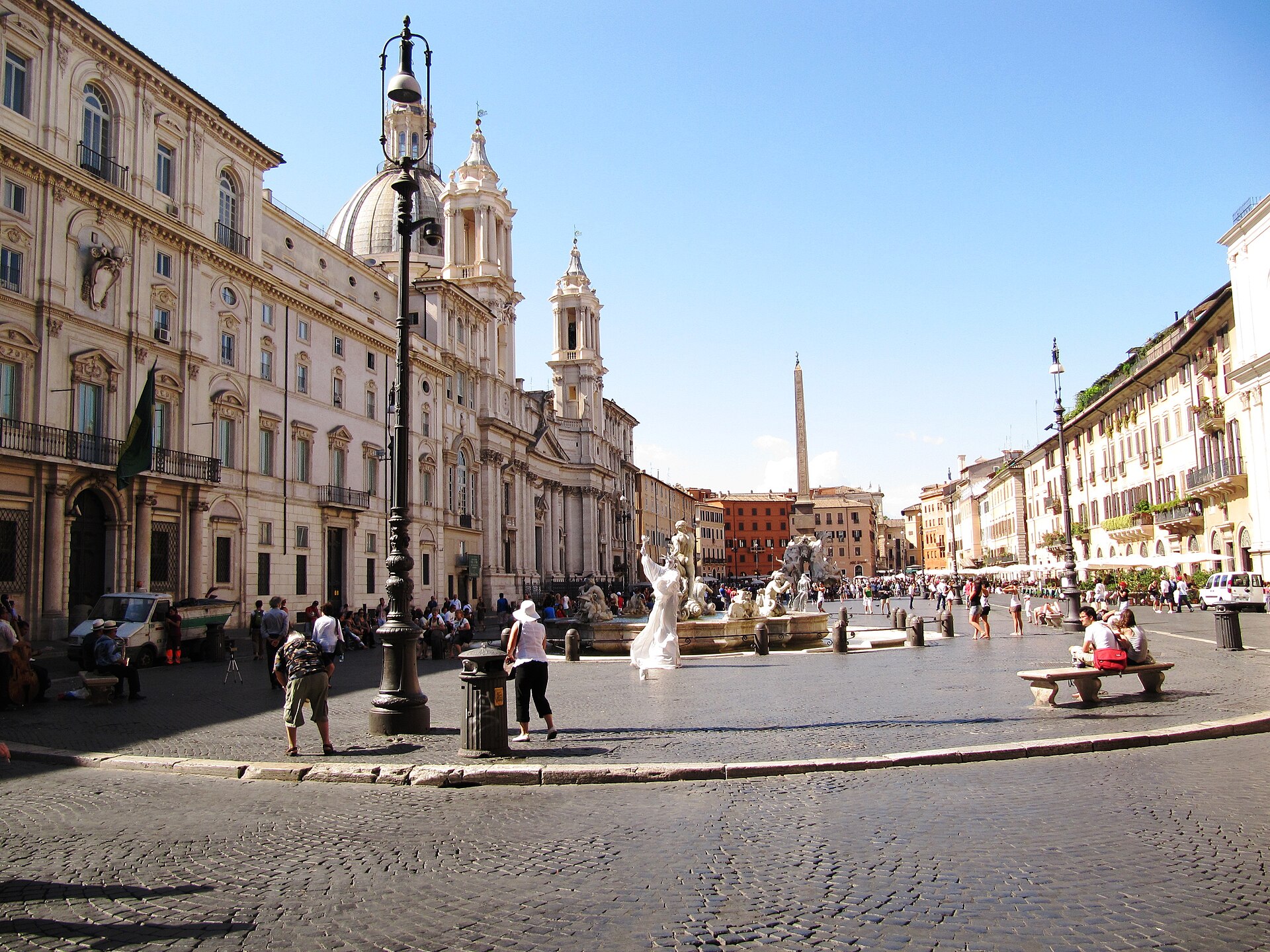
Piazza Navona
Всемирное наследие ЮНЕСКОAbout the Object
Gian Lorenzo Bernini (Fontana dei Quattro Fiumi), Giacomo della Porta (Fontana del Moro)
1651
Baroque
Piazza Navona, Roma
Square
Gallery (1)
Why the square is shaped like a stadium
Piazza Navona can be seen right through from either end. An elongated oval, rounded at the ends, with houses forming a continuous wall around the perimeter. Squares of this shape do not just happen by themselves - cities grow differently, more crookedly. This shape was inherited. Beneath you lies the Stadium of Emperor Domitian, built around 86 AD: two hundred and seventy-five meters long, one hundred and six wide, with stands for thirty thousand people. People ran and wrestled here in the Greek fashion - Domitian organized competitions in Rome similar to the Olympic games because he loved Greek culture. At first, the Romans turned up their noses: naked athletes seemed to them an unseemly foreign fashion. The stadium was not demolished. It simply fell into decay, and houses grew into its stands as if into a ready-made foundation. The rows of seats became the bases of walls, the passageways became streets, and the arena remained an empty middle. Fifteen hundred years later, what you see is the result: a square shaped precisely like a running track. If you want to see the stadium itself, an excavated piece of it is accessible beneath the northern end of the square, below street level - you can see those very arches of the stands. This, by the way, is the third time we encounter this exact same Roman technique. In Santa Sabina, a basilica law court became a church. In San Clemente, a new church was placed on top of the old one by filling it in. Here, an entire stadium was digested by a residential quarter. Rome never cleared a site - it used what was already standing. In the Middle Ages there was a market here, and later the square became a place for celebrations. In the 17th century, Pope Innocent X of the Pamphili family took it over: his palace stands right here, and he turned the square beneath his windows into an open-air reception hall. Hence the fountains.
AI translation · 🇬🇧 EN
Rate this review:
Four rivers, a bread tax, and a legend that cannot be
The main feature here is the central fountain. From a rock pierced right through, an Egyptian obelisk rises. Around it, at the four corners, sit four giants representing the rivers: the Danube, the Ganges, the Nile, and the La Plata. Four rivers of the four then known parts of the world; the meaning is direct - the pope's power extends over the entire world. On the rock is a dove with an olive branch, the coat of arms of Innocent X, the commissioner. Bernini began the work in 1648, and the fountain was unveiled in June 1651. And here is a fact that guidebook writers usually omit: the construction was funded by a tax on bread, even though the city was experiencing a famine at the time. Romans wrote on the walls that they wanted bread, not obelisks. The beauty you are standing before now was paid for in precisely this way, and it is worth knowing. The obelisk itself is not of Egyptian origin in the sense of its installation site: it was quarried for Rome and originally stood on the Appian Way, near the Circus of Maxentius - the very road you may have already walked on. Now about the Nile. Look at the figure whose head is covered with fabric. Almost certainly, you will be told that Bernini covered his face so he would not have to look at the Church of Sant'Agnese in Agone opposite - the work of Francesco Borromini, his sworn rival. It is a great story. It went all around the world. And it is impossible. Check the dates. The fountain was unveiled in June 1651. Construction of Sant'Agnese began in 1652, and Borromini took over the facade only in 1653. Bernini could not mock a building that did not yet exist. The real explanation is simpler and better: in the seventeenth century, no one in Europe knew where the sources of the Nile were located. The river whose origin is unknown is depicted with a covered face. A geographical mystery cast in marble. The rivalry between Bernini and Borromini was real, however, and it is worth knowing about: two men who worked side by side for half a century with opposing logic - for Bernini, theater, movement, the spectator; for Borromini, geometry, tension, concave and convex walls as if the stone were breathing. It ended badly: Borromini, exhausted and not as recognized as his rival, committed suicide in 1667. You can walk through their dispute on foot in fifteen minutes - from this piazza to San Carlo alle Quattro Fontane. Yet I still love the legend about the Nile. It lies about the facts, but it tells the truth about the essence: a city where two greatest hands worked a stone's throw from each other could not help but start inventing stories about them.
AI translation · 🇬🇧 EN
Rate this review:
Nearby and related
By the same architect
Close by in Rome
Routes with this object
About the Object
Gian Lorenzo Bernini (Fontana dei Quattro Fiumi), Giacomo della Porta (Fontana del Moro)
1651
Baroque
Piazza Navona, Roma
Square