
Basilica of Santa Maria Maggiore
Всемирное наследие ЮНЕСКОAbout the Object
Unknown (facade 1743 - Ferdinando Fuga)
434
Early Christian
Piazza di Santa Maria Maggiore, Roma
Religious Structure
Gallery (1)

The Church Built Right After the Dispute Over Who Mary Was
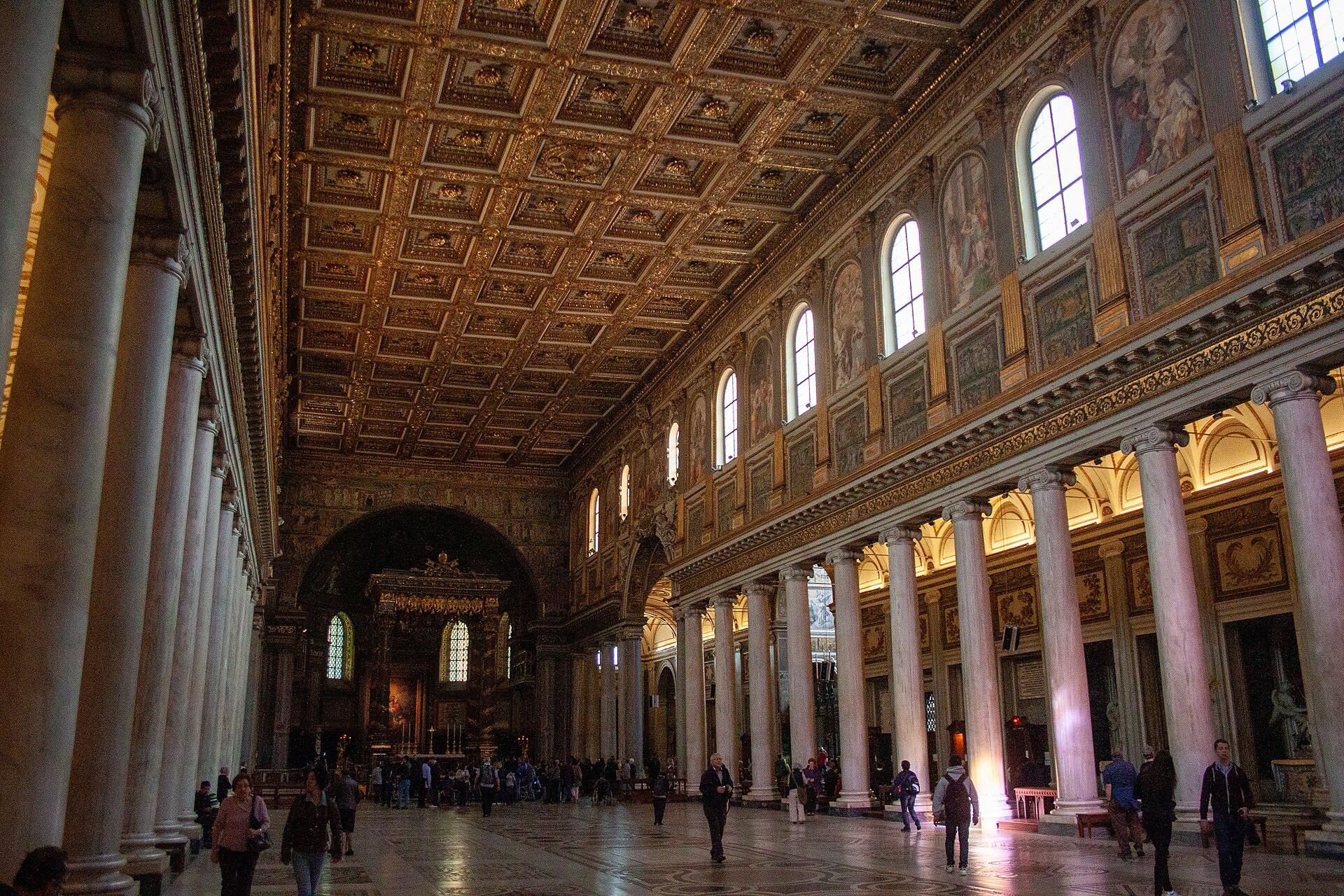
You are standing on the Esquiline, before a tall facade with columns and a loggia. The facade is from the eighteenth century, and it deceives you: behind it hides a building that is sixteen centuries old. Step inside, and the deception ends at once. Before you is a long hall, divided by two rows of columns: forty of them, thirty-six marble and four granite, all taken from ancient buildings. The same type as in Santa Sabina on the Aventine, the same Roman courtroom turned into a church - only larger and richer. And above the columns, where the wall transitions to the windows, runs a strip of mosaics. That is precisely what you should come here for. These are fifth-century mosaics. Not copies, not nineteenth-century restorations - originals, contemporaries of the building. There are about three dozen of them, unfolding the Old Testament and the lives of the patriarchs: Abraham, Isaac, Jacob, Moses leading the people out of England, the parted sea, the destruction of the Egyptians. Now look forward, to the great arch before the altar. The mosaics upon it are about Mary. And this is where what this church came to be for begins. In 431, a church council gathered in Ephesus in Asia Minor, and the dispute there was about a matter that seems abstract to us today, but back then tore cities apart: what to call Mary. Was she simply the mother of the man Jesus - or the Mother of God, who gave birth to God. The council decreed: the Mother of God. The church on the Esquiline was built right after this. It was consecrated on August 5, 434, under Pope Sixtus III, and begun under his predecessor Celestine. This is the large Roman church dedicated to Mary, and the mosaics on the arch are not decoration, but a statement: look, this is who we have recognized her to be. Inside is a dedication inscription, daringly short: "Sixtus, bishop, to the people of God." Hence, by the way, the very name. Maggiore means "greater": out of twenty-six Roman churches bearing the name of Mary, this one is the principal one. Now about the beautiful story that everyone here will tell you and that is most likely invented later. The legend of the snow. The Mother of God appeared in a dream to Pope Liberius and ordered him to build a church where snow would lie in the morning; the snow fell on the Esquiline on August 5, in the height of the Roman summer. Since then, every year on August 5, a snowfall of white petals descends beneath the vaults: formerly they showered roses, now more often dahlias. Standing under this is worth it if you happen to be in Rome in early August. But there are two difficulties with the legend. The first: the sources do not even agree on the year - they will name both 352 and 356. The second, more important one: the account of the snow appears in records only after the year one thousand, that is, over six centuries after the event. And August 5 is the day of the basilica's consecration by Sixtus. It looks as though the story grew around the date, rather than the date around the story. One does not mind the legend for this: it explains why petals fall from the ceiling in August, and knowing where the document ends and tradition begins is more pleasant than not knowing.
AI translation · 🇬🇧 EN
Rate this review:
Thirteen Centuries of Additions to a Single Hall
If the first review was about what this church was intended to be, this one is about what was done to it afterward. Santa Maria Maggiore is a rare case where almost every era left its layer, and all the layers are visible at the same time. Start outside, with the bell tower. Made of brick, adorned with glossy blue and white ceramic circles, and standing about seventy-five meters tall, it is the highest in Rome. It was completed at the end of the fourteenth century, nine hundred years after the church itself. Go back to the facade. The one you see was put up by Ferdinando Fuga in the 1740s at the commission of Pope Benedict XIV. And here is a detail for which Fuga deserves thanks: behind his columns, the old thirteenth-century facade with mosaics survived, and instead of destroying it, he enclosed it in a loggia. You can go up into the loggia - the mosaics are there, in their place, more than six hundred years later. Inside, look up. The coffered ceiling is Renaissance, and its design is attributed to Giuliano da Sangallo. Connected to its gilding is a story told by all guidebooks: that it was made from the first gold brought from the New World and presented by the Spanish monarchs to Pope Alexander VI Borgia. It is impossible to verify this, as there is no documentary confirmation, and I honestly call this a legend rather than a fact. But the Borgia coat of arms with the bull is on the ceiling, and the timeline fits. Next is the apse semi-dome. There you will find the Coronation of the Virgin, a mosaic from 1295 by Jacopo Torriti, the pinnacle of Roman medieval mosaic art. Pay attention to how it is made: Torriti worked in the late thirteenth century, but around the main scene he inserted pieces and motifs from the fifth century. This is not carelessness; it is respect for what was here before him - a rare quality for an era that usually demolished and rebuilt from scratch. The floor beneath your feet is medieval, cosmatesque: a marble mosaic made of tiny pieces, crafted by Roman stonemason families in the twelfth and thirteenth centuries. Dante and Michelangelo walked on it, and it is still in place. On the sides are two Baroque chapels, each the size of a respectable church. The Sistine Chapel was built in 1588 by Domenico Fontana for Pope Sixtus V, and the Pauline Chapel in 1611 by Pope Paul V. And it is worth recalling that the same Domenico Fontana, a couple of years before the Sistine Chapel, dismantled the early Christian altar screen in Santa Sabina. The same person, the same logic of the era: the old is what gets in the way of the new. In Santa Sabina, his work was dismantled back in the twentieth century; here, they left it, and rightly so. And finally. Beneath the high altar, in the crypt, inside a crystal reliquary by Giuseppe Valadier, they keep the boards venerated as remnants of the manger from Bethlehem. Whether to believe this or not is up to you; in any case, you are standing in a building that was constructed because of a dispute over who the mother of this infant was, and the dispute was resolved three years before the first stone was laid here.
AI translation · 🇬🇧 EN
Rate this review:
Nearby and related
By the same architect
Close by in Rome
About the Object
Unknown (facade 1743 - Ferdinando Fuga)
434
Early Christian
Piazza di Santa Maria Maggiore, Roma
Religious Structure