
Basilica di Santa Maria degli Angeli e dei Martiri
Всемирное наследие ЮНЕСКОAbout the Object
Michelangelo Buonarroti; continued by Jacopo del Duca; remodeled by Luigi Vanvitelli (1749)
1564
Ancient Roman
Piazza della Repubblica, Roma
Religious Structure
Gallery (1)

How Michelangelo built a huge church by building almost nothing
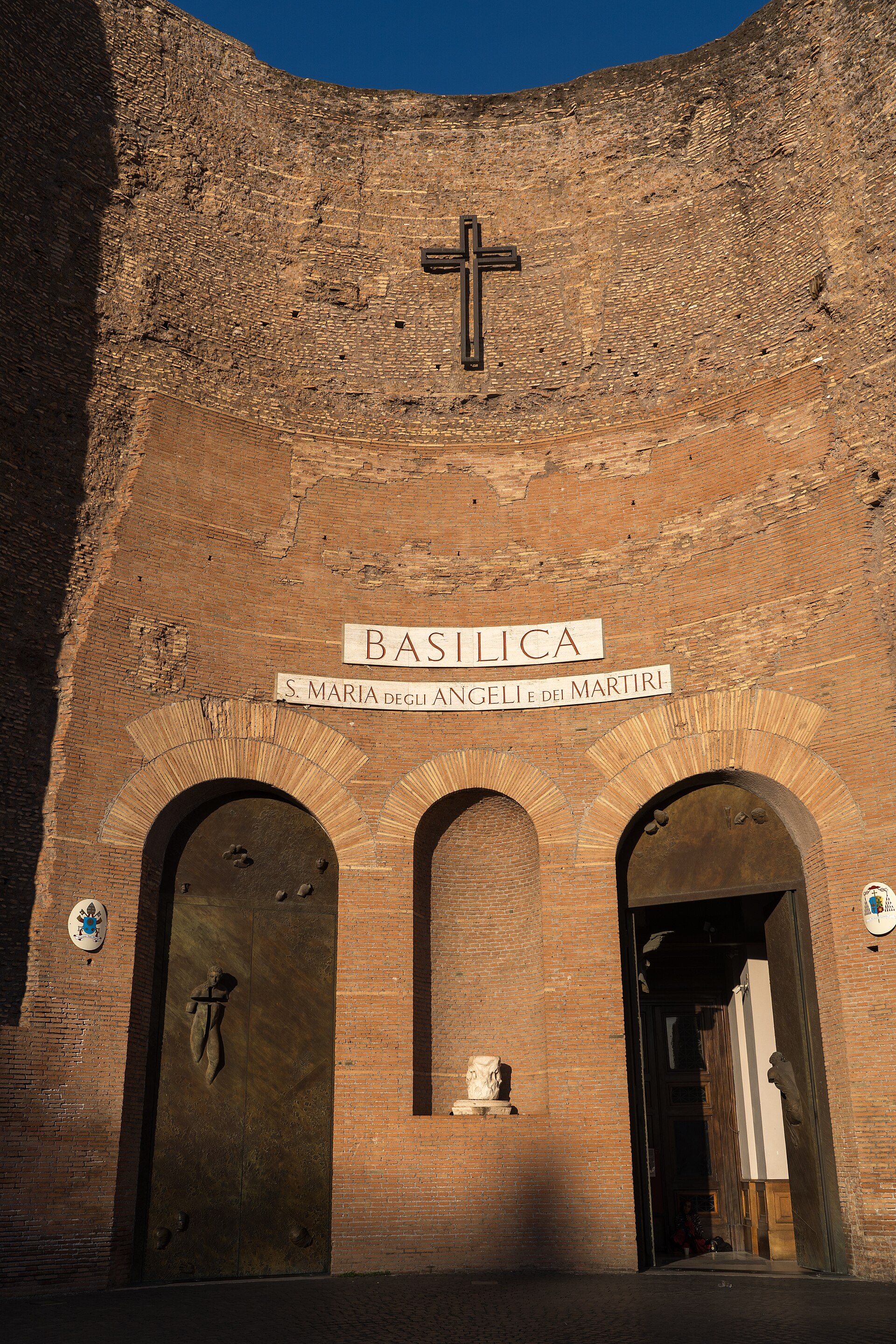
Piazza della Repubblica explains more than the basilica itself. The semicircular colonnaded square mirrors the shape of the ancient exedra, and the outlines of the Baths of Diocletian still dictate the layout of this slice of Rome. Now find the entrance to the church. It has no facade. There is a convex brick wall, a remnant of a Roman hall, with a hole in it fitted with a door. From the outside it looks like an abandoned construction site. Go on in. Inside, there is a hall ninety meters long and twenty-eight high, covered by massive vaults. This was not built in the 16th century. It was built in the early 4th century under Emperor Diocletian, between 298 and 306, and was the largest bath complex in ancient Rome. You are standing in the cold and warm halls of the baths, in the frigidarium and tepidarium. The vaults above you are Roman, and their spans are such that the Renaissance did not know how to build. In 1561, Pope Pius IV decided to make a church here and called upon Michelangelo. He was eighty-six years old. He worked on this in 1563-1564, until his very death, and the work consisted mainly of not interfering: adapting the existing hall, raising the floor to the level of the 16th-century street, and arranging the entrances. After his death, the work was continued by his pupil Jacopo del Duca. This is worth pondering while standing inside. A man who argued with every client and remade everything to suit himself, in the last year of his life took someone else's building and touched almost nothing in it. The church got an interior the size of a cathedral without a single new vault. Then history took its usual course. In the mid-18th century, the hall was remodeled by Luigi Vanvitelli, the very same who built the Royal Palace of Caserta. He turned the church around: the former nave became a transept, and the entrance moved to the western side. At the same time, a facade appeared on the square side. In 1911, this facade was demolished to bring back into view the very brick niche of the caldarium you started with. That is, they tried to bring the building to a decent appearance once, and then changed their minds and brought back the ruin. Another thing worth looking for here is the bronze line in the floor. This is a meridian laid down in 1702 at the request of Pope Clement XI to check the accuracy of the Gregorian calendar reform and learn how to calculate the date of Easter infallibly. A sunbeam from a hole in the wall falls on this strip every noon. An observatory inside a church inside baths. And from 1870 to 1946, this was the official state church of the Kingdom of Italy.
AI translation · 🇬🇧 EN
Rate this review:
Nearby and related
By the same architect
Close by in Rome
Routes with this object
About the Object
Michelangelo Buonarroti; continued by Jacopo del Duca; remodeled by Luigi Vanvitelli (1749)
1564
Ancient Roman
Piazza della Repubblica, Roma
Religious Structure