
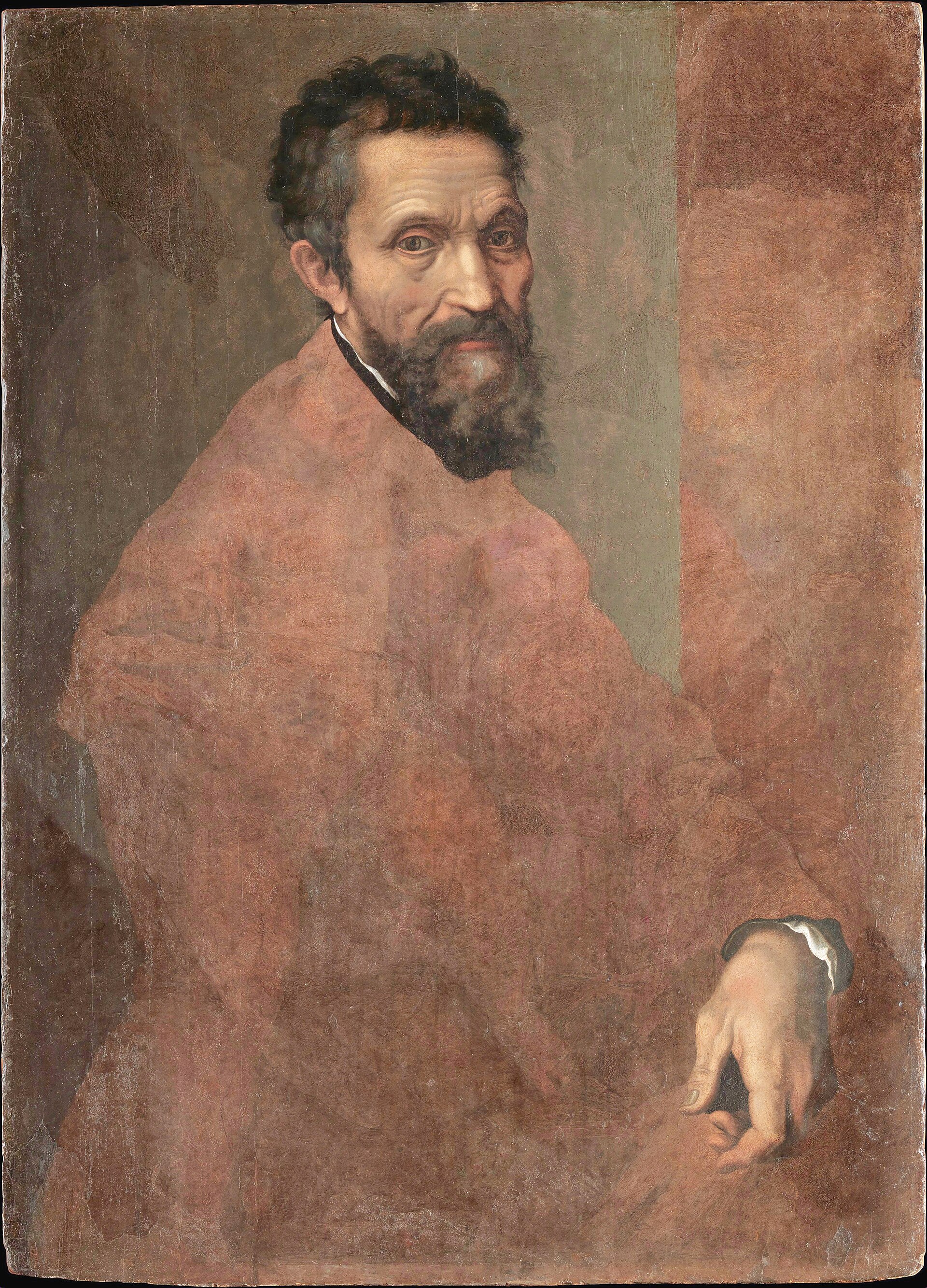
Michelangelo Buonarroti
About the Object
Michelangelo Buonarroti
1475
Other
Piazza del Campidoglio, Roma
Historic Personality
Gallery (1)

The Sculptor Who Took on Finishing a Cathedral at Seventy-Two
Michelangelo is usually spoken of as a sculptor and painter. We will talk about him as an architect - and the square where you are standing is the best place in the city for this. He lived a long life, from 1475 to 1564, and turned to architecture seriously late in life. Let us start here, from the Capitoline Hill. Michelangelo inherited the hill in a state that could hardly be called an ensemble: two disparate buildings at an angle to each other and a slope facing away from ancient Rome. He did not demolish anything. He accepted the angle as a given, placed the third building symmetrically to the second, and united the resulting irregular trapezoid with a paving design - an oval with a star right beneath your feet. The square turns its back to the Forum and its face to the city of the popes: ancient Rome is left behind, the new one lies ahead. Now about the cathedral. In 1547, at the age of seventy-two, Michelangelo took over the construction of St. Peter's Basilica, which by then had been underway for forty years and had gone through several architects. He returned the project to Bramante's vision - a central-plan church under a single dome - and led construction until his death in 1564. Ascanio Condivi, who wrote his biography during the artist's lifetime, recounts that Michelangelo refused payment for this work and undertook it, in his own words, only for the glory of God and in honor of the apostle. He conceived the dome much like he had once seen Brunelleschi's in Florence: a double shell - the inner one bears the load, the outer protects it - only larger and more elongated upwards. From the floor to the top of the cross it measures one hundred thirty-six and a half meters; no one has built a higher dome to this day. It was finished after the author's death by Giacomo della Porta and Domenico Fontana - the very one whose card we have on our map. And the last thing worth knowing, because this is a story about the fate of a design. Michelangelo and Bramante wanted a central-plan building: you enter and immediately find yourself under the dome. At the beginning of the seventeenth century, the popes decided that processions required a long nave, and Carlo Maderno added an elongated section with a facade. The cathedral accommodated twice as many people - and lost its main view. From the square, the dome slips behind the facade and almost disappears. So Michelangelo's architecture is also a story about what happens to a design after the author's death. On the Capitoline Hill, his design was carried out to the end for over a century and was completed. At the cathedral, it was altered.
AI translation · 🇬🇧 EN
Rate this review:
Nearby and related
By the same architect
Close by in Rome
About the Object
Michelangelo Buonarroti
1475
Other
Piazza del Campidoglio, Roma
Historic Personality