
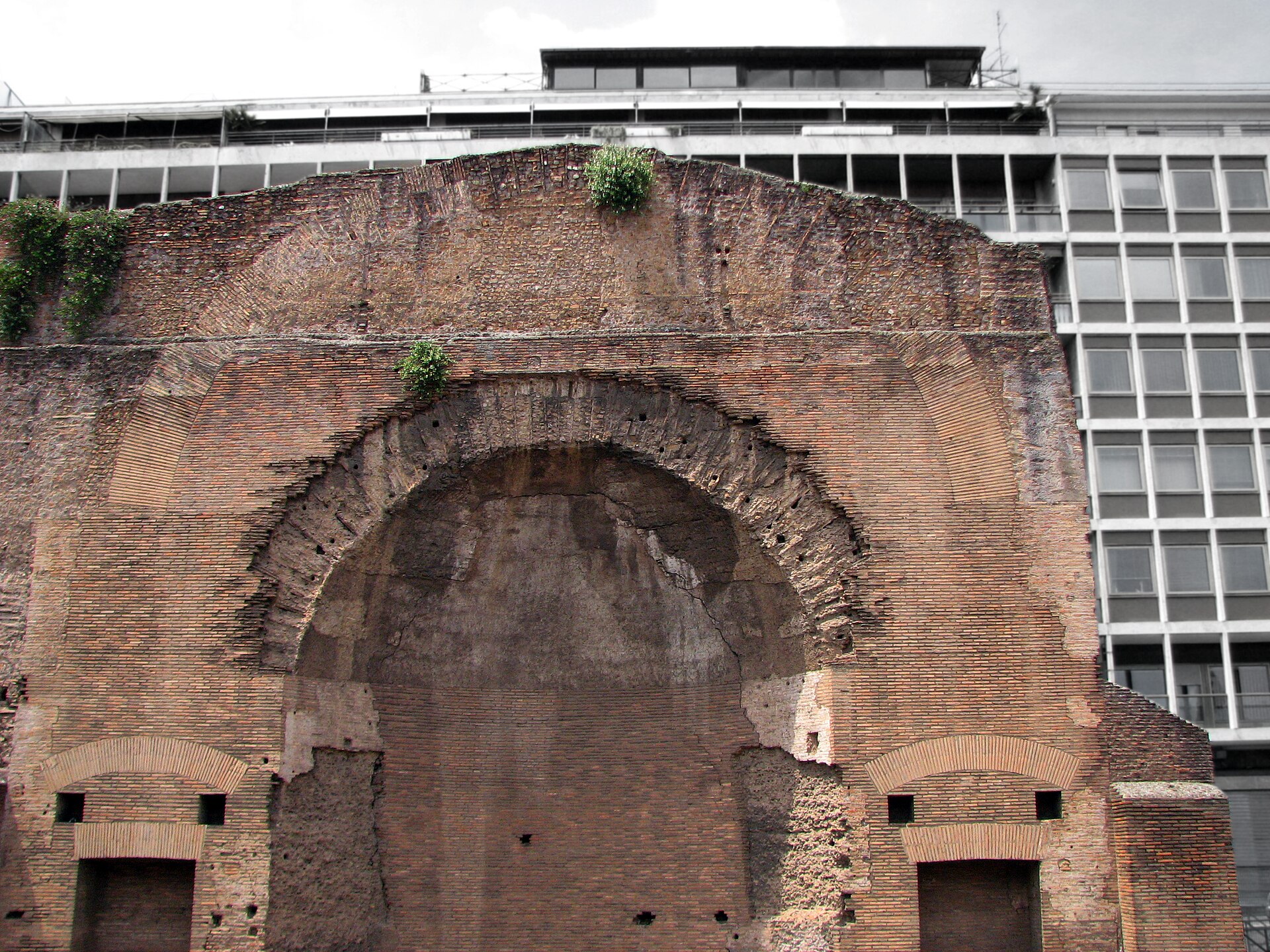
Baths of Diocletian (Terme di Diocleziano)
Всемирное наследие ЮНЕСКОAbout the Object
Architect unknown; commissioned by Emperor Maximian in honor of Diocletian. Later work by Michelangelo Buonarroti (church in the main hall, 1560s)
306
Ancient Roman
Viale Enrico de Nicola 78, Roma
Architectural Monument
Gallery (1)

The largest baths of Rome, which left behind a church, a square, a museum, and a station name
Right behind Termini station, strange things begin. You are standing inside the Baths of Diocletian and cannot see them, because they are too huge to notice. The baths were built in 298-306: commissioned by Emperor Maximian in honor of his co-ruler Diocletian. It was the largest bath complex of ancient Rome. The enclosure covered thirteen hectares, and the central building measured 280 by 160 meters. Ancient authors said they could hold far more than the Baths of Caracalla, citing a figure of three thousand people, though where that came from is unknown. Then the most interesting part begins, and this is a purely Roman story. The baths were neither demolished nor preserved as a ruin. They were disassembled into functions, and every piece continued to live its own life. The main hall became a church. In the 1560s, Michelangelo fitted the Basilica of Santa Maria degli Angeli into the frigidarium and tepidarium without destroying the ancient walls: he simply placed a floor, an altar, and doors inside. The church has a separate card on our map, and from the outside it is barely visible, because it essentially has no facade - it has the wall of the baths. One of the round halls became another church - San Bernardo alle Терme. The octagonal hall served as a planetarium from 1928 to 1983: a starry sky was projected under the ancient dome. Monastic buildings and the remaining halls became a museum - this is one of four sites of the National Roman Museum, where tombstones and inscriptions are collected, meaning ancient Rome in letters. An exedrа became a square. Piazza della Repubblica mirrors the outline of the semicircular exedra of the baths, and Romans still often call it by its old name - Piazza Esedra. The 19th-century colonnades are built along the ancient contour. And the station got a name. Termini is not "terminal". It is Thermae, the baths. The station was built after 1870, when Rome became the capital, and was named after what stood here. This is why this city is worth loving. No large structure here dies completely: it is taken apart into pieces, and each part finds a new occupation. Seventeen years later, from the baths remain a church, a second church, a planetarium, a museum, a square, and the name of the station through which half a million people pass every day.
AI translation · 🇬🇧 EN
Rate this review:
Nearby and related
By the same architect
Close by in Rome
About the Object
Architect unknown; commissioned by Emperor Maximian in honor of Diocletian. Later work by Michelangelo Buonarroti (church in the main hall, 1560s)
306
Ancient Roman
Viale Enrico de Nicola 78, Roma
Architectural Monument