
Piazza del Campidoglio (Capitoline Square)
Всемирное наследие ЮНЕСКОAbout the Object
Michelangelo Buonarroti
1546
Renaissance
Piazza del Campidoglio, Roma
Square
Gallery (1)

The square that turned its back on ancient Rome
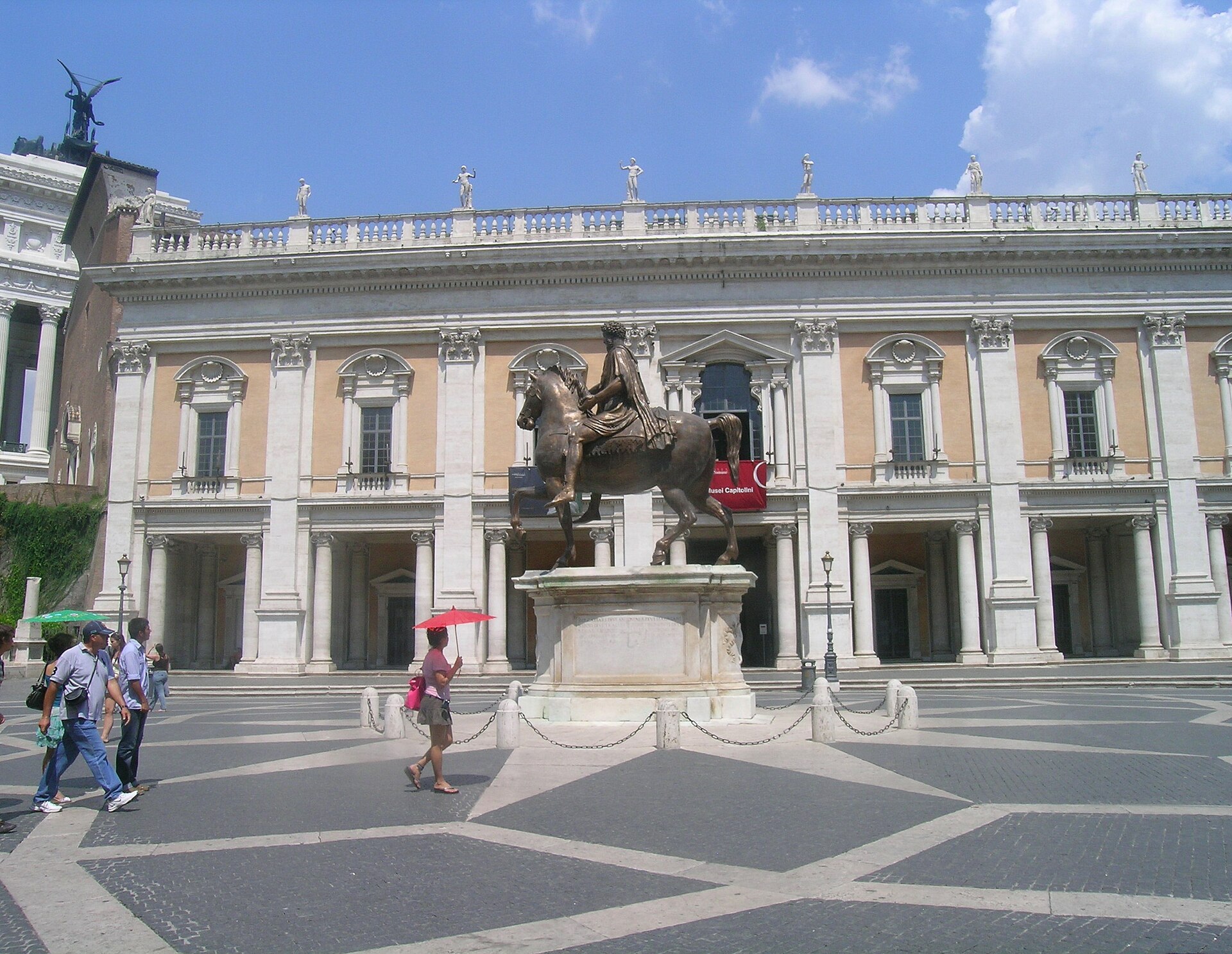
A wide, gentle staircase leads up - the Cordonata, a work by Michelangelo itself. Notice how it is designed: not steps, but a ramp with flat transverse bars, rising so gently that one could ride up it on horseback. And it imperceptibly widens towards the top, making the square above seem larger than it is. At the top, two antique statues greet you - the Dioscuri, Castor and Pollux. And further on opens up what was worth climbing up for. Three palaces stand not parallel, but at an angle: the square narrows towards the entrance and opens up inwards. It is a trapezoid, and this is done intentionally - when viewed from the stairs, it seems regular and deeper than it actually is. In the middle is an oval with a star-like pattern, and on it stands an equestrian statue. Now, the story that explains why all of this appeared in the first place. In 1536, Emperor Charles V visited Rome. Pope Paul III was preparing for the meeting and discovered something unpleasant: the Capitoline Hill, the hill from which the world was once ruled, the main hill of Rome, was a dirty wasteland with scattered buildings. It was shameful to show such a thing to the emperor. He called Michelangelo. Michelangelo was over sixty. He proposed not patching it up, but redoing it entirely: paving it, re-clothing the facades of the two existing palaces, and building a third one, the Palazzo Nuovo, so the square would be enclosed. Construction began in 1546, proceeded slowly, and he himself only managed to see the double staircase in front of the Palazzo Senatorio. The square was finished in the 17th century, but the design was not altered. And now the detail for which I advise standing here. For a thousand years, the Capitoline looked at the Forum - down there, where the ancient city stood. Michelangelo turned the square around. It faces west, towards St. Peter's Basilica. That is, the main hill of ancient Rome turned its back on ancient Rome and faced Christian Rome. A single urban planning gesture that says more than any treatise about what happened to this city between Augustus and the Renaissance. Behind the Palazzo Senatorio, from the balustrade, the Forum is visible from above, from the reverse side. From here it is easy to understand what exactly was left behind. About the statue in the middle. This is the equestrian Marcus Aurelius, and what you see is a copy; the original was taken inside, to the Capitoline Museums. It hasn't always stood here: for over a thousand years it stood by the Lateran, and only in 1538, already under Michelangelo, was it moved here - and he designed the pedestal for it. And it survived by misunderstanding. There were more than twenty bronze equestrian statues of emperors, and all were melted down for bells and coins. This one was not touched because in the Middle Ages it was believed to be Constantine, the first Christian emperor. The most famous equestrian monument of antiquity survived thanks to a misidentification.
AI translation · 🇬🇧 EN
Rate this review:
Nearby and related
By the same architect
Close by in Rome
Routes with this object
About the Object
Michelangelo Buonarroti
1546
Renaissance
Piazza del Campidoglio, Roma
Square