
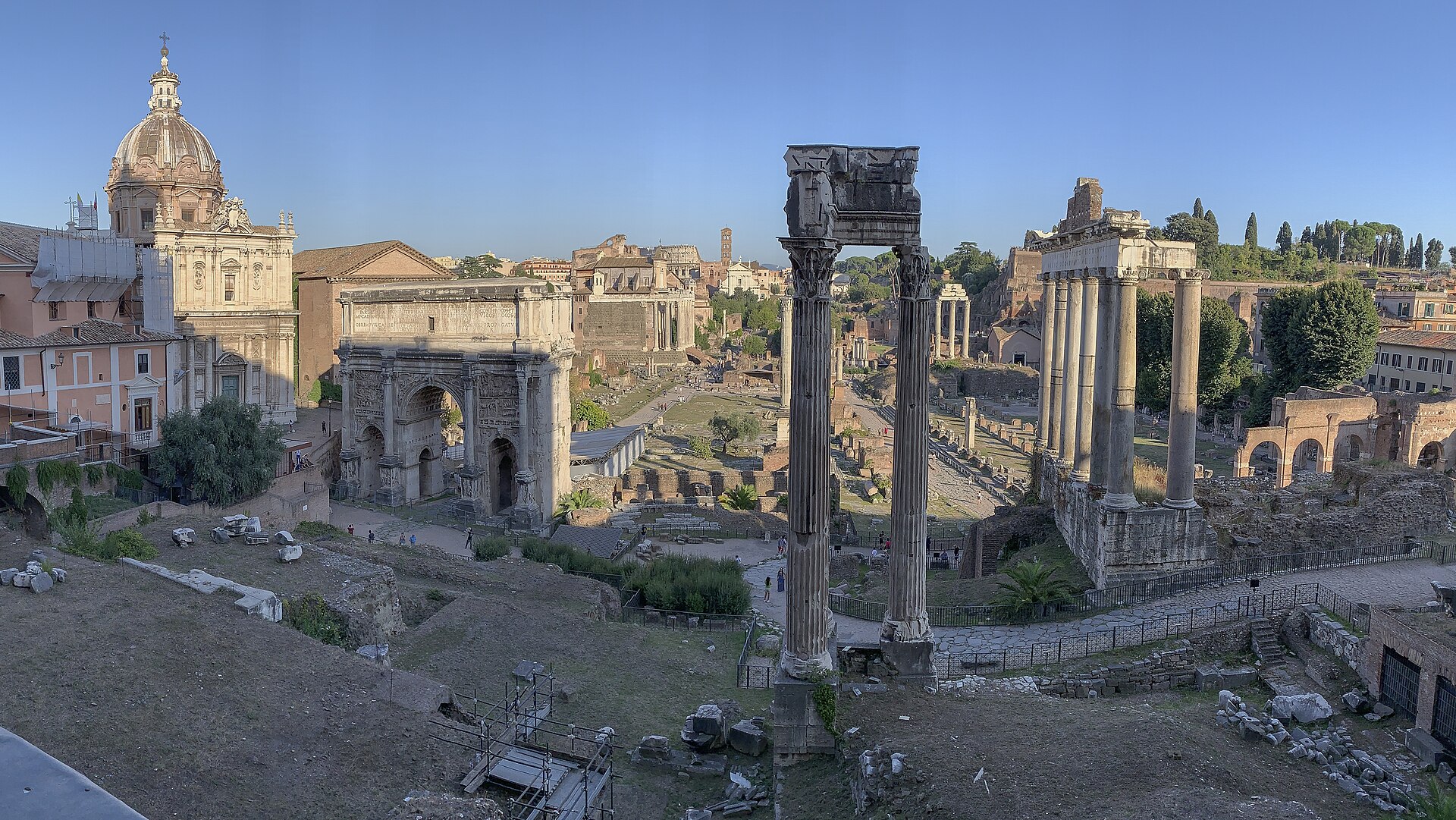
Roman Forum (Forum Romanum)
Всемирное наследие ЮНЕСКОAbout the Object
c. 500 BC
Ancient Roman
Via della Salara Vecchia 5/6, Roma
Memorial Place
Gallery (1)

Forum: A swamp that became the center of the world
From below, among the ruins themselves, everything looks different. Understanding what is what here at first glance is impossible - and that is normal. Nobody designed the Forum. It grew over eight centuries, and each successive century built upon the previous one. It all started badly. Between the Palatine and Capitoline hills lay a damp lowland - a swamp, and for some time a city dump. It was drained, the water was channeled into a large canal, and a square appeared on the freed space: first a market and sanctuaries, then everything else. "Everything else" is the management of the world. The senate stood here, trials were held here, trade took place here, war and peace were declared here. Consuls, emperors, and senators spent centuries building the Forum with temples and basilicas, each with his own. Find the Rostra, the oratorical tribune. The name literally means "noses": the platform was decorated with the ramming prows of ships captured in the naval battle at Antium in 338 BC. From this tribune, Mark Antony spoke over the body of the murdered Caesar - a speech that the whole world knows through Shakespeare's retelling. And a year later, the head and hands of Cicero, executed by the Second Triumvirate, were displayed on this same tribune. Fulvia, the wife of Mark Antony, pierced the tongue of the great orator with a hair hairpin. The place where Rome's best speeches were delivered became the place where these speeches were punished. Nearby is the Curia, the senate meeting hall. What you see was restored in 1937 based on the building of Diocletian, and before it was the Curia of Caesar, and before it another, which burned down in 52 BC. The Forum is structured like this throughout: almost nothing here is in its first edition. Look at the Arch of Septimius Severus, erected in 203. In the inscription at the top were the names of the emperor and his two sons, Caracalla and Geta. Then Caracalla killed Geta and ordered his brother's name erased. The letters were bronze, fixed in drilled sockets - and the sockets remained. Look closely: on the stone, the empty space can still be read where the man whom they ordered to be forgotten was. The curse of memory, damnatio memoriae, can be touched here with a finger. And the youngest thing on the Forum is the lonely Column of Phocas, erected in 608 in honor of the visit of the Byzantine emperor. It is one of the few that have been standing since that very day. Perhaps it was erected in gratitude: Phocas gave the Pantheon to the pope. A year later, the Pantheon became a church and survived.
AI translation · 🇬🇧 EN
Rate this review:
Basilica on the Forum: A hall where nothing was sacred
Now about a word that confuses everyone. Find the remains of the Basilica Aemilia and the Basilica Julia - two long areas with steps and stubby columns, facing each other. These are basilicas. And now the main point: in ancient Rome, a basilica had nothing to do with religion. A basilica was a covered hall for business. Politicians held sessions here, money changers and usurers sat here, and publicani worked here - tax farmers hired by the state to collect taxes. It was set up like this: a consortium pledged to pay the treasury a stipulated amount, had the right to collect as much as they could, and kept the difference. Hence, by the way, the reputation of tax collectors in the Gospels. Basilica Julia on the right was a civil court. Centumvirs worked here - a panel of one hundred and eighty judges divided into four chambers of forty-five people. Four trials took place simultaneously in one hall and were separated from each other only by curtains and screens. Lawyers hired an audience: a crowd that applauded every successful argument of their employer and hissed at the opponent. Another detail - right at the steps, underfoot. Game boards are scratched into the stone. These hired clappers and whistlers played dice between sessions - they were bored and carved the steps of the Roman court into their board game. Two thousand years as if they never were. There is another trace here, more accurate than any chronicle. The Basilica Aemilia was built in 179 BC, rebuilt many times, and finally burned down in 410 AD when Rome was sacked by the Visigoths. Roman coins are still fused into its pavement, melted by that very fire. Someone was doing business until the last minute. Remember the layout of this hall: an elongated rectangle, rows of columns, side aisles, an upper row of windows, an elevation at the end where the magistrate sat. Nothing cultic, pure function - to accommodate a crowd under a roof and give it a place for business. It is precisely this layout that the Christian church would adopt a few centuries later. The antique temple was not suitable for a service: it was the home of a deity, not a hall for people, and they prayed outside. And the community needed a room where everyone could fit. The ready-made type stood right here, on the Forum. The apse where the judge sat would be occupied by the altar, and almost nothing else in the layout would have to be changed. So if it seems to you that the temple and the court in Rome look suspiciously similar, you are not imagining it. This is literally the same building.
AI translation · 🇬🇧 EN
Rate this review:
A Thousand Years When Cows Grazed on the Forum
The hardest thing to imagine here is not the Rome of the emperors, but what came between it and you. The Forum wasn't destroyed in a single blow. It slowly went under the ground. Buildings were dismantled for stone and lime, rubble and debris accumulated, earth was washed in, the level rose—and what had been the center of the world turned into a wasteland. By the sixteenth century, this wasteland had a name: Campo Vaccino, the Cow Field. Cattle were grazed and traded here. People walked over the roofs of the senate and law courts without knowing it, because the roofs were several meters below the soles of their shoes. Whatever found an owner survived—and this rule is more visible at the Forum than anywhere else. Find the strangest building here: the Baroque facade of the church of San Lorenzo in Miranda, sticking right out of the portico of a Roman temple. Below is the Temple of Antoninus and Faustina, consecrated in 141 AD by Emperor Antoninus Pius in honor of his deceased wife, and after his death—in honor of both. In the eleventh century, the temple was turned into a church: it was believed that Saint Lawrence was condemned to death here. The current church was built in 1601. Meanwhile, the columns of the Roman portico didn't go anywhere—they were simply left standing, and the Baroque superstructure was built on top. It looks absurd. And precisely for this reason, the temple is intact, while only the steps remain of the Basilica Julia. Recovering the Forum back took a long time. In 1803, the archaeologist Carlo Fea began clearing the earth around the Arch of Septimius Severus. Later in the nineteenth century, they dug systematically, and in 1898 Giacomo Boni took over the work and did it differently than his predecessors: he read the earth in layers rather than pulling monuments out of it. Boni directed the excavations until his death in 1925. What you walk on is the result of this work. The Forum has not been preserved; it was excavated. And what you see as mixed layers of different centuries is not disorder, but honesty: no one chose to pick one single century and throw away the rest.
AI translation · 🇬🇧 EN
Rate this review:
Nearby and related
Close by in Rome
About the Object
c. 500 BC
Ancient Roman
Via della Salara Vecchia 5/6, Roma
Memorial Place
Visitor Information
Ticketed
Morning
Метро Colosseo. Рельеф неровный, к части памятников доступ затруднён. Общий билет с Колизеем и Палатином