
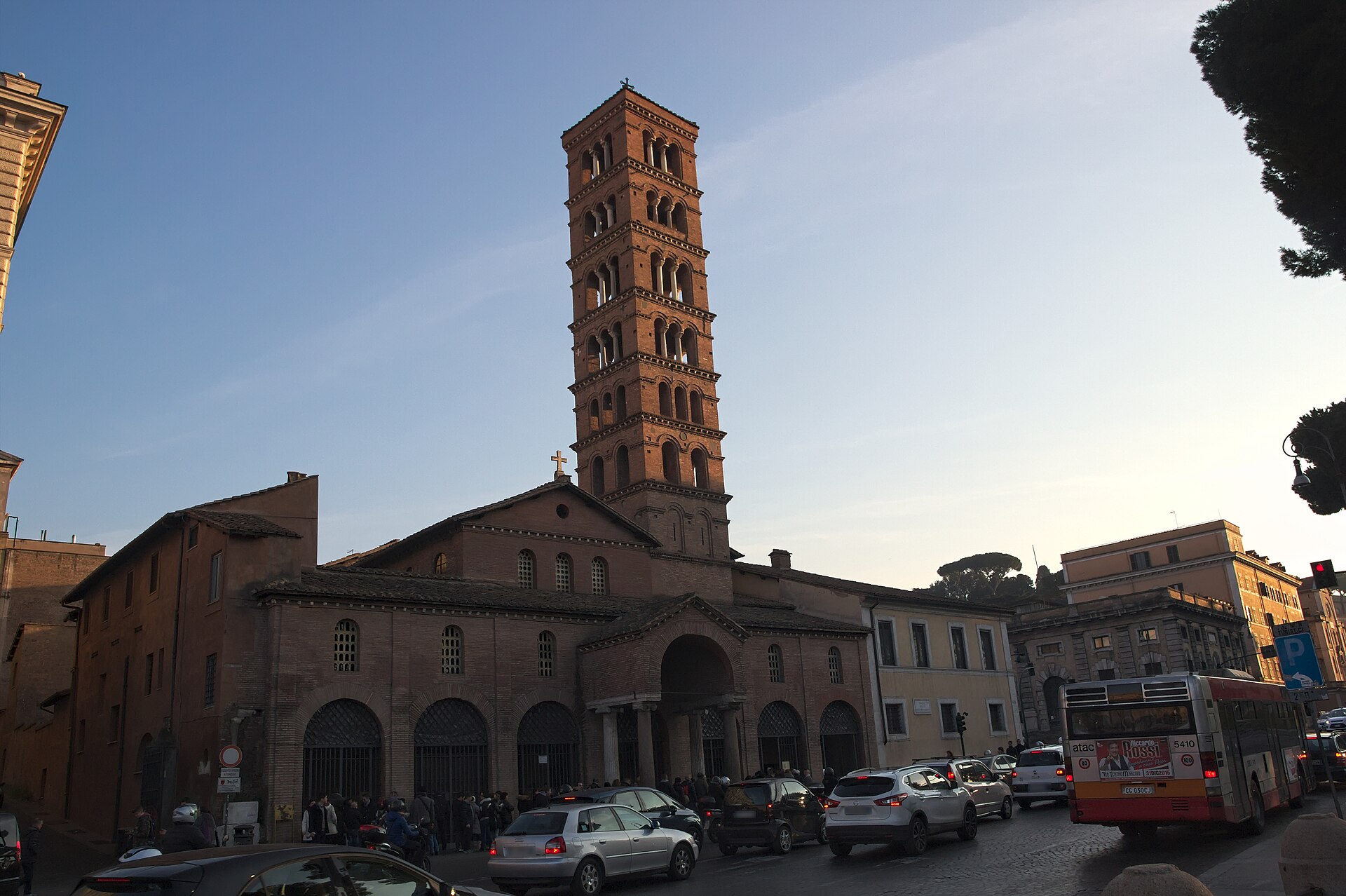
Santa Maria in Cosmedin
Всемирное наследие ЮНЕСКОAbout the Object
Architect unknown; 12th-century portico and campanile; altar baldachin by Deodato di Cosma (1294)
600
Romanesque
Piazza della Bocca della Verità 18, Roma
Religious Structure
Gallery (3)

The Church That Lost Its Baroque Facade and Regained Its Poverty
Hundreds of people walk past this church every day, and almost all of them are heading for the stone face in its portico. The building itself is more interesting than that slab, and here is why. The church was built in the 6th century on the site of an ancient food market, near the former Forum Boarium. It was founded by the Greek community that had moved to Rome from Byzantium; the neighboring San Giorgio in Velabro belonged to the same community. In the 12th century, a portico and a campanile were added to the church, that very same seven-tier brick bell tower by which it is recognized from afar. And then begins a story that can hardly be seen anywhere else in Rome in such a pure form. In the 18th century, like half of Roman churches, this one was fitted with a baroque facade: curved, with volutes and a pediment, which completely covered the medieval wall. Having stood for a century and a half, it ceased to be satisfying. At the end of the 19th century, the baroque facade was demolished and the building was returned to its original appearance: a bare brick wall, a portico, and a bell tower. It is worth pausing for a minute to think about what this means. Usually in Rome, the new is layered onto the old and remains forever; here, an entire layer was consciously removed, deciding that the 6th-century church was more important than the 18th-century church. Such decisions were made across Europe in the 19th century, and they are almost always controversial: the restorer chooses which of the building's authentic ages to consider the real one. Inside, watch the floor. It is laid out in the Cosmatesque technique: 12th- and 13th-century masters assembled such patterns from ancient marble, cutting circles of porphyry and serpentine directly from old columns. That means beneath your feet is dismantled Ancient Rome, laid out in a geometric pattern. The ambos, the episcopal throne, and the choir enclosure are made in the same technique. The ciborium over the main altar is signed: Deodato di Cosma, 1294. And one thing in the right aisle, which is easy to walk past: the mosaic of the Adoration of the Magi. This is all that remains of the Greek church that stood on this site before the current one. Practical info. Admission is free. Open daily from approximately 9:30 to 18:00, in winter they close earlier, and the gates are locked ten minutes before the end; it is worth checking the hours on the website `cosmedin.org`. The queue outside is for the Mouth of Truth, not for the church: the interior is almost always empty. The location lies between our Aventine route and the Forum.
AI translation · 🇬🇧 EN
📷 Wikimedia Commons · author unknown · Public domain · https://commons.wikimedia.org/wiki/File:Roma._Basilica_di_Santa_Maria_in_Cosmedin_Exterieur_Barokke_voorgevel_van_1718_met_campanile%2C_GD004888.jpg
📷 Wikimedia Commons · author unknown · Public domain · https://commons.wikimedia.org/wiki/File:Roma._Basilica_di_Santa_Maria_in_Cosmedin_Exterieur_Voorgevel_met_campanile_na_1894-1899%2C_GD004889.jpg
Rate this review:
Nearby and related
Close by in Rome
About the Object
Architect unknown; 12th-century portico and campanile; altar baldachin by Deodato di Cosma (1294)
600
Romanesque
Piazza della Bocca della Verità 18, Roma
Religious Structure