
Vittoriano (Victor Emmanuel II Monument)
Всемирное наследие ЮНЕСКОAbout the Object
Giuseppe Sacconi
1911
Neoclassicism
Piazza Venezia, Roma
Sculpture / Monument
Gallery (2)
The monument that Rome dislikes, but from which Rome is viewed
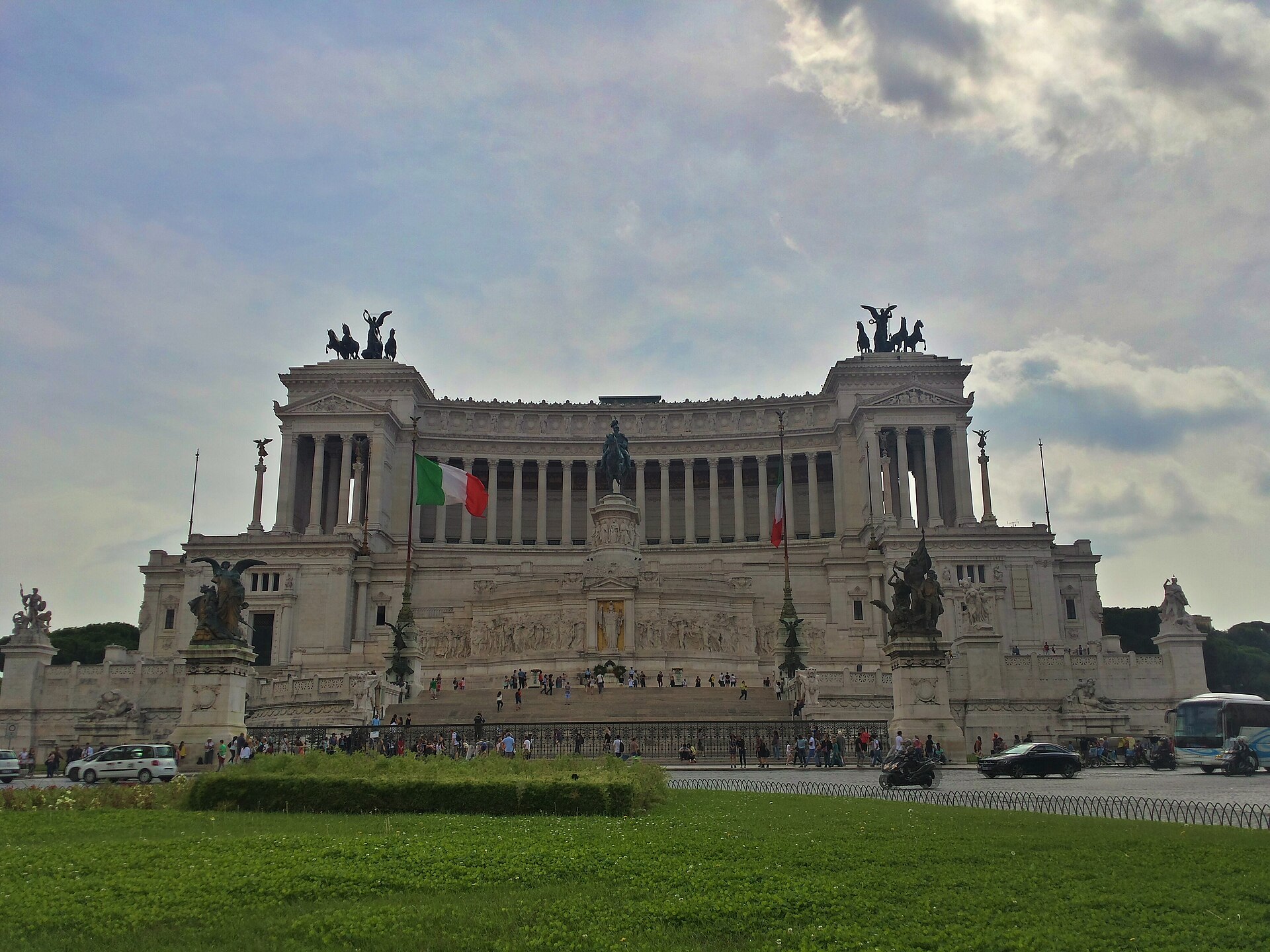
It is visible from almost everywhere, and it is impossible not to notice it despite all your efforts: a white marble mountain with steps, a colonnade, and bronze chariots on top, in the middle of a city the color of ochre and brick. Over a hundred years, the Romans have come up with several nicknames for it, and both of the main ones are insulting: the "typewriter" and the "wedding cake". Neither is about architecture, both are about shape. Let us start with why it is here. In 1870, Italy united and took Rome for itself, making it the capital. The new state needed something to counter the city of the popes: papal Rome had St. Peter's Basilica, squares, and colonnades, while the kingdom had nothing. The monument to the first king of united Italy, Victor Emmanuel II, was supposed to be that answer. Giuseppe Sacconi won the competition, and construction began in 1885. Sacconi conceived not a monument in the usual sense, but an entire slope-sanctuary, arranged like an ancient acropolis: staircases, terraces, a colonnade on top. Now about the price. The most prominent spot in the city was chosen - the northern slope of the Capitoline Hill near Piazza Venezia. Houses and a monastery stood on this slope, neighborhoods of medieval layout, and all of this was demolished. Clearance lasted from the mid-1880s to almost the end of the century. Some parts were salvaged and preserved piecemeal: the marble screen from the Aracoeli monastery, demolished for the sake of the monument, now lies in the museum of the neighboring Palazzo Venezia. Take a look at it if you drop by: it is literally a shard of what stood here before. Then construction dragged on for a long time. The monument was opened on June 4, 1911, for the fiftieth anniversary of the country's unification, although it was not finished at the time; work was finally completed only in 1935. Inside the colonnade, two bronze quadrigas appeared, each driven by a winged Victoria, and the colonnade itself is raised fifteen meters. In the middle of all this is the equestrian statue of the king, gilded bronze, twelve meters in length. The scale is easily checked: from below, the horse's leg is level with a human height. There is one subtlety here that explains a lot. Victor Emmanuel II himself is not in this monument. The king is buried in the Pantheon, together with his son Umberto I and the painter Raphael. That is, before you is a monument to a man whose grave is elsewhere, and in this sense the Vittoriano was from the very beginning not a tombstone, but a declaration. And then it acquired a meaning that was not planned. In 1921, Italy buried the Unknown Soldier of the First World War. The body was chosen from eleven unidentified remains, and it was chosen by a woman - Maria Bergamas, the mother of a missing soldier. On October 28 she made her choice, and on November 4 the coffin was buried here, at the Altar of the Fatherland. From that day on, the Vittoriano ceased to be just a monument to the king: people come here to the soldier, a guard stands by the tomb, and state ceremonies take place on these steps. The attitude towards it has remained twofold. In architecture books it is called an example of smug and tactless construction, and modernism historians usually simply leave it out of the equation. And yet the best view of Rome opens precisely from here: a glass lift goes up, and if you walk up the steps, the observation deck is free. That is how it works: the Romans call it a typewriter, and everyone climbs up it.
AI translation · 🇬🇧 EN
📷 Wikimedia Commons · Shweta.raizada · CC BY 3.0 · https://commons.wikimedia.org/wiki/File:Winged_Victory.JPG
Rate this review:
Nearby and related
Close by in Rome
About the Object
Giuseppe Sacconi
1911
Neoclassicism
Piazza Venezia, Roma
Sculpture / Monument