
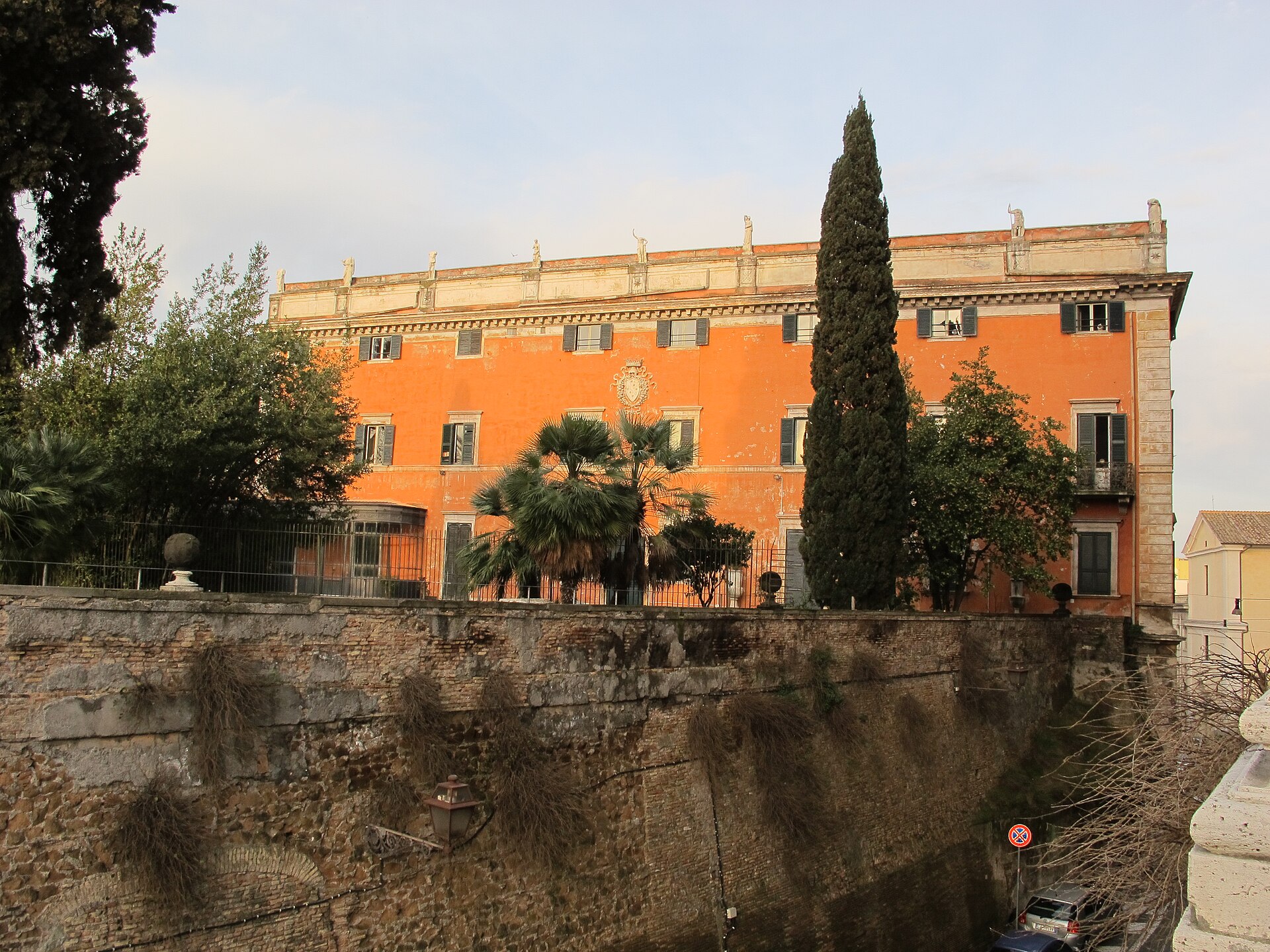
Giardino di Villa Aldobrandini
Всемирное наследие ЮНЕСКОAbout the Object
Giacomo della Porta (palace stairs and loggias, early 17th century); earlier Carlo Lambardi
1601
Renaissance
Via Mazzarino 11, Roma
Park
Gallery (2)

The garden that stayed eight meters above the city
Walking from Piazza Venezia toward Via Nazionale, you pass by a long, blank wall and usually don't even notice it. The wall is high, nothing is visible behind it, and it looks like a slope retaining wall. Up above behind it lies an eight-thousand-square-meter garden that you can enter for free, from seven in the morning until sunset. The entrance is not on the street you were walking along. You have to round the corner onto Via Mazzarino and climb a steep staircase that runs between ancient ruins from the late 1st century. After half a minute of climbing, the city noise is left below, literally: it is lower than you. The garden started as a vineyard. In 1566, Monsignor Giulio Vitelli bought a plot with buildings on this hill, and in 1601, Pope Clement VIII gifted the estate to his nephew, Cardinal Pietro Aldobrandini. The cardinal's affairs were managed by Giacomo della Porta, the very same whose Il Gesù facade was later replicated worldwide; here he worked on the stairs and loggias of the palazzo. Later, the estate passed through noble families, from the Pamphilj to the Borghese. And now comes the most interesting part, which explains why the garden hangs suspended. When Rome became the capital of a united Italy, the city began to be carved up by new streets. After 1870, Via Nazionale was cut through this slope, and the Aldobrandini estate was drastically truncated: previously it extended toward the Palazzo Pallavicini-Rospigliosi, now only a rectangle at the top remains of it. The wall you walked along is precisely the cut section. What looks today like a beautiful hanging garden was an ordinary garden until the street passed beneath it. In 1926, the plot passed to the state and opened to everyone. Today it is also a small botanical garden: camellias, lemons, myrtle, cypresses, laurels, various palms, and a large ginkgo tree. Benches, shade, a view over the rooftops, and not a single queue.
AI translation · 🇬🇧 EN
📷 Wikimedia Commons · Vlad Lesnov · CC BY 3.0 · https://commons.wikimedia.org/wiki/File:Villa_Aldobrandini_-_panoramio_(1).jpg
Rate this review:
Nearby and related
By the same architect
Close by in Rome
About the Object
Giacomo della Porta (palace stairs and loggias, early 17th century); earlier Carlo Lambardi
1601
Renaissance
Via Mazzarino 11, Roma
Park