
Palazzo Farnese
Всемирное наследие ЮНЕСКОAbout the Object
Antonio da Sangallo the Younger, Michelangelo Buonarroti, Giacomo della Porta
1589
Renaissance
Piazza Farnese 67, Roma
Public Building
Gallery (1)

The Palace Finished by a Single Cornice
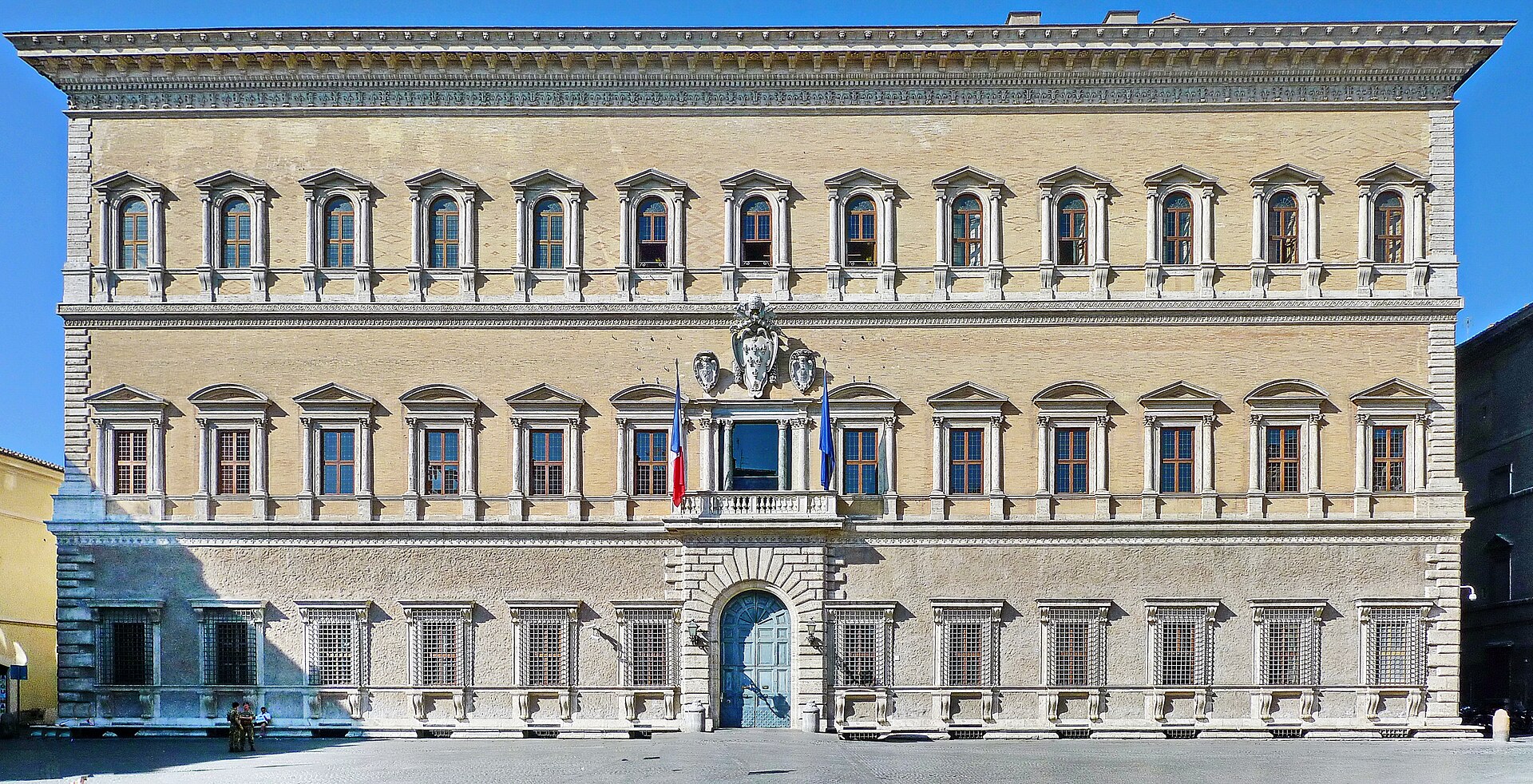
From the middle of Piazza Farnese, the large yellow building is visible in its entirety. Nothing flashy: a flat wall, neat rows of windows, no columns or pilasters on the facade. This is Rome's largest private palace and the model from which palaces all over Europe were later copied. In 1841, Englishman Charles Barry used it as a model when building the Reform Club in London. It was built by three men, and this is a case where you can see who did what. Antonio da Sangallo the Younger started it in the 1510s for Cardinal Alessandro Farnese, who in 1534 became Pope Paul III. Sangallo brought the house up to the third floor and led the work until 1546. He also came up with the main visual trick: from the main entrance, the gaze flies across the courtyard, through the loggia arcade, and rests upon the Tiber. In 1546, Sangallo died, and Michelangelo took charge of the work. He was seventy-one years old, the house was almost ready, and it made no sense to redo it entirely. He did three things: a large projecting cornice at the top, a central window above the entrance, and the upper tier of the courtyard. Look at the cornice. It is huge, much heavier than usual, and juts out from the wall further than customary. It is precisely because of it that the building reads as a single body, rather than as three floors stacked on top of each other. The facade has no vertical divisions to pull it together: the wall is smooth, rustication is only on the corners and around the entrance arch, and the windows each stand on their own, with alternating triangular and semicircular pediments. Everything rests on horizontals, and the final, most powerful horizontal is Michelangelo's cornice. A single line placed on top finished someone else's building. The facade on the Via Giulia side and the loggia were finished after him; the palace was finally completed in 1589. Some things can also be seen through the gateway opening. The courtyard with columns and arches is built, among other things, from the stone of ancient structures: 16th-century Rome took material where it was already lying dressed. The halls of the palace housed the Farnese collection of antiquities, the best private collection of ancient sculpture since antiquity itself. Part of it was excavated in the Baths of Caracalla. Today the originals are in Naples, and a copy of the Farnese Hercules stands in one of the halls. And the last thing that never happened. Michelangelo proposed throwing a bridge across the Tiber to connect the palace with the gardens and the Villa Farnesina on the other bank - a single estate on both sides of the river, connected by a private bridge. The project remained on paper. You can get inside, but not from the street: since 1635, the French Embassy has been here, and you must book a tour in advance via the website.
AI translation · 🇬🇧 EN
Rate this review:
Nearby and related
By the same architect
Close by in Rome
About the Object
Antonio da Sangallo the Younger, Michelangelo Buonarroti, Giacomo della Porta
1589
Renaissance
Piazza Farnese 67, Roma
Public Building