
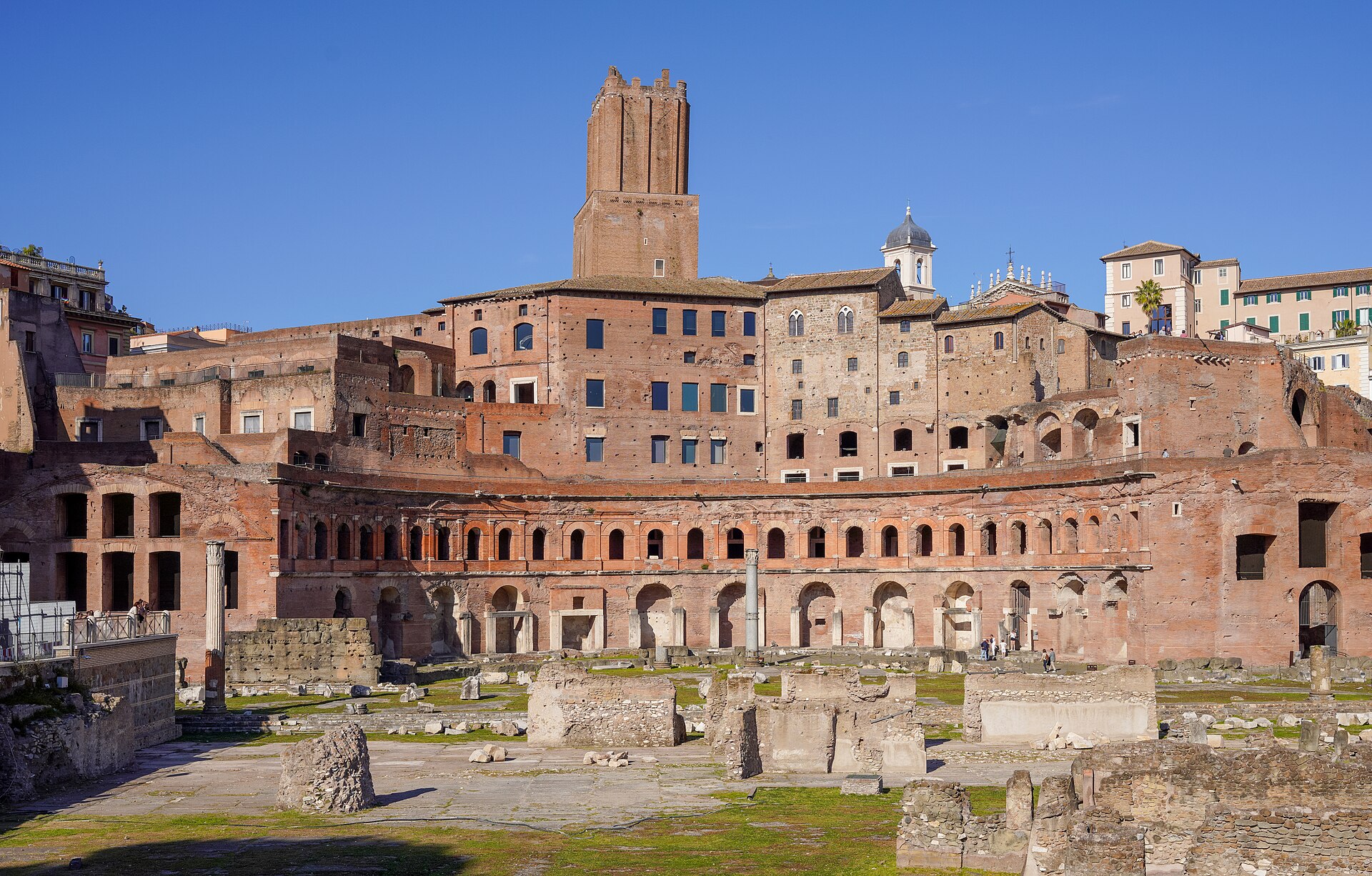
Trajan's Forum and Markets (Foro e Mercati di Traiano)
Всемирное наследие ЮНЕСКОAbout the Object
Apollodorus of Damascus
113
Ancient Roman
Via IV Novembre 94, Roma
Memorial Place
Gallery (1)

Trajan's Forum: The last, the largest, and built on the site of a leveled hill
The Imperial Fora were built one after another - Caesar, Augustus, further down the list. This one is the last, and also the best. Its author is known, which is a rarity for Roman fora: Apollodorus of Damascus. It is worth understanding who he was. Not a court architect, but a field engineer who worked with Trajan in the wars. In 105 AD, he built a bridge across the Danube for troop deployment into Dacia: over a kilometer long, wooden arches on stone piers driven into the riverbed. For over a thousand years after that, no one built a longer arch bridge. A man used to setting up crossings for an army was then given the center of Rome to work on - and it shows in how everything is arranged here. To begin with, there is what is not here. Between the Capitoline and Quirinal hills, there was no room for such an ensemble - and the Quirinal was simply leveled. Exactly how much was removed is known, and the way they recorded it is worth a whole treatise: a column was placed nearby of the exact height as the sheared-off spur. Forty meters including the base and pedestal. The column is a ruler showing how much of the hill was carried away. Further on, everything is laid out along a single axis, rigidly and clearly. A triumphal arch at the entrance. Behind it, an open courtyard with colonnades and an equestrian statue of Trajan in the middle. Across the axis is the huge Basilica Ulpia, stretched out wide. Behind it, the column. And at the very end, a temple built after the emperor's death. The basilica is named after Trajan's family name: his full name was Marcus Ulpius Traianus. And this is why it is worth coming here if you have already been to the Roman Forum. The Basilica Ulpia was the most important basilica of the empire. And it served not for religious purposes, but for the administration of justice. This is the largest example of the type you have already seen at the Forum in the remains of the Basilicas Aemilia and Julia: an elongated hall, rows of columns, side aisles, clerestory lighting, an apse at the end. A building for court and business, without a single trace of cult. Two or three centuries later, the Christian community would adopt this very layout - and in the place where the magistrate sat, an altar would stand. Today, rows of columns and floor fragments remain from the Basilica Ulpia. But if you want to see what it was like, you should not go here. You should go to the Aventine, to Santa Sabina, where the exact same hall stands intact - because it became a church. And finally, about the author, to close his story. Trajan died, and Hadrian became emperor, the very one under whom the Pantheon would be completed. Hadrian loved to design himself. And when he undertook the Temple of Venus and Roma, Apollodorus, according to stories, remarked that the seated statues in the niches were too large: if they stood up, their heads would hit the vault. The remark was to the point. Hadrian had him executed. The man who built Rome's last and best forum and a bridge that no one surpassed for a thousand years ended up telling the client the truth about proportions.
AI translation · 🇬🇧 EN
Rate this review:
Trajan's Markets: the world's first shopping mall, which it might never have been
A semi-circular brick behemoth spanning several tiers, cut into the hillside, is what is commonly called Trajan's Market and the "world's first shopping mall". The phrase is catchy, and you will find it in any guidebook. There is a catch with it, and it is more interesting than the phrase itself. First, the generally accepted version. The complex was built in the 2nd century under Trajan, by the same Apollodorus. One hundred and fifty rooms on five levels. They traded in silks and spices from the Middle East, fresh fish, fruit, flowers, wine, oil, and fabrics. The main street inside is called Via Biberatica, named after the taverns that once occupied it. And the upper tier was occupied by welfare offices: free grain was distributed from there to Roman men and boys. Shops opened early and closed around noon. Expensive stores laid out a mosaic at the entrance depicting what they sold, serving as a sign for those who could not read. Shopping was done almost exclusively by men; women went out perhaps only to tailors and shoemakers. Judging by employment documents from the years 117-193, the merchants were also almost entirely men. And now for the catch. Today, many researchers believe that the "market" was no market at all. One hundred and fifty rooms and halls look more like an administrative complex, a new center of governance and justice, offices for civil servants. The shops may have been only on the lower level. The exact same building is described in one book as the world's first shopping arcade, and in another as an imperial chancellery. We do not know for sure, and it is more honest to admit that than to choose the prettier version. The tower at the top, which seems part of the complex, has nothing to do with Trajan at all. The Torre delle Milizie was built in the Middle Ages, placed on top just as they did back then with pre-existing structures. And the column. It was consecrated in 113 AD in honor of Trajan's two campaigns in Dacia, present-day Romania. A ribbon of reliefs about two hundred and seventy meters long spirals up the shaft, a most detailed story of the war that is almost impossible to make out from below. Inside, the column is hollow, featuring a spiral staircase, and small windows in the shaft provide light. When Trajan died in 117 AD, his ashes were placed in a golden urn in the hollow base of the column. That is how it was saved. There is a legend: Pope Gregory the Great was so moved by a relief where Trajan helps a woman who lost her son that he prayed the pagan's soul out of hell, and received an answer that Trajan was saved, but he should not ask for other pagans anymore. The land around the column was declared sacred, and the column was left untouched. And in 1587, the statue of Trajan was removed from the top and replaced with the Apostle Peter. He is still standing there. The same approach as everywhere else in this city: the building is not demolished, its dedication is changed, and it lives on.
AI translation · 🇬🇧 EN
Rate this review:
Nearby and related
Close by in Rome
About the Object
Apollodorus of Damascus
113
Ancient Roman
Via IV Novembre 94, Roma
Memorial Place
Visitor Information
Ticketed
Morning
Вход с Via IV Novembre. Внутри Музей императорских форумов