
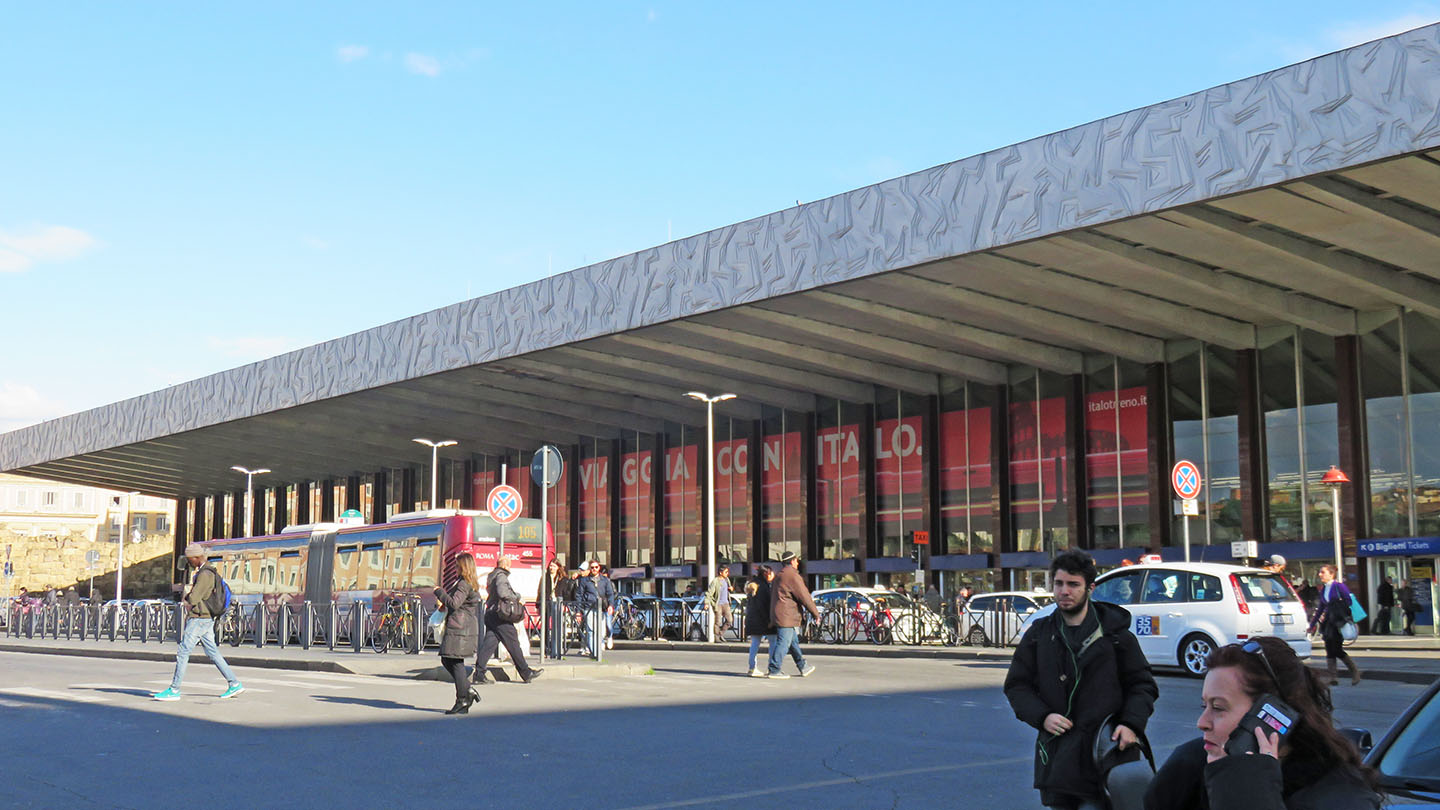
Roma Termini Railway Station
Всемирное наследие ЮНЕСКОAbout the Object
Angiolo Mazzoni (side wings); Eugenio Montuori, Leo Calini, Annibale Vitellozzi, Massimo Castellazzi, Vasco Fadigati, Achille Pintonello (main building)
1950
Modernism
Piazza dei Cinquecento, Roma
Railway Station
Gallery (3)

The Station Built by Two Different States
If you arrive in Rome by train, your acquaintance with the city begins here, and it begins strangely. You step out onto the square, and above you is a long, low canopy projecting forward without a single column, pure 1950s engineering, and beneath it a glass wall spanning the entire width of the station. And then you walk along the building on Via Giolitti, and there the architecture is completely different: a blank, multi-story travertine wall, heavy, long, with small windows stretching along the tracks. Architectural historian Jean-Francois Lejeune writes that the architecture of these long wings directly references ancient aqueducts and, more broadly, the metaphysical painting of Giorgio de Chirico. This is neither a mismatch nor a late-period alteration. Literally two eras have collided here, and the seam between them is visible from the street. Chronologically. The first station on this site appeared back under papal rule, and the permanent building designed by Salvatore Bianchi was completed in 1874: two wings with columns and porticos, in the middle a train shed with a semi-circular glass end wall, with carriage drivers in front of the entrance. It stood directly opposite the ruins of the Baths of Diocletian and lasted until the late 1930s. Under Mussolini, it was decided to demolish the old station and build a new, huge one befitting the capital of an empire. The job was given to Angiolo Mazzoni, the architect of the Italian railways, and he managed to build the side wings, the very ones stretching along Via Giolitti. Lejeune's comparison to de Chirico is worth remembering: he says the exact same thing about the arcades of the Palace of Italian Civilization in the EUR district. The twenties and thirties in Italy generally loved the empty arch and sharp shadow. Then the war happened. Construction was stopped in 1943, the regime collapsed, and the unfinished station was left standing with ready wings and no main building. And this is where the second half of the story begins. In 1947, republican Italy announced a design competition for the completion. Not one project won, but two, and the authors were forced to work together: the team of Leo Calini and Eugenio Montuori and the team of Massimo Castellazzi, Vasco Fadigati, Achille Pintonello, and Annibale Vitellozzi. From this forced collaboration emerged the main building, opened in 1950, the glass wall spanning the entire width and that very canopy hanging over the entrance like a wave. From the Piazza dei Cinquecento, the building can be seen in its entirety. To the left and right is the heavy stone of the thirties, pining for Ancient Rome. In the center is the light glass of the fifties, pining for nothing. Between them lie seven years, a war, and a change of political regime. In few places in Europe can the turning point of an era be seen so literally, simply by turning one's head. And finally, something worth taking twenty steps to the side for. The building stands right next to the Baths of Diocletian, which are about seventeen centuries old. Mazzoni's arcade imitates ancient Rome, while real ancient Rome is right there, across the street, in the original.
AI translation · 🇬🇧 EN
📷 Wikimedia Commons · Lalupa · CC BY-SA 3.0 · https://commons.wikimedia.org/wiki/File:Esquilino_-_edifici_di_Termini_a_via_Giolitti_1000971.jpg
📷 Wikimedia Commons · — · Public domain · https://commons.wikimedia.org/wiki/File:Stazione20Termini201890.jpg
Rate this review:
Nearby and related
By the same architect
Close by in Rome
About the Object
Angiolo Mazzoni (side wings); Eugenio Montuori, Leo Calini, Annibale Vitellozzi, Massimo Castellazzi, Vasco Fadigati, Achille Pintonello (main building)
1950
Modernism
Piazza dei Cinquecento, Roma
Railway Station