
Sant'Andrea al Quirinale
Всемирное наследие ЮНЕСКОAbout the Object
Gian Lorenzo Bernini
1670
Baroque
Via del Quirinale 30, Roma
Religious Structure
Gallery (1)

Bernini's Answer, Two Hundred Meters from Borromini
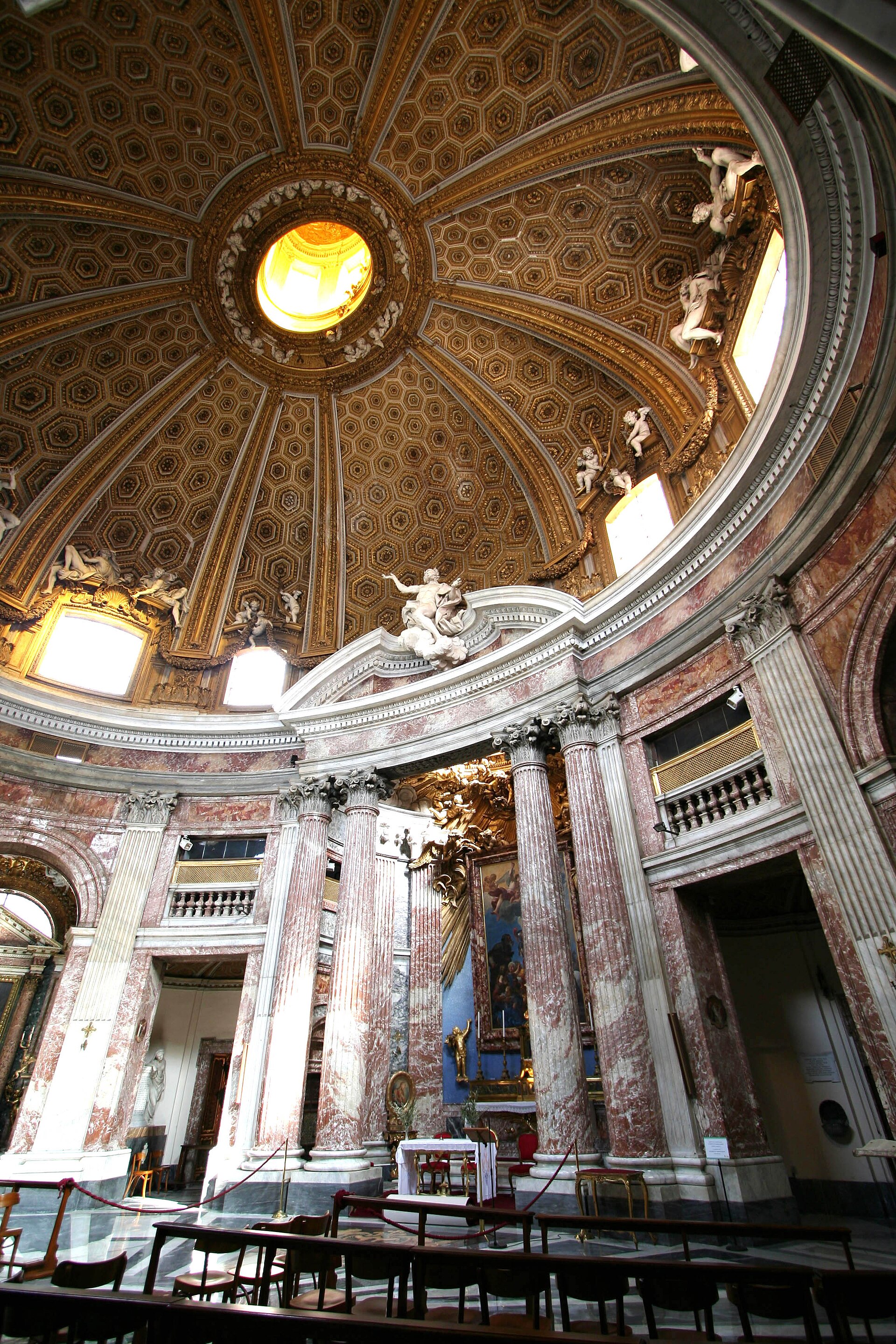
Two hundred meters down the street from San Carlino stands the second small oval church, built by the second great architect of the era. No other city offers such a comparison. Bernini built it between 1658 and 1670 for the Jesuit novitiate, a house where young members of the order were trained. The patron was Cardinal Camillo Pamphili, the nephew of that very Innocent X whose family commissioned the fountain in Piazza Navona. Outside, everything is calm: a flat facade, a semicircular portico on two columns like a step thrust out to meet the street. No wave, no wall movement. Borromini would not recognize himself here. Inside, however, one should notice what happens to the person who enters. The church is also oval. But the oval is turned: you enter not from the narrow end, but from the long side, and the altar turns out to be right in front of you, three steps away. There is nowhere to walk. Instead of a corridor leading you forward, you are immediately inside, at the center, and the entire building unfolds around you. This is the difference between the two masters, and it is read with your feet. Borromini makes the walls move and the viewer follow the geometry. Bernini leaves the walls in peace and moves the viewer himself: he places them at the right spot and stages a spectacle all around. The spectacle here is literal. Above the altar, in the broken pediment, a white figure of the Apostle Andrew by Antonio Raggi sits on a cloud, that very Andrew crucified on a saltire cross to whom the church is dedicated. He rises upward toward the dome, gazing into its light. And in the dome, around the lantern, are molded cherub heads, and the gold is crafted so that the light from the lantern seems to come not from the sun, but from inside the building. That is, you are shown the ascension - not by a painting on the wall, but by the very arrangement of space: colored marble below, a white figure higher up, and higher still, golden light. Baroque here is not decoration, but direction. And a small detail that I think is the best. Bernini's son, Domenico, recalled that in his old age his father would come here and sit inside for a long time, looking at what he had made. Of all his works, he considered this one his most successful. The man who built the colonnade of St. Peter's Basilica went to rest his soul in a small church on the Quirinal.
AI translation · 🇬🇧 EN
Rate this review:
Nearby and related
By the same architect
Close by in Rome
About the Object
Gian Lorenzo Bernini
1670
Baroque
Via del Quirinale 30, Roma
Religious Structure