
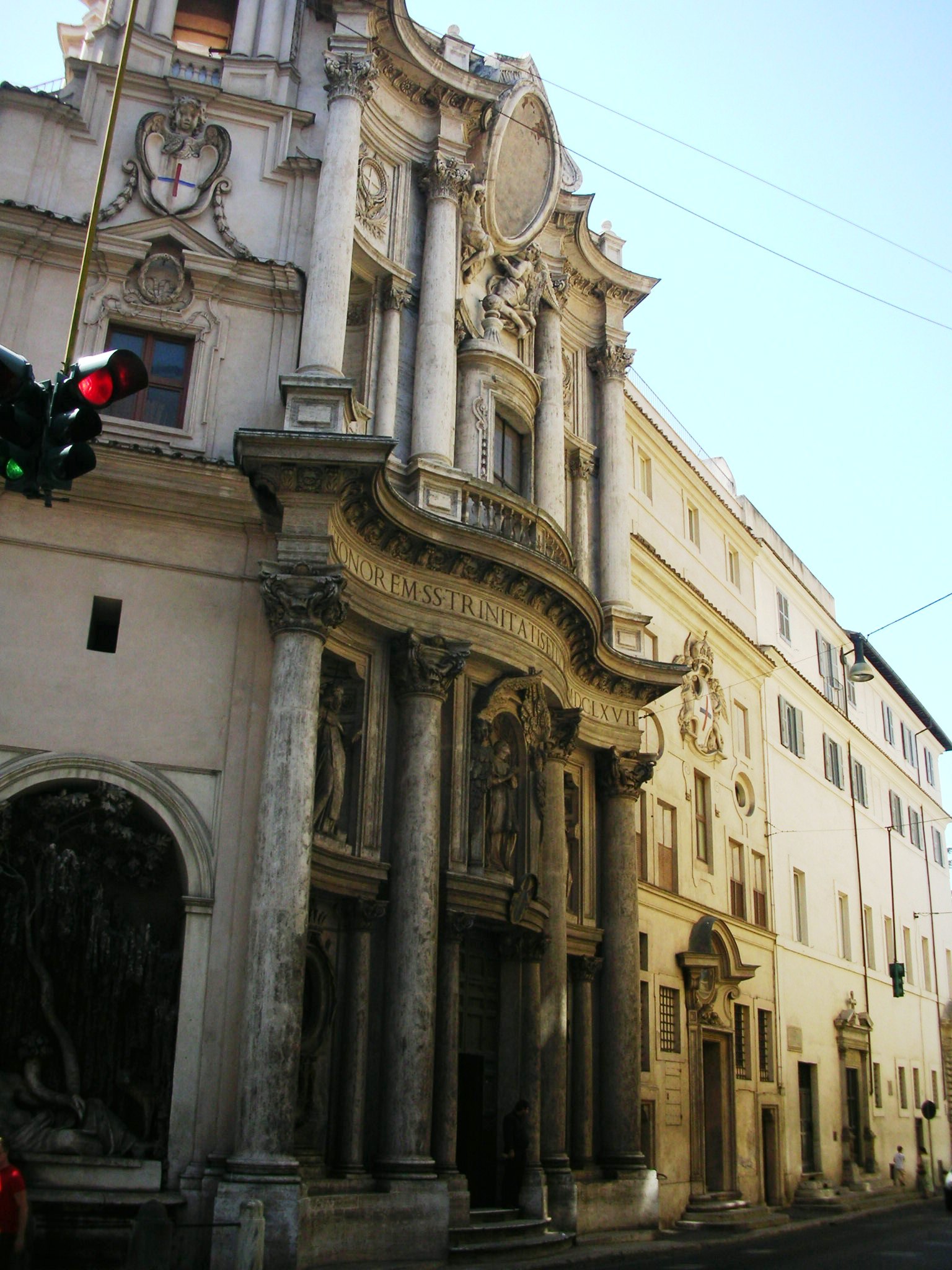
San Carlo alle Quattro Fontane (San Carlino)
Всемирное наследие ЮНЕСКОAbout the Object
Francesco Borromini
1667
Baroque
Via del Quirinale 23, Roma
Religious Structure
Gallery (1)

The church that fits inside a pier of Saint Peter's Basilica
It is hard to find: it stands on the corner of two narrow streets, at the Four Fountains intersection, and does not shout about itself at all. It is easy to walk right past. Do not walk past it. First, about the size, because it defines everything else. This church would fit entirely inside just one of the four piers that support the dome of Saint Peter's Basilica. One pier of the basilica - and this whole church. It received the commission in 1634 from the Trinitarian Order - a Spanish brotherhood that engaged in ransoming Christians from captivity. The order had little money, the plot was tight and irregular, and the architect was young and almost unknown. For Francesco Borromini, this was his first major independent commission. He turned the cramped space into a technique. Look at the facade. The lower tier goes in a wave: concave, convex, concave. The upper one is concave, concave, concave. The wall does not stand, it moves, and on a narrow street this is felt physically: the building seems to breathe toward you. Inside, everything continues upward. In plan, the church is an oval, the beloved figure of the Baroque, but Borromini went further: he sliced the space into fragments of intersecting ovals, and the walls went in waves, like the facade. Not a single point where the gaze can rest. Above all this is an oval dome with coffered panels that decrease in size toward the top, making it seem taller than it is, and a tiny lantern from which light pours down. This is the Baroque in its purest form: not "richly decorated," but a space that moves. And compare this with what you saw at Piazza Navona. With Bernini, it is theater: figures, water, an effect calculated for a spectator who stands and watches. Borromini does not have a single figure, not a single scene - only geometry, walls, and light. The two worked a stone's throw from each other and spent their whole lives doing the exact opposite.
AI translation · 🇬🇧 EN
Rate this review:
Thirty years, four fountains and an empty niche in the crypt
Work on this church stretched over thirty odd years, and not because the architect was slow. The order was running out of money. The interior was finished by 1641, and they were able to return to the facade only in 1665. It was completed in 1667, the year of Borromini's death. The facade of San Carlino is one of his last works. There is plenty to look at right at the intersection. At the four corners, embedded into the walls of the houses, lie four figures with water - the very Four Fountains that gave their name to both the place and the church. They appeared by order of Pope Sixtus V, between 1588 and 1593, when the city was being redesigned. One of the river gods, with a she-wolf nearby, is the Tiber, the second is most likely the Arno; the two female figures are interpreted in various ways. The intersection stands at the highest point of the Quirinal, and that is the whole point. From the middle of the intersection along the streets, three obelisks are visible at once, placed by the same Sixtus V, at Santa Maria Maggiore, at Trinitai dei Monti and in Quirinal Square. This is not a coincidence, but a design: the pope and his architect Domenico Fontana placed landmarks across the city that could be seen from a distance so that the pilgrim would not get lost. The very Fontana who moved the obelisk to Saint Peter's Square and dismantled the altar screen in Santa Sabina. And now for the reason why I advise descending into the crypt. Borromini was a closed, difficult and suspicious man; he had noticeably fewer commissions than the brilliant and affable Bernini, although everyone acknowledged his gift. On August 2, 1667, at the age of fifty-eight, he threw himself on his own sword. He died the next day, having managed to dictate his will. In the crypt of his first church, he had prepared a place for himself in advance - a small side chapel with a single window. After what happened, they did not bury him there: he chose to lie next to his teacher Carlo Maderno, in the church of San Giovanni dei Fiorentini, and lies there without his own gravestone. And the niche in the crypt of San Carlino remained empty. It is still empty.
AI translation · 🇬🇧 EN
Rate this review:
Nearby and related
By the same architect
Close by in Rome
About the Object
Francesco Borromini
1667
Baroque
Via del Quirinale 23, Roma
Religious Structure