
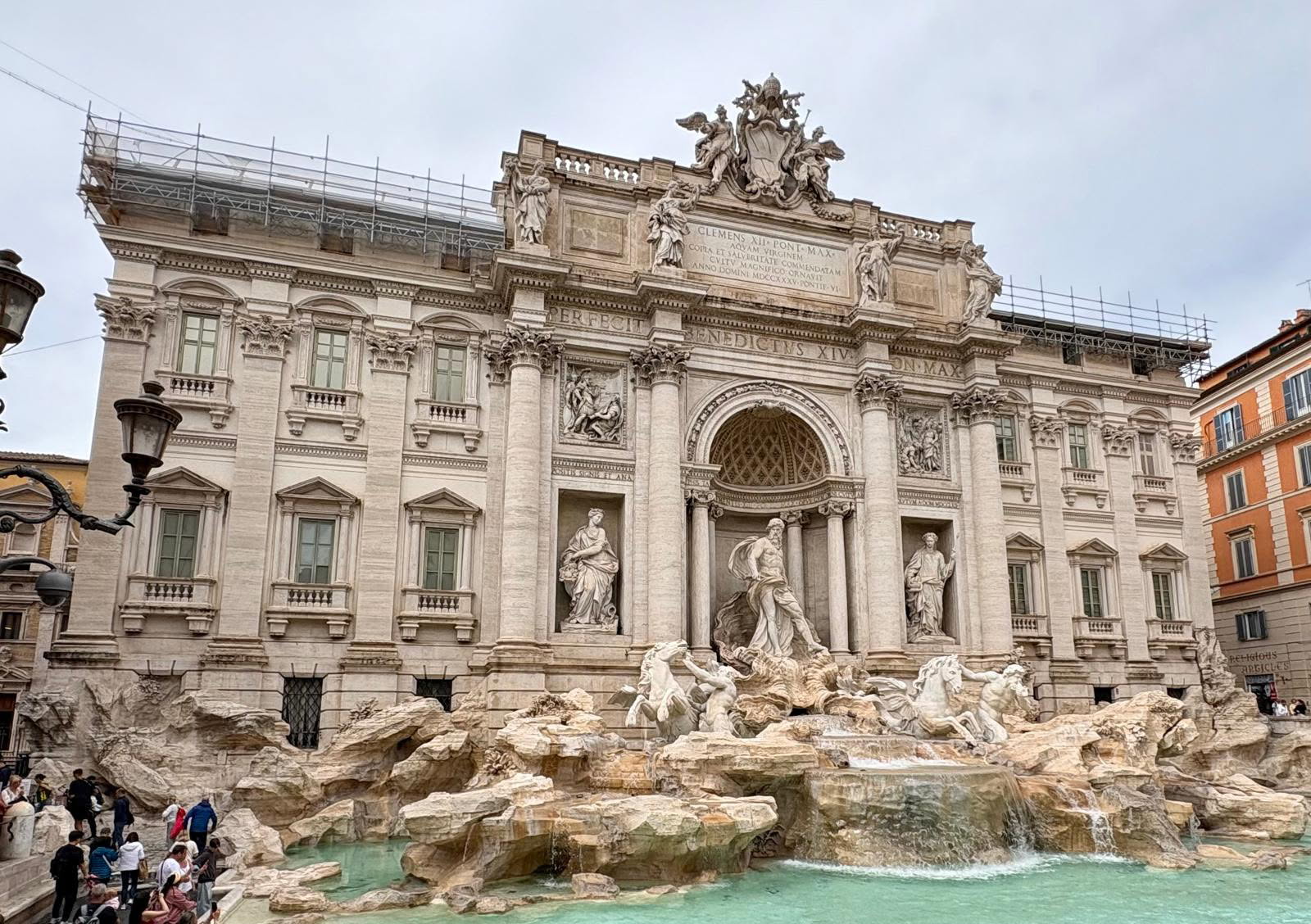
Trevi Fountain (Fontana di Trevi)
Всемирное наследие ЮНЕСКОAbout the Object
Nicola Salvi; after his death, the work was completed by Pietro Bracci
1762
Baroque
Piazza di Trevi, Roma
Sculpture / Monument
Gallery (1)

The End of a Two-Thousand-Year-Old Aqueduct
You cannot approach it gradually. The surrounding streets are narrow, the fountain remains hidden until the very last step-and suddenly it opens up all at once, spanning the entire wall of the palace, accompanied by a roar of water that you hear before you even see it. First, about how it is constructed, because that changes your perspective. Trevi is not just a sculpture with water. It is the terminus of an aqueduct. In Rome, such structures are called mostra - a "display": the place where water, having traveled from afar via an aqueduct, comes out into the open and makes its presence known. The more important the aqueduct, the louder the finale. Water flows here via the Aqua Virgo aqueduct, built in 19 BC under Augustus. The sources are more than twenty kilometers outside the city. This aqueduct still functions today: it is the only ancient Roman water supply system that has never stopped operating, and the water falling before you now arrived along the exact same route it did two thousand years ago. Even the name comes from there. Legend has it that a young woman named Trivia showed the Roman engineers the spring, and "Trevi" derived from her name. Whether this is true or not, the word "virgo" (maiden) is officially part of the aqueduct's name. Now, about what you see. Built between 1732 and 1762 to the design of Nicola Salvi, the facade is integrated into the wall of Palazzo Poli - meaning the palace serves as a backdrop for the fountain. In the center, within an opening resembling a triumphal arch, stands Oceanus-not a sea god, but the personification of the river encircling the world, from which all waters in antiquity were believed to originate. His shell-chariot is drawn by horses guided by tritons: one horse is calm, the other struggles-representing the tranquil and turbulent sea side by side. Salvi did not live to see it completed: he died in 1751, and the work was finished by his longtime friend Pietro Bracci, who carved Oceanus himself. And three final things, each in its own way telling the story of what this fountain has become. First: it contains about three million liters of water, which was once considered the best-tasting in Rome. You cannot drink it now-the water is treated with disinfectants. Second: tossing a coin over your shoulder. Tradition promises you will return to Rome, and about three thousand euros are thrown into the fountain daily. The money is fished out and donated to charity. Third: the world owes the fame of this fountain not to Salvi, but to cinema. In 1960, Fellini filmed the famous scene in La Dolce Vita here with Anita Ekberg wading into the water-and ever since, the Trevi has become the most photographed fountain on Earth. And if you want to see where all this water flows from-just a couple of steps away, beneath a former cinema, a section of the Aqua Virgo aqueduct itself has been excavated, along with the remains of a Roman apartment building. The site is called the "City of Water." Almost no one goes there, and that is a pity: it helps you understand something you cannot grasp at the fountain itself-that this is all, first and foremost, about an ancient water system.
AI translation · 🇬🇧 EN
Rate this review:
Nearby and related
Close by in Rome
About the Object
Nicola Salvi; after his death, the work was completed by Pietro Bracci
1762
Baroque
Piazza di Trevi, Roma
Sculpture / Monument