
Santa Maria della Vittoria
Всемирное наследие ЮНЕСКОAbout the Object
Carlo Maderno (church), Gian Lorenzo Bernini (Cornaro Chapel)
1646
Baroque
Via XX Settembre 17, Roma
Religious Structure
Gallery (1)

A Chapel Arranged Like a Theater, with Spectators in the Boxes
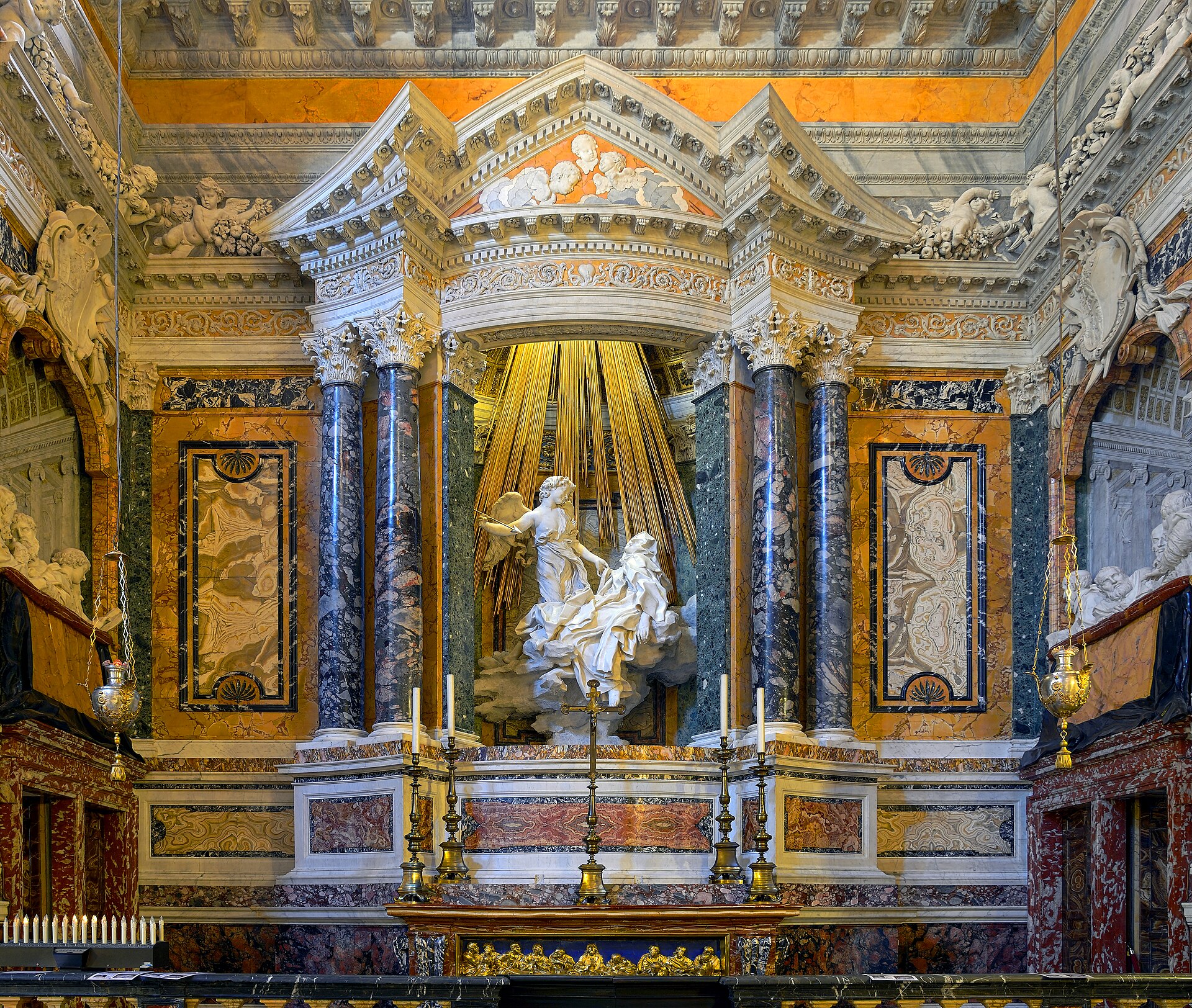
The church stands out in no way from the outside - a cramped Baroque facade on a noisy street. Inside it is dark, warm, gilded, candles are burning. To the left is a side chapel. This is the Cornaro Chapel, and the main thing about it is how it is arranged. On the sides of the altar, boxes are built into the walls. In the boxes sit people made of marble: Cardinal Federico Cornaro, who paid for the chapel, and his ancestors. They are not praying and they are not looking at us. They have turned toward the center, are talking among themselves, leaning forward - looking at what is happening in the middle, like spectators in a theater. And in the middle is the Ecstasy of Saint Teresa, a 1646 work by Bernini. Teresa of Avila, a 16th-century Spanish nun, described a vision in her writings: an angel with a golden spear pierced her heart, and the pain was such that she moaned, but did not want it to end. Bernini chose precisely this moment. She lies on a cloud, thrown back, eyes closed, mouth slightly open, the body drowned in folds of fabric - the folds are made in such a way that the marble seems soft and heavy at the same time. Above her stands an angel with a smile that from different points looks now tender, now cruel, and holds an arrow, preparing to strike a second time. From above, rays fall upon them - bronze, gilded, and real light from a hidden window runs along them. This puts the viewer in an awkward position, and Bernini knew what he was doing. The scene is religious, yet looks indecently corporal; people have been arguing about this since the 17th century and will not stop. But look at the arrangement as a whole, and not just at the figure. There is a stage. There is lighting. There is a curtain of marble. There is the audience in the boxes. The viewer, that is you, stands in the stalls. Baroque here is not a lush style - it is a theater assembled from stone, bronze, and real sunlight, and you participate in it by the mere fact of your presence. If you have already been to Sant'Andrea al Quirinale, you will recognize the device: there Bernini similarly placed the viewer in the center and arranged an ascension around them. Here the same thing is done in a single chapel, and therefore it is easy to view it in its entirety. And two remarks about the church itself, both good. The first is about the name. Our Lady of Victory refers to a specific victory: the Battle of White Mountain near Prague on November 8, 1620. The regimental priest with the Catholic army was the Carmelite Dominic of Jesus and Mary, and he wore an image of the Mother of God around his neck; the victory was attributed to him. A year and a half later, the image was brought here, and the church, begun as the Chapel of Saint Paul, changed its name. That is, the chapel with the most corporal scene in Roman Baroque stands in a church named after a battle. The second is about how the facade was paid for. When digging the foundation for the church in 1608, an antique statue was found - the Sleeping Hermaphroditus. Cardinal Scipione Borghese, a passionate collector, took the statue, and in return paid for the construction of the facade. The church, one might say, exchanged a pagan rarity found in its own pit for its own facade - and such deals were par for the course in Rome.
AI translation · 🇬🇧 EN
Rate this review:
Nearby and related
By the same architect
Close by in Rome
About the Object
Carlo Maderno (church), Gian Lorenzo Bernini (Cornaro Chapel)
1646
Baroque
Via XX Settembre 17, Roma
Religious Structure