
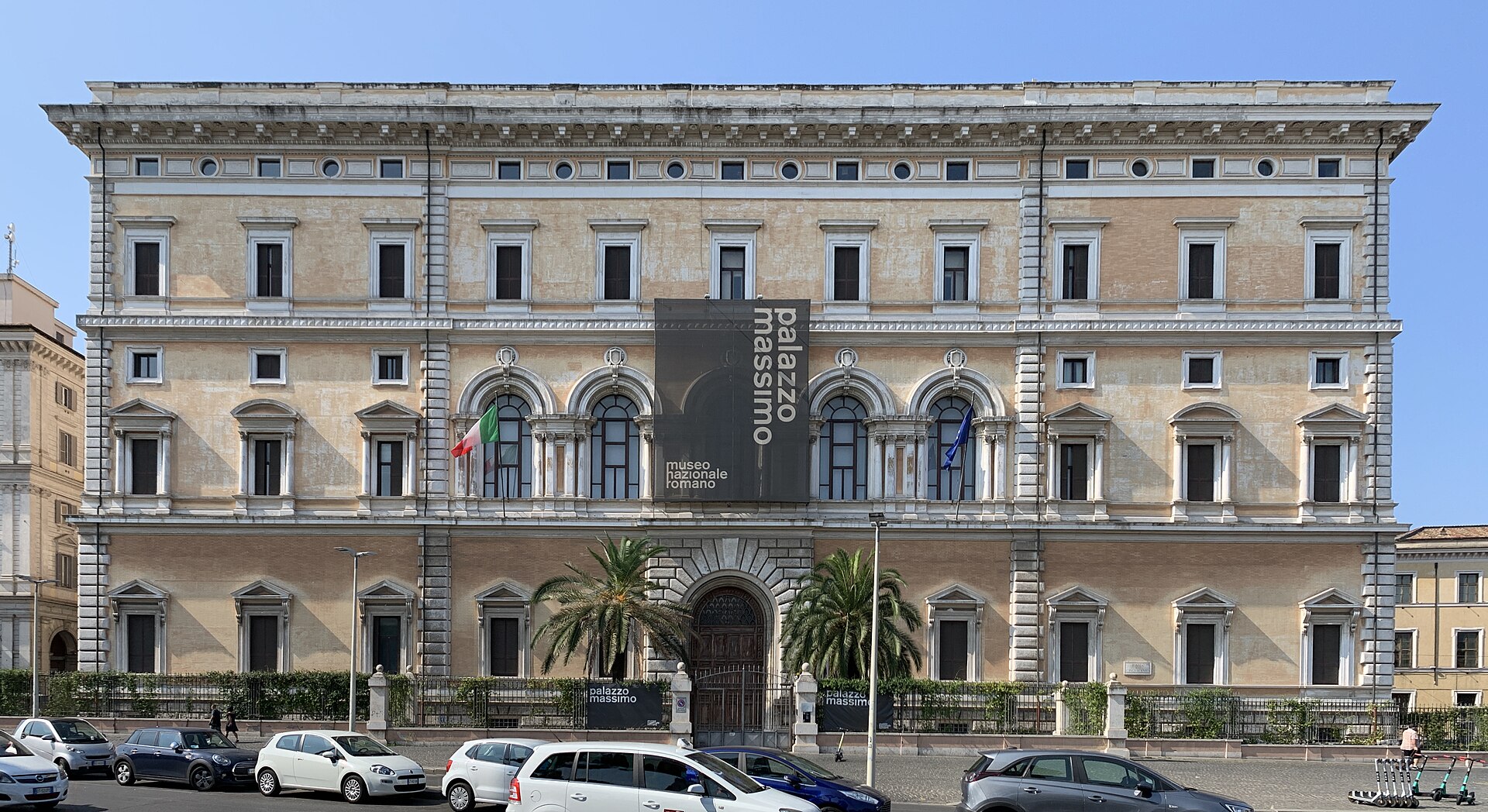
Palazzo Massimo alle Terme (National Roman Museum)
Всемирное наследие ЮНЕСКОAbout the Object
Camillo Pistrucci; conversion into a museum - Costantino Dardi
1883
Neo-Renaissance
Largo di Villa Peretti 1, Roma
Museum
Gallery (1)

The Jesuit College That Became the Main Hall of Ancient Rome
With this building, it is best to start with the trompe l'oeil. It looks like a 16th-century palazzo, stands a stone's throw from Termini Station, and bears the name of an old Roman family. In reality, it is a modern recreation from the 1880s, and it was built neither as a museum nor as a residence, but as a school. The building was erected between 1883 and 1887 to a design by Camillo Pistrucci in the Neo-Renaissance spirit, on the site of the Villa Peretti, which was laid out by Pope Sixtus V and later belonged to the Massimo family. It housed a Jesuit college, which operated until 1960. In 1981, the state bought the building, restoration was entrusted to Costantino Dardi, and in 1983 it opened as the main venue of the National Roman Museum. The logic here is Roman to the core: to showcase antiquity, the city took a building that only pretends to be old and filled it with things that are truly old. The museum itself is older than its home. It was founded in 1889, and its collection grew out of finds made in Rome after 1870, when the city became the capital of a united Italy and began to expand. Every foundation pit for a new ministerial district yielded antiquity, and all of this had to be put somewhere. What to come here for. For the frescoes from the Villa of Livia in Prima Porta, wife of the Emperor Augustus. This is a subterranean dining room where all four walls from floor to ceiling are painted with a garden: trees, birds, fruit. The room was cool and enclosed, and the painting was designed so that the diner would feel as though they were sitting outdoors. An illusion invented two thousand years before any interior design. For the ground floor, where there are no statues, but small things: ivory dice, sewing needles, compasses, tiny abacuses, little spoons for grinding cosmetics. Antiquity in this hall ceases to be grandiose. In the same place is the mummy of an eight-year-old girl from Grottarossa, buried with jewelry and a doll. And for the courtyard. A portic with statues, light through the columns, shadow - the best entrance to a collection one could imagine: you have not bought a ticket yet, and you are already inside. Practical information, for which this card is worth reading to the end. The National Roman Museum consists of four venues: Palazzo Massimo itself, the Baths of Diocletian around the corner, Palazzo Altemps, and the Crypta Balbi. A single ticket is valid for all four for three consecutive days. That is, by paying once, you get four museums and three days to tour them, in a city where almost everything else is sold piece by piece.
AI translation · 🇬🇧 EN
Rate this review:
Nearby and related
Close by in Rome
About the Object
Camillo Pistrucci; conversion into a museum - Costantino Dardi
1883
Neo-Renaissance
Largo di Villa Peretti 1, Roma
Museum