
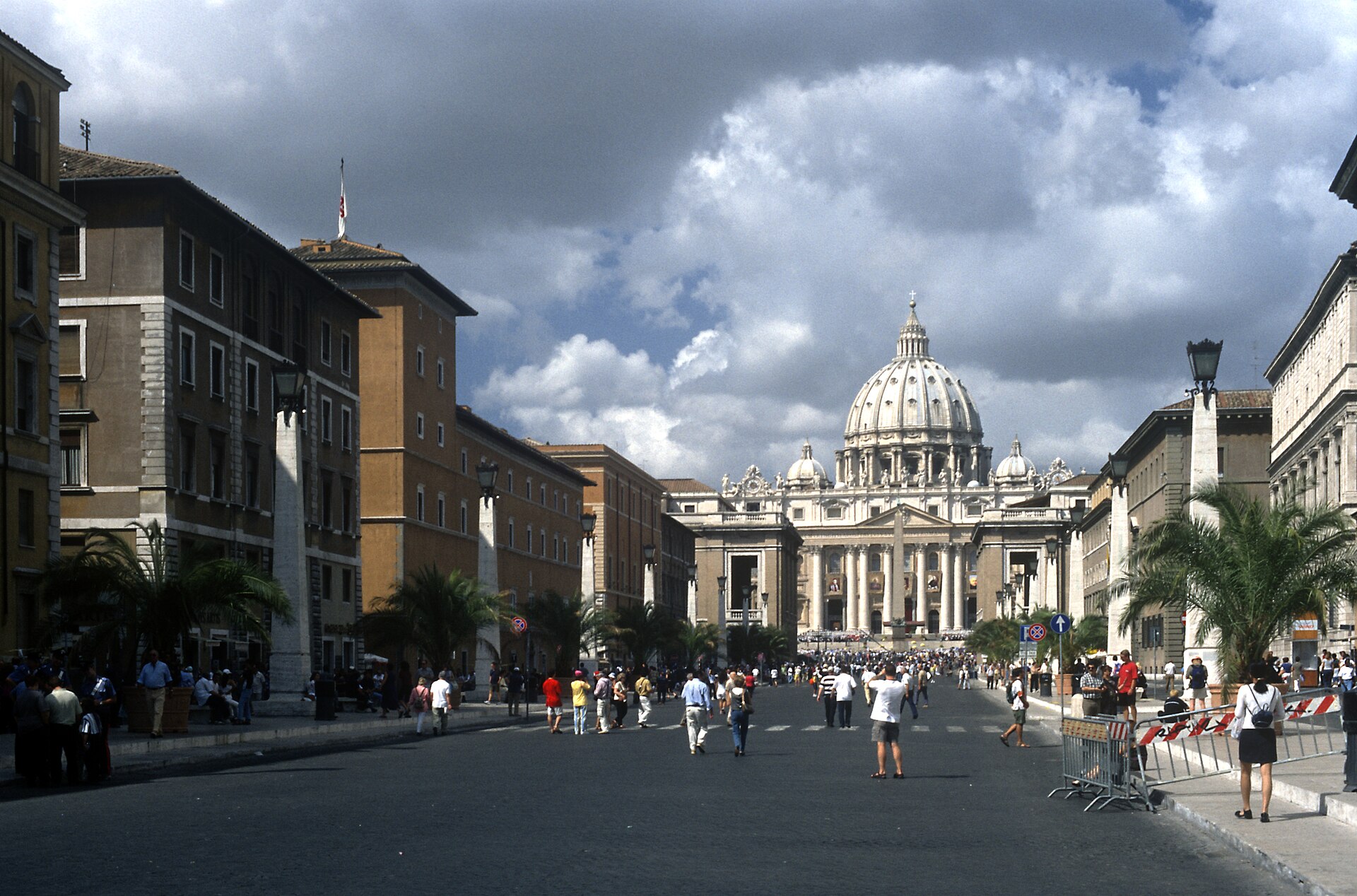
Via della Conciliazione
About the Object
Marcello Piacentini, Attilio Spaccarelli
1950
Rationalism
Via della Conciliazione, Roma
Street
Gallery (3)

The Street That Should Not Have Been
If you walk to St. Peter's Basilica on foot from the Tiber, you walk along it - a wide, straight avenue ending at the dome. It seems it has always been this way: majestic, solemn, the dome visible from afar and growing as you approach. It has not always been this way. And, if we are to believe Bernini, it was not supposed to be this way at all. To begin with, look at what stood here. Between the river and the square lay a dense medieval quarter - the Borgo, and right through its middle ran a narrow wedge of houses that the Romans called the Spina, the "spine." On both sides of it were two cramped streets, Borgo Vecchio and Borgo Nuovo, crooked, dark, built up over centuries. And this was Bernini's intention when he built his colonnade in the 1650s. The pilgrim would make his way through the alleys, seeing nothing, and suddenly, stepping out of the confinement, find himself in a colossal square where the arms of the colonnade embraced him, and ahead the cathedral rose up. The impact was calculated: darkness and confinement first, then sudden expansiveness. Bernini even planned a third section of the colonnade that would have enclosed the square from the front and made this exit from the darkness even sharper. He did not have time to build it - his patron, Pope Alexander VII, died, and the square remained open on this side. Now about what happened next. In 1929, Italy and the Vatican signed the Lateran Pacts and made peace after sixty years of hostility. Making peace is conciliazione in Italian. Hence the name of the street. On October 29, 1936, Mussolini symbolically struck the first house with a pickaxe. Demolition continued for twelve months. The Spina was entirely demolished; several churches and palaces disappeared, part of them were dismantled and reassembled along the sides of the new street. The residents of the Borgo were evacuated - not to the neighborhood, but to new settlements on the outskirts, the borgate. The street was designed by Marcello Piacentini and Attilio Spaccarelli. It was opened for the Jubilee year of 1950. What came of it you can see for yourselves. The dome of the cathedral is now visible from the bridge, from a kilometer away. Majestic. And the effect for which Bernini built his colonnade has vanished forever: there is nowhere left to emerge from the darkness, the expanse begins half a kilometer before the square and therefore fails to amaze. Architectural historian Jean-François Lejeune classifies this street among "radical and extremely problematic" urban renewal operations - on a par with the demolitions for the Via dei Fori Imperiali by the Colosseum. And he also notes something unsettling: for Piacentini this was his main and most contested work, and at the same time the work that he calmly brought to completion AFTER the fall of the regime under which he had begun it. The architect who built for Mussolini was supported by the Vatican and the young politician Giulio Andreotti, Pier Luigi Nervi vouched for him, and Piacentini not only survived but once again became the dean of the faculty of architecture. There is a surviving photograph: Polish soldiers stand on the dome of the cathedral and look down at the construction. The Spina is gone, work is underway in its place. April 27, 1946 - the war ended a year ago, the regime that began the demolition is completely gone, and the street continues to be built toward the jubilee. Everyone is free to judge it for themselves. Some will say the street should have been cut through long ago: it was impossible to get close to the main temple of the Catholic world. Others will say they demolished a living neighborhood and killed the best architectural effect in Europe for a postcard view. I think the most honest thing is to keep both thoughts in mind at once and not choose. But what you definitely should not do is walk along it and think it has always been this way.
AI translation · 🇬🇧 EN
📷 Wikimedia Commons · Pietro Canton · Public domain · https://commons.wikimedia.org/wiki/File:Demolition_of_the_Spina_di_Borgo_1.jpg
📷 Wikimedia Commons · Benon Tuszyński · Public domain · https://commons.wikimedia.org/wiki/File:Polish_II_Corps_(79)_-_1946-04-27_-_Rome.jpg
Rate this review:
Nearby and related
By the same architect
Close by in Rome
About the Object
Marcello Piacentini, Attilio Spaccarelli
1950
Rationalism
Via della Conciliazione, Roma
Street