
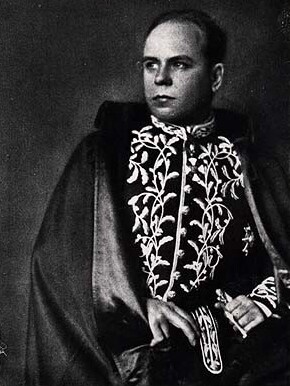
Marcello Piacentini
About the Object
Marcello Piacentini
1881
Other
Via della Conciliazione, Roma
Historic Personality
Gallery (1)

The Regime's Chief Architect, Who Outlived the Regime
The street you are standing on is his masterwork. And his most controversial. Marcello Piacentini lived from 1881 to 1960, and urban planner Daniel Solomon, whose essay is included in Jean-François Lejeune's collection, calls him straight out: the dominant figure in the construction of modern Rome. An architect of versatile talent, simultaneously a modernist and a classicist, who knew how to think at the scale of a city and handle an individual building. An important caveat that Solomon makes right away: Piacentini made a name for himself LONG before the Fascists came to power. He was not a creature of the regime - he was an established master to whom the regime gave power. Next comes the part for which this card is worth reading slowly. Solomon puts it this way: perhaps the best decision Mussolini made in his twenty-two years of rule was to entrust Piacentini with major commissions and immense authority over the expansion of Rome. Read that sentence again: it suggests that even a dictatorship can make correct personnel decisions, and that does not make the dictatorship any better. There was a second pillar. A huge role in his rise was played by Margherita Sarfatti - a journalist, art critic, highly influential cultural advisor, and Mussolini’s mistress. She was Jewish. When Italy adopted the racial laws, she had to flee - first to Paris, then to South America; she only returned in 1947. Solomon calls the alliance between a Jewish woman and a rabid antisemitic dictator a paradox that will hardly ever be unraveled. Now, about what Piacentini thought of architecture. In the twenties and thirties, he fought against what he called “transalpine rationalism”: Gropius, Ernst May, Le Corbusier, Mendelsohn were barbarians to him, threatening urban civilization. He feared that the Mediterranean sun would burn through two thousand years of culture via the glass walls of Northern modernism. He sought a “third path” for himself - between 19th-century eclecticism and German experiments: minimalist Nordic classicism, consonant with Roman history. Italy was to become modern without ceasing to be itself. The list of what he did is immense: the 1931 master plan for Rome, the Sapienza University campus, opened on March 31, 1935, the development of Via Veneto, the EUR district, and after the war, the Sports Palace in EUR together with Pier Luigi Nervi. And finally, how this story ended. After the war, Piacentini, in Solomon’s words, was assigned to a special circle of hell reserved for prominent fascists. But his influence did not end: the 1931 master plan, where he was a key author, continued to guide the development of entire neighborhoods and remained in effect until the early sixties. He himself set about restoring the abandoned EUR - and finished Via della Conciliazione for the 1950 Jubilee year. He was vouched for by the Vatican, young politician Giulio Andreotti, engineer Pier Luigi Nervi, and historian Enrico Calandra. In 1951, he became dean of the Faculty of Architecture once again. Solomon also notes a general truth: many architects who rose under Piacentini and Mussolini continued to work after the war - “through a combination of chicanery, repentance, hypocrisy, and unstoppable talent.” The street beneath your feet is the most direct monument to this combination.
AI translation · 🇬🇧 EN
Rate this review:
Nearby and related
By the same architect
Close by in Rome
About the Object
Marcello Piacentini
1881
Other
Via della Conciliazione, Roma
Historic Personality