
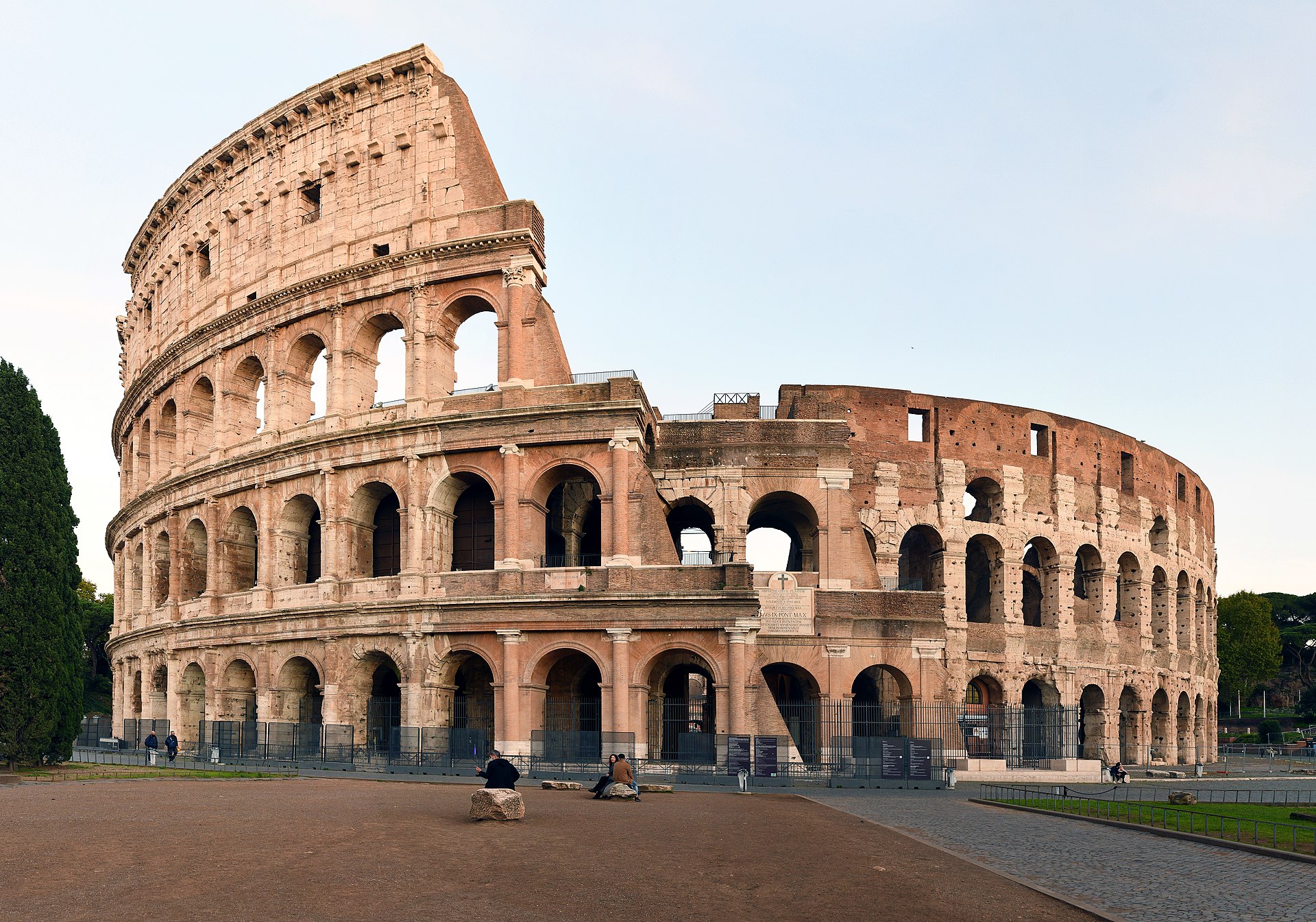
Colosseum (Flavian Amphitheatre)
Всемирное наследие ЮНЕСКОAbout the Object
80
Ancient Roman
Piazza del Colosseo 1, Roma
Public Building
Gallery (1)

The Colosseum: A Gift to the City on the Site of a Hated Emperor’s Lake
You stand before it, and the first thing to understand is that this colossal structure was a political gesture. Just a few years before it appeared, there was a lake here. Following the fire of 64 AD, Nero appropriated the burned-out center of Rome and built his Golden House there—a palace with a park and an artificial reservoir right in the middle of the city. Rome did not forgive this. When Nero committed suicide, and after a year of turmoil Vespasian took power—a soldier and a pragmatist—he made a move that needed no explanation: he drained the imperial lake and put a building for everyone in its place. The location spoke for itself—tyranny was over, and the land was being returned to the people. It was built by Jewish captives. Shortly before this, Vespasian had suppressed the Jewish revolt, and the labor force for the construction came from there. The building erected as a gift to the Roman people was built by people brought to Rome in chains. This is rarely mentioned at the entrance, but it is worth remembering: "bread and circuses" had a flip side, and it is visible right in the masonry. Construction began in 72 AD, and in 80 AD, already under his son Titus, the amphitheater was opened. The opening lasted a hundred days. Sources diverge on how many animals were killed during it: the Greek historian Dio Cassius writes of nine thousand across all the games, while later accounts cite other figures. They agree on one thing—the count was in the thousands. Actually, the name "Colosseum" stuck to it later, and most likely not because of its size. Nearby stood a colossal bronze statue of Nero—the very same colossus. The statue is long gone, but the nickname remained with the building. In antiquity, it was called differently: the Flavian Amphitheater, after the name of the dynasty. Inside, battles went on for almost five hundred years. Gladiators, convicts, and slaves fought each other and beasts, often to the death. Spectators participated: with a handkerchief they begged for mercy, with a lowered finger they demanded the death blow. Survivors often had their throats cut anyway. Seating was strictly by rank. Senators sat on the podium right by the arena, and not even on stone benches: they brought their own chairs. The higher the tier, the lower the social class; at the very top, under the open sky, sat those who were allotted almost nothing in this city. The cross-section of society was inscribed into the cross-section of the building. How many people could fit in here is still debated. Old chronicles name eighty-seven thousand, while modern estimates are more cautious—from fifty to eighty thousand. The discrepancy is easily explained: no one knows for sure how many temporary seats were set up. And one more correction worth keeping in mind when looking at the cross inside. It was erected in memory of Christian martyrs who died in this arena. But later research has not confirmed that martyrs were executed specifically here. The cross stands in a spot that tradition attached retrospectively—and if you think about it, that is also part of the Colosseum's history.
AI translation · 🇬🇧 EN
Rate this review:
Why the Colosseum is still standing: the arch that leans against the next one
Now look at the wall. Three tiers of arches, eighty pieces in each. This is not decoration. This is the structure itself, and it hides an idea that was conceived precisely by the Romans. An arch is a tricky thing. It holds weight, but demands a price in return: it pushes the supports apart. This is called thrust, and it is precisely because of this that a single arch strives to tear its own legs apart. You can only neutralize thrust with a buttress - a mass of masonry, a buttress, something that will take the pressure upon itself. The Romans found a more graceful solution. If you place arches in a row close together, the thrust of each meets the thrust of the neighboring one, and they neutralize each other. In such a row, the supports between the arches work calmly; you only need to prop up the ends. And now the main point: at the Colosseum, the row is closed into an ellipse. It has no ends at all. Each arch leans against the next, and so in a circle - the system closes in on itself and stands without a single buttress. Further down, this same technique was repeated vertically. Three tiers of arcades one above the other, and inside - four more annular corridors with similar arches under the stands. The arch holds the weight of the spectators and the rows overhead, while empty space remains beneath it through which people walk. The building turned out not to be a monolith with cut-out holes, but a framework in which emptiness is a working part. Materials are selected according to the load. The load-bearing skeleton is travertine, hard limestone from Tivoli, hauled from over twenty kilometers away. The vault and foundation are concrete, the Roman mixture that made everything else possible. The hidden walls are brick and volcanic tuff, meaning something lighter and cheaper where it is not visible. About one hundred thousand cubic meters of travertine went into the facade. The blocks were not fastened with mortar - they were stitched together with iron clamps, about three hundred tons of iron in total. Up close, the wall turns out to be full of pits and gouges. This is not erosion. These are the traces of the clamps that were later ripped out. More on this in the third story. Orders on the facade are arranged according to the rule familiar to classical architecture: at the bottom the simplest, towards the top the most ornate. The lower tier is Tuscan, a Roman invention often mistaken for Doric, and this confusion lives on even in guidebooks. The middle is Ionic. The upper is Corinthian, with capitals made of acanthus leaves. Above them is a blank attic wall with Corinthian pilasters. Statues once stood in the arches of the two upper tiers. And finally, the reason for which all this was started. The eighty lower arches were numbered: a Roman numeral is carved above each one. Except for four - two for the emperor and the consul, two for the performers. The spectator found the number on his ticket, entered his arch, climbed his staircase, and came out to his row through an opening called a vomitorium - from the word to vomit, having nothing to do with nausea. Fifty-odd thousand people sat down and dispersed quickly, without a crush. This scheme still works today: any modern stadium is arranged in the exact same way.
AI translation · 🇬🇧 EN
Rate this review:
Half of the Colosseum is missing. It was distributed among Roman palaces
If you walk around the building, something strange becomes apparent: on one side there is a four-tiered wall, and on the other it is simply gone. Roughly half of the outer ring has survived. The question to ask is not what destroyed it, but where it went. The uncomfortable answer is that the Colosseum was taken apart. Not by barbarians and not by time, but by Rome itself. When the empire ended and the games stopped, a mountain of dressed stone remained in the middle of the city - already quarried, already brought in, already processed. In the Middle Ages and especially during the Renaissance, this was a ready-made quarry in the middle of the city - there was no need to break rock in Tivoli, everything lay ready in the center. Travertine and marble were hauled from here for St. Peter's Basilica, Palazzo Venezia, Palazzo Barberini, San Giovanni in Laterano, and Palazzo della Cancelleria. They took it apart not in secret: the popes managed this, and one of them even had a separate cart for it. At the same time, the iron was pried out. Those very three hundred tons of brackets that held the blocks together were expensive and lay in plain sight - they were knocked out of the masonry, and the pits in the walls are left from them. Thus, a building that had stood for centuries was given away in parts over the course of several centuries. This stopped in the middle of the 18th century. In 1749, Pope Benedict XIV declared the Colosseum a sacred place - in memory of the Christian martyrs allegedly killed in the arena. The basis turned out to be a legend: there is no proof that martyrs were executed specifically here. But the legend worked better than any monument protection decree. Stone stopped being taken, and what remained, remained. That is the whole of Rome. A building constructed as a political gesture was later dismantled for other buildings, and saved by a mistake - and now it stands as the main symbol of the city. Half of the Colosseum has not vanished anywhere: it is all around you, in the walls of the cathedrals and palaces that you will walk past this week.
AI translation · 🇬🇧 EN
Rate this review:
Nearby and related
Close by in Rome
About the Object
80
Ancient Roman
Piazza del Colosseo 1, Roma
Public Building
Visitor Information
Ticketed
Morning
Метро Colosseo (линия B). Общий билет с Римским форумом и Палатином