
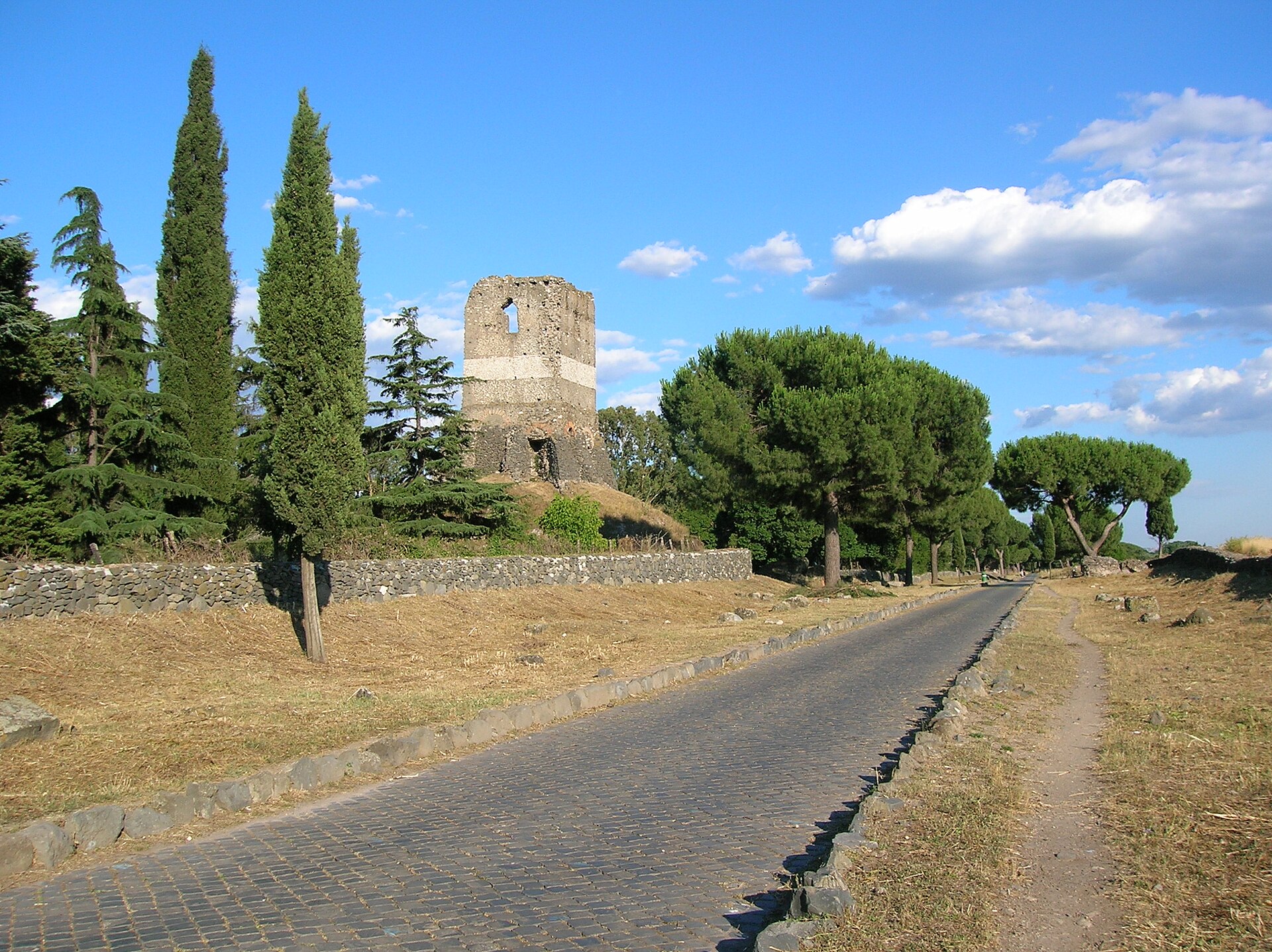
Appian Way (Via Appia Antica)
Всемирное наследие ЮНЕСКОAbout the Object
Appius Claudius Caecus
c. 312 BC
Ancient Roman
Via Appia Antica, Roma
Memorial Place
Gallery (1)

The Appian Way: The First Thing Rome Built as an Empire
Beyond Porta San Sebastiano - right through those gates of the Aurelian Walls - begins a road that is twenty-three hundred years old. It is still paved, and people still walk on it. The first section was built in 312 BC by order of the censor Appius Claudius, whose name the road bears. In 190 it was extended to the ports of Benevento, Taranto, and Brindisi, and the road became Rome's link with its eastern possessions. Everything that went into and out of the empire went this way. It is worth pausing at the paving itself. A Roman road is not just an embankment, but a four-layer structure. At the bottom is a foundation of fist-sized stones. On top of it lies a thick layer of crushed stone with mortar, tamped down to take the load as a whole. Above that is a finer leveling layer - crushed pottery, sand, and lime. And only on top is the surface: near Rome, these are large slabs of basalt, a hard volcanic rock, fitted closely together. Hence its durability - the road works not just by its surface, but through its entire thickness. In books, these layers are usually called by Latin words: statumen - "established", rudus - "rubble", nucleus - "core", summa crusta - "upper crust". The names are beautiful, but with a caveat: Vitruvius uses them to describe the floor structure in a house, and a seventeenth-century scholar applied them to roads. The layers are real, the names are a later habit. And in the slabs, deep grooves are visible - ruts pressed by wagon wheels over centuries of traffic. They are especially visible under the arch of Porta Maggiore, where a section of the ancient pavement has survived. Now about what moved along this road. Dictator Sulla was carried along it for burial in 78 BC, and Emperor Augusta in 14 AD. The arrested Apostle Paul was brought along it to Rome in 56 AD. And along it in 71 BC, Crassus carried out the most terrifying demonstration in Roman history: after the defeat of Spartacus's uprising, about six thousand prisoners were crucified along the road from Capua to Rome. Anyone traveling to the capital rode between crosses for more than one day. Now about why there are so many tombs along the road. Burying inside the city was forbidden, and this ban is ancient: it is recorded even in the Laws of the Twelve Tables - the dead may neither be buried nor burned within the city. The boundary was the pomerium, the sacred line of Rome. Exceptions were made rarely: infants under forty days and special persons - Caesar carved out such a right for himself. The logic was not squeamish, but ritual: the dead caused defilement, not the grave. Therefore, families wanted to keep their dead close - to be able to visit them. And cemeteries grew up right outside the line, along the outbound roads. The Appian Way is lined with tombs for kilometers, and under the fields on both sides lies a giant labyrinth of catacombs - where the first Christian communities buried their dead. Among the Christian sites here is the Church of Domine Quo Vadis, built where, according to legend, Peter, fleeing Rome, met Christ, and the catacombs of San Callisto and San Sebastiano. The most noticeable tomb is that of Cecilia Metella at the third kilometer. A huge stone cylinder built for a noblewoman of whom we know almost nothing: we know that her father and husband were wealthy patricians and successful commanders of the late Republic, and nothing about herself. The monument exists, the person does not. Yet it is known what was done to this monument later. In 1302, Pope Boniface VIII gifted the tomb to his family, the Caetani. They built it into a fortified castle that blocked the Appian Way, and began charging a toll. The ancient tomb of a noble Roman woman turned into a tax collector's booth. You have already recognized the trick if you read the previous cards. The Colosseum was dismantled into palaces, the Pantheon was melted down into a canopy, the pyramid was walled into a wall, and the tomb was adapted into a customs house. In Rome, nothing is lost, but nothing remains itself.
AI translation · 🇬🇧 EN
Rate this review:
Nearby and related
Close by in Rome
About the Object
Appius Claudius Caecus
c. 312 BC
Ancient Roman
Via Appia Antica, Roma
Memorial Place
Visitor Information
Free
Morning
Начинается за воротами Порта Сан-Себастиано. Идти далеко и по древней брусчатке - удобная обувь обязательна; часть пути удобнее на автобусе или велосипеде