
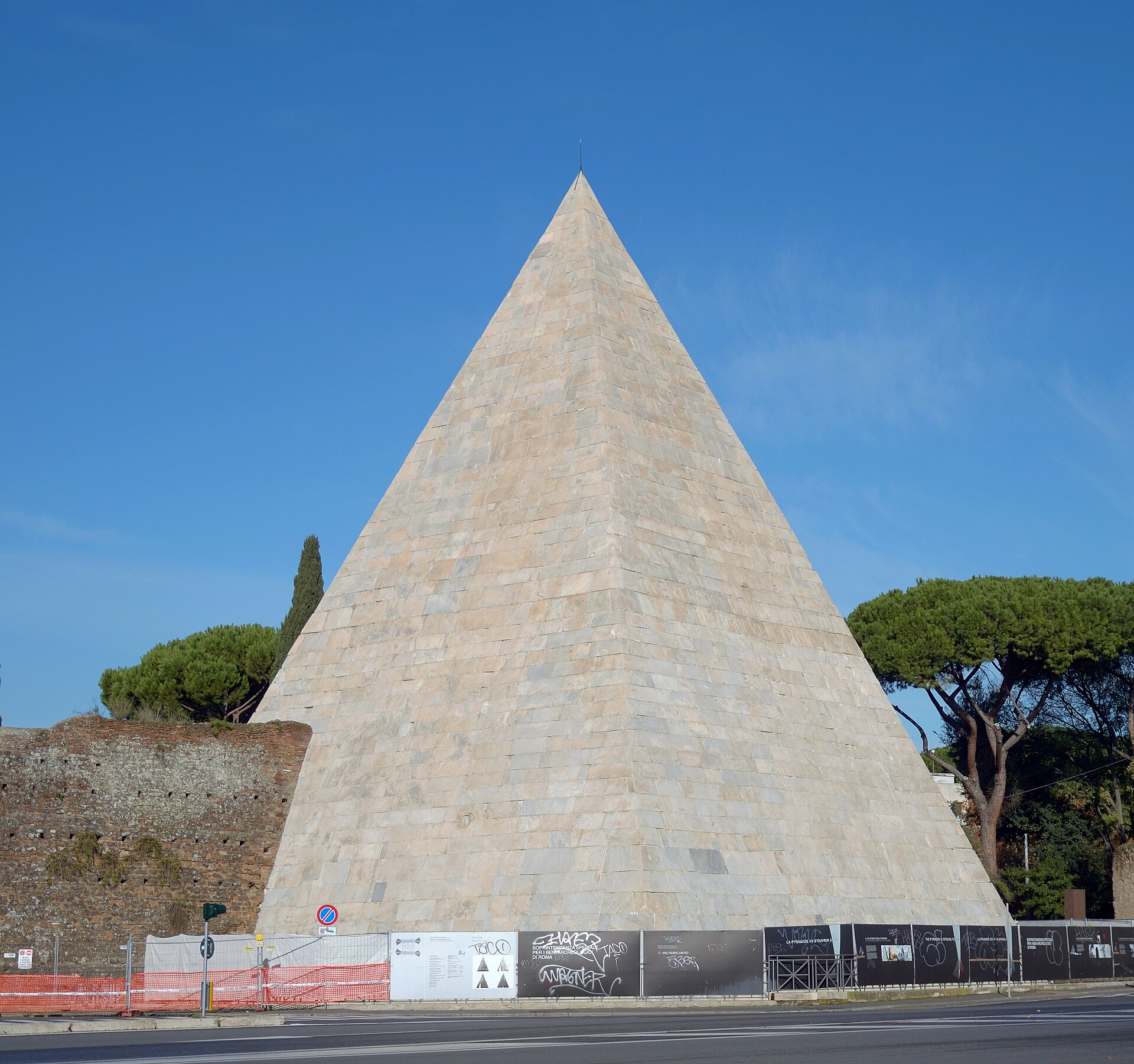
Pyramid of Cestius (Piramide di Caio Cestio)
Всемирное наследие ЮНЕСКОAbout the Object
12 BC
Ancient Roman
Piazzale Ostiense, Roma
Architectural Monument
Gallery (1)
The Pyramid in Rome: A Roman Who Wanted an Egyptian Burial
There is a real pyramid in Rome. Just one. Thirty-six meters of white marble, sharp as a sharpened pencil, built directly into the city wall near the Porta San Paolo. It was built for himself by Gaius Cestius—a wealthy praetor, tribune, and member of the college of septemviri epulonum, who were responsible for organizing festive banquets. He died in 12 BC, and the pyramid is his tomb. According to the inscription on it, it was erected in three hundred and thirty days. Why a pyramid? Because it was fashionable. In 30 BC, Octavian defeated Mark Antony, deposed Cleopatra, and annexed Egypt. Egyptomania swept through Rome: the city flooded with obelisks, sphinxes, and the cult of Isis. For a Roman of the late 1st century BC, a tomb in the shape of a pyramid was a gesture no stranger than ordering a Japanese-style house today. Take a closer look at the proportions—they explain a lot. This pyramid is much sharper than the Egyptian ones: the pyramids of Giza have a gentle slope, whereas this one is almost vertical. The reason is that the model was not Giza, but the Nubian pyramids—those located further south in ancient Meroë, which are indeed elongated upwards. These were the ones the Romans saw and remembered after the conquest. And then came the event that makes this pyramid truly worth seeing together with the wall. Two hundred and eighty years later, Aurelian arrived with his construction project, and the pyramid happened to be right on the line of defense. It was neither demolished nor bypassed—it was integrated. The private tomb of a wealthy official became part of the defensive wall, and that is precisely why it has survived to this day intact: no one would dare dismantle a fortification for stone. Cestius's vanity was saved by Aurelian's paranoia. And finally, the last reason to come here rather than just look from the square. Beneath the wall, right at the foot of the pyramid, lies the Non-Catholic Cemetery—since 1738, this has been the burial place for those not permitted a resting place on consecrated Catholic ground, mostly Englishmen and Germans. In the old section lies the poet John Keats, who died in Rome in 1821; his gravestone bears no name, only the inscription: 'Here lies One whose Name was writ in Water.' Nearby is his friend, the painter Joseph Severn. Not far away are the ashes of Percy Bysshe Shelley, who drowned in 1822, and Goethe's son, Julius. It turns out to be a quiet corner where everything is made of borrowed elements: an Egyptian form over Roman ashes, English poets beneath a Roman wall. A very Roman place, even though there is seemingly nothing Roman about it.
AI translation · 🇬🇧 EN
Rate this review:
Nearby and related
Close by in Rome
About the Object
12 BC
Ancient Roman
Piazzale Ostiense, Roma
Architectural Monument
Visitor Information
Free
Anytime
Снаружи видна с Пьяццале Остиенсе в любое время, метро Piramide. Внутрь - только по записи, в дни специальных открытий. Рядом некатолическое кладбище с могилами Китса и Шелли