
Baths of Caracalla (Terme di Caracalla)
Всемирное наследие ЮНЕСКОAbout the Object
217
Ancient Roman
Viale delle Terme di Caracalla 52, Roma
Public Building
Gallery (2)

Baths of Caracalla: A Roman’s Day, Room by Room
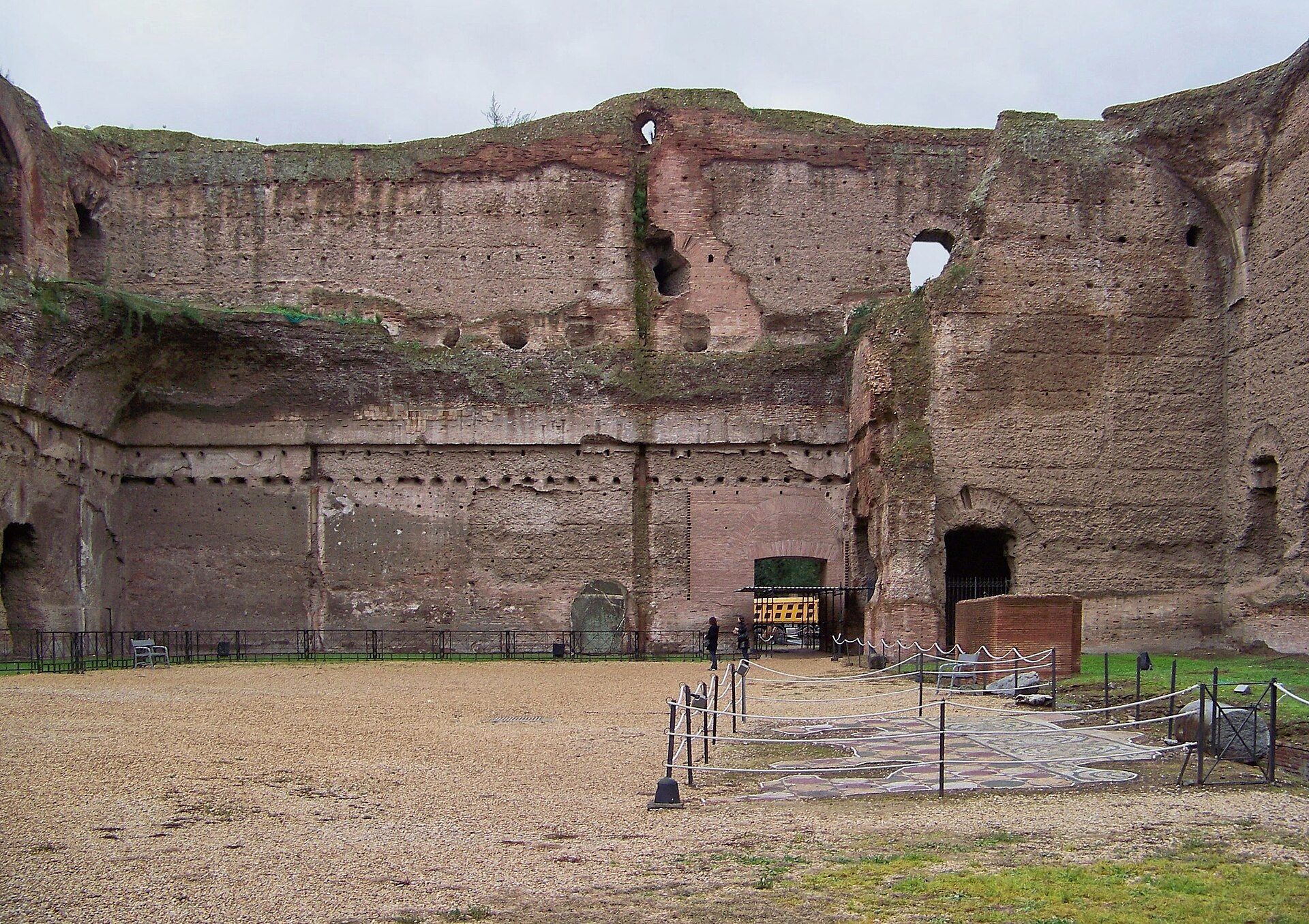
Forget the word “bathhouse.” This place could hold more than sixteen hundred people at once, and the complex occupied a plot of roughly three hundred thirty by three hundred thirty meters. Aside from the baths themselves, there were exercise halls, gardens, a library, art galleries, lecture rooms, and food and drink stalls. It was an urban leisure center where people came to spend the entire day, and bathing made up barely half of it. Caracalla ordered construction to begin in 212, and they opened in 217. Afterward, the baths operated for about three hundred years—until the aqueducts feeding them were cut during the Gothic invasion. The building wasn’t destroyed. It was simply left without water, and that was enough. Let’s walk through the rooms in the order a Roman would have. It started with the apodyterium, the changing room. From there, they went to the laconicum, a dry sweating room like a Turkish bath, to work up a sweat. Then came the caldarium: a hot bath in a bronze basin. After that came the most unusual part for us: scraping the body. There was no soap in the modern sense; dirt and dead skin were removed with a curved scraper called a strigil. Next was the tepidarium, warm water, and after that—the frigidarium, an indoor ice-cold pool you had to plunge into. They finished with a swim in the open-air pool, the natatio. This whole sequence required heating, and it was hidden right underfoot: hot air circulated below, beneath the floors, distributing warmth through the halls. The floor in the caldarium was literally hot. It’s also worth stepping into the palaestrae, the wrestling halls. Broken mosaics depicting athletes lean against the walls, and from the main space open rooms where wrestlers were rubbed with oil and wax before a match to make their skin more pliable, and then dusted with powder so their opponent could grip them. That is precisely what is worth imagining as you stand in the empty brick halls: not a ruin, but a place where fifteen hundred people simultaneously sweated, swam, wrestled, read, and traded.
AI translation · 🇬🇧 EN
📷 Wikimedia Commons · Ethan Doyle White · CC BY-SA 4.0 · https://commons.wikimedia.org/wiki/File:Baths_of_Caracalla%2C_facing_Caldarium.jpg
Rate this review:
The Baths that split into three cities—and are still working
The baths stopped being baths in 537 when the Goths destroyed the Roman aqueducts. Yet they have somehow failed to cease existing to this day. Let’s start with the most non-obvious aspect: the structure. To roof halls of such width, the Romans developed a system of vaults resting on massive piers here: a central space under a groin vault, lower side halls taking the thrust, and a row of windows above. Exactly this scheme would be adopted a hundred years later for the Basilica of Maxentius—a civic hall built from the blueprints of a bathhouse. And twelve centuries later, Bramante and Michelangelo would come to measure the Basilica of Maxentius while working on St. Peter's Basilica. The lineage stretches right from here: baths — basilica — the main church of the Christian world. Next, the contents were scattered. During excavations here, two famous sculptures were found—the Farnese Bull and the Farnese Hercules. They are no longer in Rome: both moved to Naples, into the Farnese collection, and now stand there in the Archaeological Museum. The Farnese Bull is the largest sculptural group surviving from antiquity. And that very floor mosaic with life-sized athletes, which used to be right here, is now in the Vatican, in the Gregorian Profane Museum. One building, three cities. And the most enduring part. In 1960, when Rome hosted the Olympics, gymnastics competitions were held in the ancient palaestra—right where wrestlers used to be dusted with powder. One thousand seven hundred and forty-three years later, the hall for athletes was used as a hall for athletes once again. And every summer, an opera and ballet festival takes place in the baths. The ruins function as an open-air theater, and tickets for them sell out. So, as you leave, don't think of these walls as dead. A building that was deprived of water a millennium and a half ago is still distributing itself in pieces: its structure to cathedrals, its sculpture to Naples, its mosaic to the Vatican, its arena to Olympians and opera singers. In Rome, that’s just normal.
AI translation · 🇬🇧 EN
Rate this review:
Nearby and related
Close by in Rome
About the Object
217
Ancient Roman
Viale delle Terme di Caracalla 52, Roma
Public Building
Visitor Information
Ticketed
Morning
Метро Circo Massimo. Территория ровная и просторная. Летом на руинах идёт оперный фестиваль