
Museum of Friendship of the Peoples of the USSR (Olympic Glory Museum)
About the Object
V. Ganiev (author of the project), S. Adylov (chief architect of Tashkent); the design derives from N. Zaidov's unbuilt museum project for Jizzakh; interior paintings (early 1980s) by Vladimir Burmakin and Ruzy Charyev
1976
Modernism
Проспект Шарафа Рашидова, 4а (в 1976 году - проспект Ленина, на пересечении с проспектом 50-летия УзССР, ныне улица Абдуллы Кадыри), Ташкент
Museum
Gallery (1)
Ring on the Hill: The Museum Renamed Just Before Opening
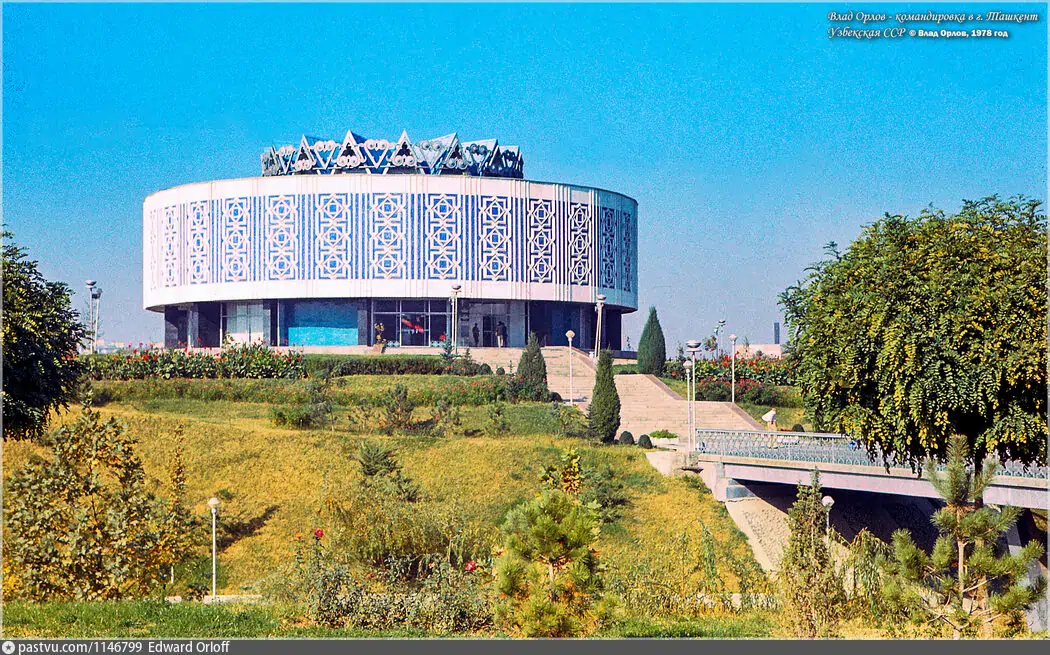
In the autumn of 1975, it turned out that half a year remained until the tenth anniversary of the earthquake, and there was no memorial site in the city. There was no longer any time for major construction, so they decided to erect a sculptural monument and landscape five hectares around it. The site was chosen on the embankment of the Anhor Canal, between Lenin Avenue and the 50th Anniversary of the UzSSR Avenue, which is on the site of the former Kashgar mahalla, beneath which lay the epicenter. By 1975, there was a vacant lot and a dump left over from the clearing of rubble and the construction of surrounding microdistricts. Already in the course of work, a building was added to the monument. The formula "monument plus museum" was so familiar for the USSR that it seemed self-evident, and a museum of the history of the restoration of Tashkent was placed on the hill above the monument. There was no time for development, and a ready-made project was taken as the basis - developed at Tashgenplan and already approved in the Central Committee of the republic, but never built, the museum of the 1916 uprising in Jizzakh. There, the building was a flat puck on a glazed stylobate of a smaller diameter, covered along its entire circumference with an ornament of large eight-pointed stars. The Jizzakh project, in turn, went back to the Wedding Palace in Alma-Ata in 1971, the drawings of which Tashkent architects had brought from a business trip shortly before. The shape of a circle turned out to be convenient because it is easily filled with any meaning. In 1982, it was written about directly: the museum building resembles a wide ring inlaid with national ornament, and this shape was not chosen by chance - remember the Olympic symbol, it also consists of rings; the ring-shaped form symbolizes friendship, cohesion, dedication. Fourteen years later, the building will become the Museum of Olympic Glory, and the ring will fit there too. The Tashkent version differed from the Jizzakh one in that it was crowned with a "crown" with overhead decorative elements. The facades, as a magazine wrote in 1977, are inlaid with national ornament - white on blue. They built without an approved project and without an estimate: expenses were practically unlimited, and all construction organizations in the city were ordered to cooperate. The general contractor was the Vysotstroy trust, and the frame was erected by Gidroenergostroy. Gray stone was allocated by Uzbekmarmur, which caused a shortage of stone for the metro construction, and the opening of the first, Chilanzar line had to be postponed for several months. Red and black stone was brought from Ukraine, as there was none suitable in Uzbekistan. Literally on the eve of the opening, the museum was renamed and partly repurposed. Instead of the Museum of the History of the Restoration of Tashkent, it became the Museum of Friendship of Peoples of the USSR - this better met the tasks of the republic's leadership, especially since Sharaf Rashidov oversaw the ideological direction of "international friendship of peoples" in the USSR. The exposition was finalized at the last moment: materials from earlier periods that had nothing to do with the earthquake were added to the sections on the assistance of the union republics after 1966. The opening was planned for April 26, 1976, exactly on the anniversary. It took place almost a month later, on May 20, and this was a decision rather than a delay: in those days, the 4th International Film Festival of Asian, African and Latin American countries was taking place in Tashkent, and the opening took place in the presence of dozens of foreign delegations. The next day, May 21, Rashidov presented awards to the builders invited to the grand opening; at the same time, sculptor Dmitry Ryabichev was awarded the title of People's Artist of the Uzbek SSR. Further, the building changed its content two more times. In the early 1980s, the interior received carved ganch ceilings and perimeter wall paintings on the theme "We are strong with Lenin's friendship of peoples" - the work of Vladimir Burmakin and Ruza Charyyev. After the collapse of the USSR, national cultural centers were housed in the building. And in 1996, for the fifth anniversary of Uzbekistan's independence, the museum was repurposed once again - into the Museum of Olympic Glory, modeled after the Lausanne one.
AI translation · 🇬🇧 EN
Rate this review:
Who is the author: three sources, three answers
The authorship of this building is a story that says a lot about how authors were credited in the USSR. First version - contemporary to the building. In 1977, a republican architectural magazine published a spread with a photograph of the complex and a caption stating: the complex was created by a creative team led by Honored Artist of the RSFSR, Honored Art Worker of the Uzbek SSR D. B. Ryabichev and USSR State Prize laureate, Chief Architect of Tashkent S. R. Adilov. Two people, both with a full set of titles, both leaders. There is no one else in the caption. Second version - five years later. In 1982, the book "Architect and Time" was published in Tashkent, entirely dedicated to Sabir Adilov. And there the list of authors is different: architects S. Adilov and V. Ganiev, sculptors D. Ryabichev and Yu. Tursunov. That is, in a book about Adilov himself, a second architect appeared next to him for the first time. Third version - the latest and most detailed. According to the research of architectural historians, based on interviews with Valery Ganiev himself, the design of the territory within Tashgenplan was entrusted specifically to him - a twenty-seven-year-old architect. His first idea was an almost Suprematist composition: a black granite cube as a symbol of the split earth and a museum building with a golden ring soaring above it as a symbol of friendship that conquered the elements. The clients did not accept such laconicism: more illustration and more national features were required. The answer that Ganiev remembered and later retold went like this: the leadership loves grilles and the color blue. It is impossible to fully cross-check these three versions against each other, but some of their discrepancies are visible anyway. In 1975, Ganiev had neither titles nor a name, and he did not make it into the 1977 caption. He made it into the 1982 book when the building was already standing, and the question of whose it was became a matter of history rather than reporting. And only forty odd years later did he tell how it all happened in the first person. Another plot of the same kind is the award. It is believed that the authors received an award for the complex in 1979, and this is true, but the award was not the one usually mentioned. The 1982 book, published three years after the award, formulates it unequivocally: for the creation of the "Courage" monument complex, its authors were awarded the 1979 USSR Lenin Komsomol Prize. This is a Komsomol prize, not a Lenin prize, and the difference in the Soviet award hierarchy was significant.
AI translation · 🇬🇧 EN
Rate this review:
Nearby and related
By the same architect
Close by in Tashkent
About the Object
V. Ganiev (author of the project), S. Adylov (chief architect of Tashkent); the design derives from N. Zaidov's unbuilt museum project for Jizzakh; interior paintings (early 1980s) by Vladimir Burmakin and Ruzy Charyev
1976
Modernism
Проспект Шарафа Рашидова, 4а (в 1976 году - проспект Ленина, на пересечении с проспектом 50-летия УзССР, ныне улица Абдуллы Кадыри), Ташкент
Museum