
Republican Puppet Theatre
About the Object
V. V. Kuzlyanov, with I. G. Zatserkovnaya, S. Yu. Askarova, S. Sabirova; engineers M. Fedosov, S. Zharikov
1979
National Style
Проспект Космонавтов, 1, Ташкент
Theater
Gallery (1)

Puppet Theater: A Fairy Tale Gifted to Children
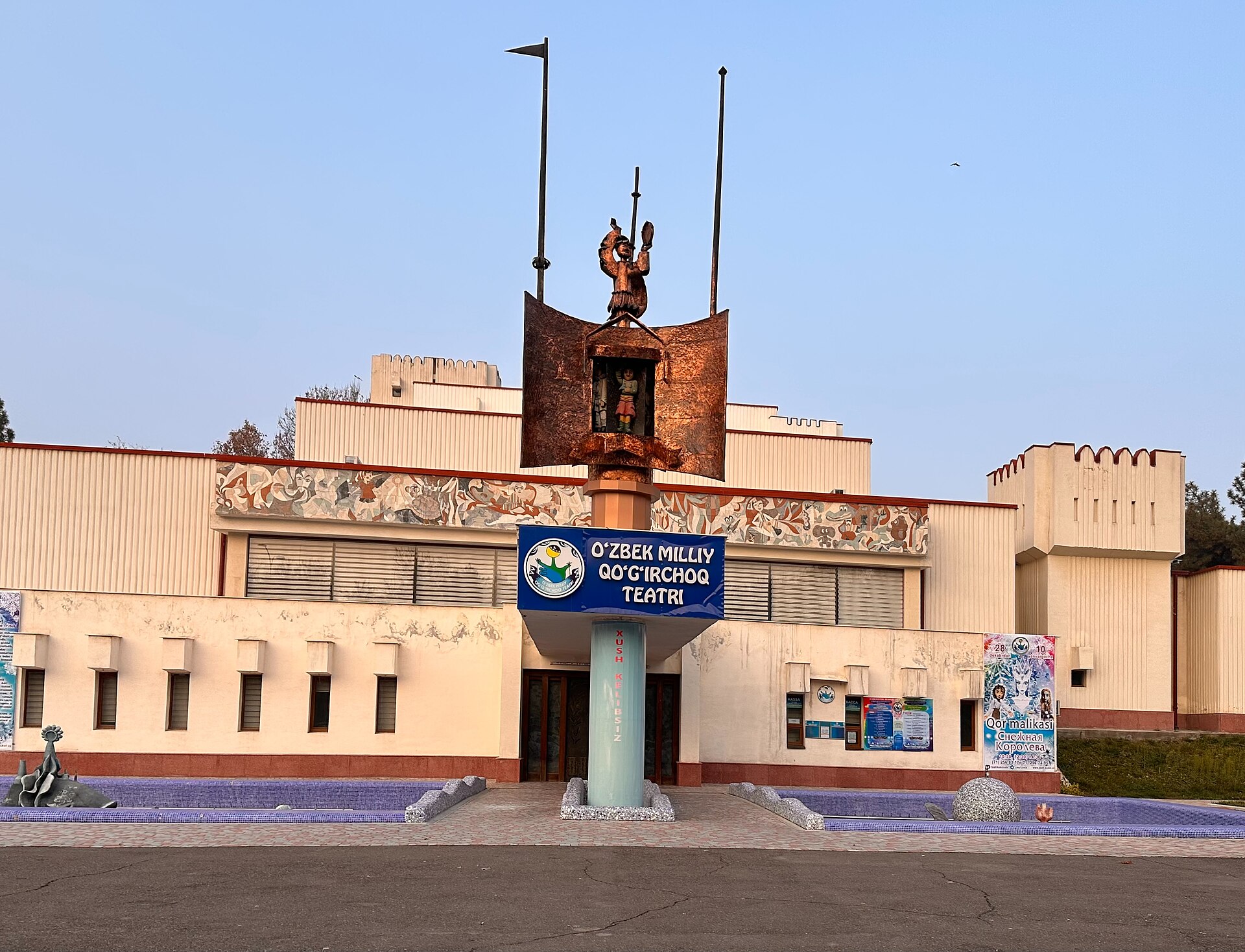
You are standing before a building with towers, battlements, and narrow vertical windows resembling arrowslits, across a bridge over a moat. The Republican Puppet Theater opened here on October 25, 1979, and the magazine "Architecture and Construction of Uzbekistan" titled its article about it back then "A Fairy Tale Gifted to Children." Prior to this, the theater had operated for decades in a dilapidated former house kitchen building, performing shows in a tiny, stuffy hall. The city executive committee made the decision to build a new premises back in 1968, but it - as delicately stated in that same article - fizzled out, and years of neglect ensued. The authors of the article compared what happened to the story of Cinderella, and judging by the description of the former conditions, without much exaggeration. A date came to the rescue. The year 1979 was declared the International Year of the Child, and Tashkent decided to host a festival of puppet theaters from Asian countries - delegations arrived from Vietnam, Laos, Bangladesh, Japan, the Philippines, and Turkey, along with troupes from Mongolia, Azerbaijan, Armenia, Georgia, Kazakhstan, Kyrgyzstan, and Bashkortostan. The building was constructed for the festival: they started in August 1978 and finished in October 1979. Just over a year for the theater. It was designed by architect V. V. Kuzlyanov with a small group of co-authors. The result was not a theater in the usual sense, but something between a fairy-tale castle and a fortress: a bridge across the moat, towers with arrowslits, battlements, and vertical wall rustication. A copper figure of the fair barker Palvan Kachal - the main character of the Turkic and Iranian world's folk puppet theater - stands here by right: puppeteers in these parts have been working for two thousand years. Architectural historian Boris Chukhovich drew attention to the fact that this castle turned out not to be Disney-esque at all. Rounded trapezoidal merlons, corrugated wall treatment, and narrow window slits refer not to Charles Perrault's fairy tales, but to Kushan and Khorezm fortresses: such battlements crowned Central Asian palaces since antiquity, and the corrugated wall originates from the early medieval fortresses of ancient Khorezm. In other words, a home for a very old local art accidentally dressed itself in the forms of the pre-Islamic architecture of these very places. Inside, there is a foyer, a puppet museum, a summer foyer in the form of a courtyard, and an octagonal rehearsal hall. The three-hundred-and-fifty-seat auditorium featured special chairs with a folding element so that an adult and a small child sat at the same level and both could see the stage. In 2019, the building underwent a renovation that noticeably changed the interiors. The facades retained much of their original appearance.
AI translation · 🇬🇧 EN
Rate this review:
Nearby and related
Close by in Tashkent
About the Object
V. V. Kuzlyanov, with I. G. Zatserkovnaya, S. Yu. Askarova, S. Sabirova; engineers M. Fedosov, S. Zharikov
1979
National Style
Проспект Космонавтов, 1, Ташкент
Theater