
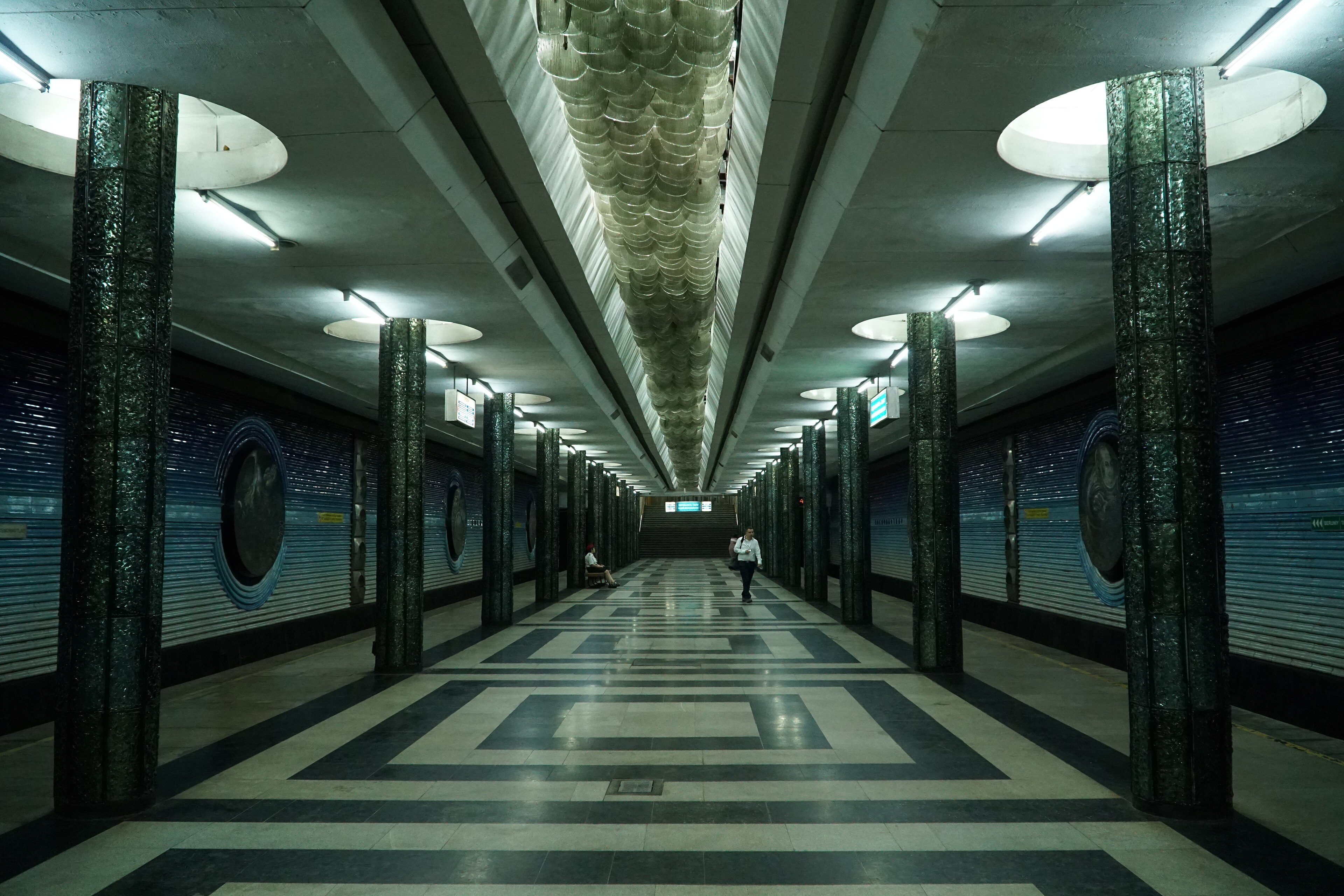
Kosmonavtlar Metro Station
Всемирное наследие ЮНЕСКОAbout the Object
Architects S. M. Sutyagin, S. I. Sokolov, B. Bekbaev; artists A. Kedrin, A. Gan (track-wall composition, the Milky Way light strip)
1984
Modernism
Cosmonauts Square, Yunus Rajabi mahalla, Yakkasaray District, Tashkent, 100000, Uzbekistan
Railway Station
Gallery (3)
Kosmonavtlar Metro Station (Cosmonauts' Avenue)
As you descend into the “Kosmonavtlar” station, prepare for a small intergalactic journey. This project, built between 1981 and 1984, was personally approved by the republic's leader, Sharaf Rashidov. The idea to dedicate the station to space came at a very opportune moment: in 1981, Vladimir Dzhanibekov, a native of Uzbekistan and a cosmonaut, made his second flight. Architects Sergo Sutyagin and S. Sokolov built the concept on a beautiful contrast. Upstairs, in the ground-level vestibules, you are greeted by “sunny Earth” with finishes of warm, light travertine. But once you descend to the platform, you find yourself in the cold, captivating space of the cosmos. By the way, as you walk through the underground passage, take a closer look at the cladding: the rhythm of its pattern is based on the Fibonacci sequence. The main visual feature of the platform is the stunning color gradient on the track walls. Special ceramic elements were manufactured for it, their color smoothly transitioning from soft blue to deep ultramarine. This color stretch creates a complete sense of infinity, dissolving into darkness. Look up: the ceiling is cut by a luminous strip of openwork glass. This is the Milky Way, created by artist Arnold Gan. And the station's vaults are gently supported by round columns of cast glass, effectively illuminated from within. Initially, the architects wanted to use neon and stainless steel, but ultimately chose noble classics: glass, carefully selected marble, and granite. Along the walls are round niche-portholes with frescoes by artist A. Kedrin. They encrypt the entire history of human thought's flight: from the mythical Icarus and the medieval astronomer Ulugbek to Yuri Gagarin. Incidentally, a funny story is associated with these portholes. In early sketches, the authors wanted to make them convex, with a telescopic effect. But the stern engineer-technologists rejected the idea: it turned out that such protrusions would be dangerous due to the swaying of a passing train. As a result, the portholes were made concave into the wall. The “Kosmonavtlar” metro station is a recognized masterpiece. In the late 1980s, Tashkent architects in an anonymous survey unanimously declared it the most beautiful station in the city. And in spring 2024, it rightfully received official status as a protected object of cultural heritage.
AI translation · 🇬🇧 EN
📷 https://ru.wikipedia.org/wiki/%D0%9A%D0%BE%D1%81%D0%BC%D0%BE%D0%BD%D0%B0%D0%B2%D1%82%D0%BB%D0%B0%D1%80#/media/%D0%A4%D0%B0%D0%B9%D0%BB:Kosmonavtlar_Station_of_Tashkent_Metro_6.jpg
📷 https://ru.wikipedia.org/wiki/%D0%9A%D0%BE%D1%81%D0%BC%D0%BE%D0%BD%D0%B0%D0%B2%D1%82%D0%BB%D0%B0%D1%80#/media/%D0%A4%D0%B0%D0%B9%D0%BB:Kosmonavtlar_metro_station_(1)_2023.JPG
Rate this review:
Cosmos Ruled in 1982
The station opened in late 1984, but was described in a magazine two years earlier - in a review of the entire Uzbekistan Line under construction, published in the fifth issue of Architecture and Construction of Uzbekistan for 1982. The description is brief, but it shows how precisely the theme dictated the structure. It begins with engineering. The station is of the column type, but, as the magazine writes, with certain structural changes related to the theme of the architectural solution: an increase in ceiling height and the replacement of square-section reinforced concrete columns with round ones made of metal pipes. That is, they first decided what the station was about, and only then chose what to make the supports from. Next comes a direct formulation of the concept: the swiftness and dynamism characteristic of the space theme formed the basis of the architectural solution. Walls made of bluish-turquoise ceramics are assembled from standard elements that create horizontal articulation and the character of movement with "vortices". The magazine puts the word "vortices" in quotation marks - apparently sensing itself that there is no architectural term for this. In these vortices, the text continues, the theme of stages is depicted: from Ulugh Beg, who studied stellar galaxies, and Icarus, who dreamed of flight, to Yuri Gagarin - the first cosmonaut - and others. And the composition concludes, literally, with "a look into the future of space." The artists are A. Kedrin and A. Gan. About the columns: round, made of cast glass, expanding upward, illuminated by hidden fixtures. About the ceiling: suspended, cut in the center by a light strip made of openwork cast glass by A. Gan, personifying the Milky Way in outer space. All this is the future tense, 1982. Comparing it with what is at the station today, it is easy to see: they built it just as they drew it. For the Uzbekistan Line, this is not always the case - for its other stations, the project and the result diverge - but here the project description reads like a description of the existing station. Except that the "vortices" in quotation marks eventually ceased to need explanation.
AI translation · 🇬🇧 EN
Rate this review:
Stars That Were Initially Drawn Elsewhere
In December 1971, when there were still six years left before the first train of the Tashkent metro, a TASS correspondent described the future first line in 'Pravda Vostoka', station by station, along with their decoration themes. There were many themes: the grandeur of Lenin Square, the solemnity and spaciousness of Revolution Square, the friendship of peoples at 'Dustlik' station, and motifs of peace at 'Tinchlik' station. The stations were supposed to tell - through sculpture, panels, mosaics, frescoes, ornaments, and stained glass - how Tashkent fought for Soviet power, how the industry of Uzbekistan rose, and about the generosity of cotton fields, orchards, and vineyards. And at the end of the list stood a phrase that now reads quite differently: 'And in the Academic City - at the station named after the great astronomer Ulugbek - star lamps will flare up on the blue vault.' That station was not built. The first line did not reach Akademgorodok: its extension to the northeast, toward the tractor plant, remained on paper along with several other names from that list - 'Farhad', 'Mukimi', 'Park of Culture'. The name Ulugbek appeared in the Tashkent metro only in 1992, when the '50 Years of the USSR' station was renamed - and in a completely different part of the city, in Chilanzar. Meanwhile, the star lamps on the blue vault lit up here, at 'Kosmonavtlar Prospekti', in 1984, on a different line, by different authors, and for a different reason. And Ulugbek is present at this station: the astronomer who studied stellar galaxies opens the very sequence on the track walls that leads from him through Icarus to Gagarin. No connection has been established between the 1971 concept and the 1984 station, and there is no need to pretend that one grew out of the other: different lines, different architects, thirteen years between them. But the coincidence is curious. The first idea to make a station about the sky in the Tashkent metro and name it after the Uzbek astronomer appeared even before the first foundation pit was dug. It was realized from another attempt - and judging by the results of the 1987 poll, it was realized better than anything else built in this metro.
AI translation · 🇬🇧 EN
Rate this review:
Nearby and related
By the same architect
Close by in Tashkent
Routes with this object
About the Object
Architects S. M. Sutyagin, S. I. Sokolov, B. Bekbaev; artists A. Kedrin, A. Gan (track-wall composition, the Milky Way light strip)
1984
Modernism
Cosmonauts Square, Yunus Rajabi mahalla, Yakkasaray District, Tashkent, 100000, Uzbekistan
Railway Station
Visitor Information
$ 0,2
after lunch
