
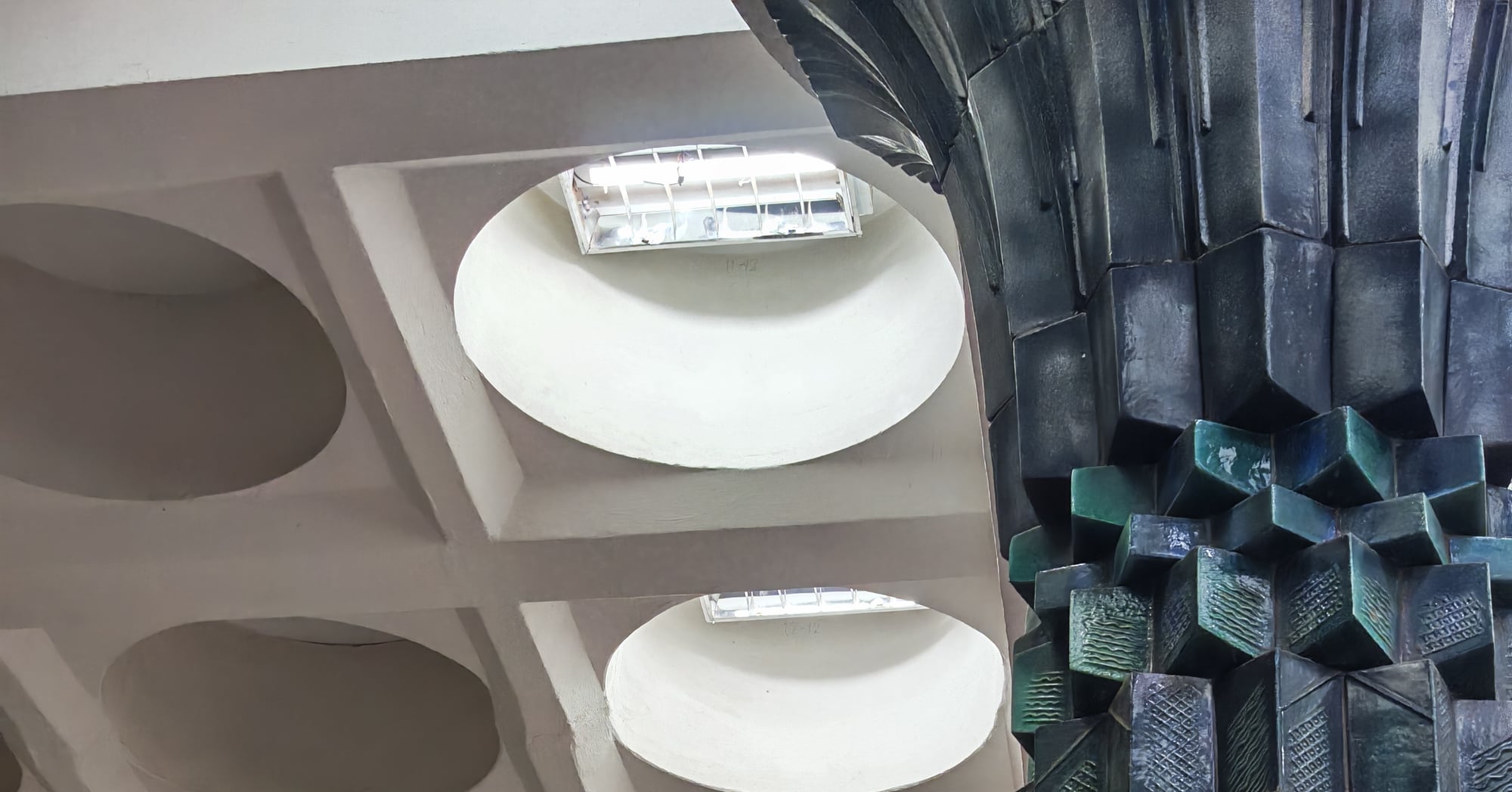
Ten works of Tashkent modernism have been added to the UNESCO World Heritage List. The decision was taken on Sunday, 26 July 2026, at the 48th session of the World Heritage Committee, which runs in Busan from 19 to 29 July. The nomination is called "Tashkent Modernist Architecture: Modernity and Tradition in Central Asia". For Uzbekistan this is the first nomination to receive that status in twenty-five years, and the first time modernist architecture has been inscribed from Central Asia or anywhere in the post-Soviet space.
The nomination covers buildings from the early 1960s to the early 1990s. The nomination text itself calls them an ensemble marking an important stage in the reconstruction and transformation of Tashkent after the 1966 earthquake, and it takes in museums, exhibition halls, housing, cultural institutions, and scientific and infrastructure facilities.
Here are the ten:
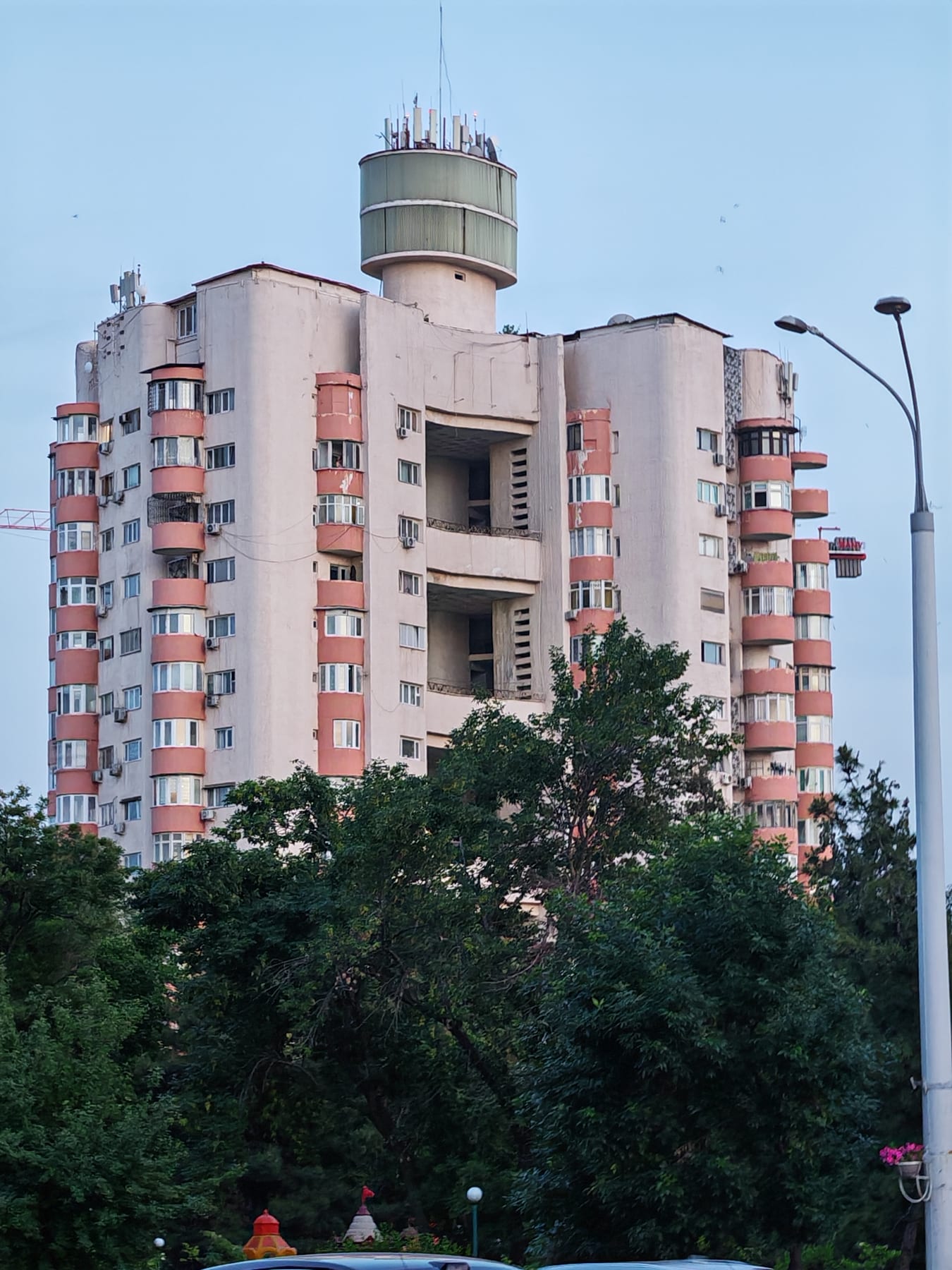
- Pearl residential building, 1975-1985
- State Museum of History of Uzbekistan, 1968-1970
- Palace of the Friendship of Peoples, late 1970s - 1981
- State Museum of Arts of Uzbekistan, 1967-1974
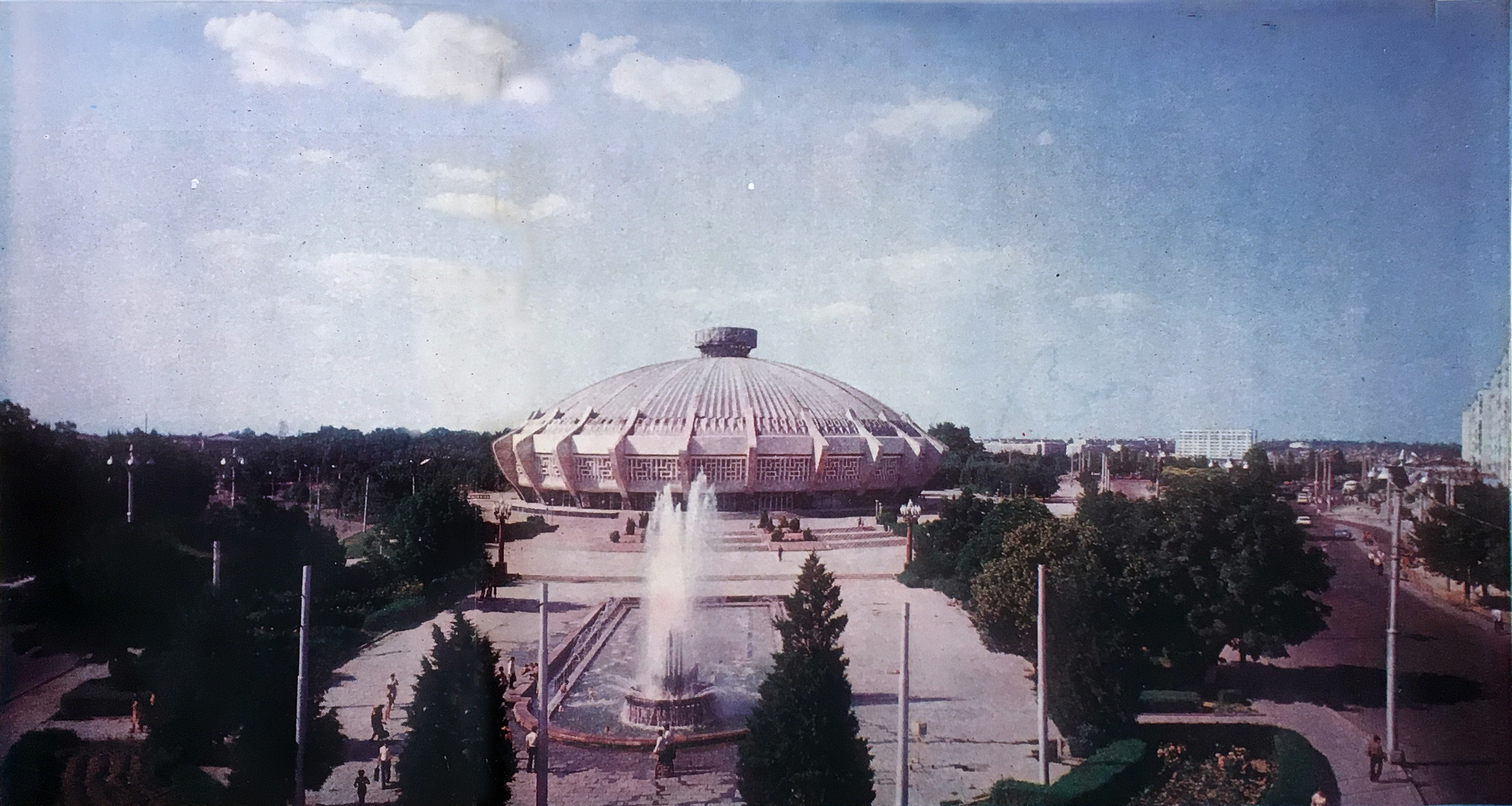
- Tashkent State Circus, 1965-1975
- Central Exhibition Hall of the Academy of Arts, 1972-1974
- Palace of Arts, the Panoramic Cinema, 1962-1964
- Chorsu Market, 1983-1990
- Kosmonavtlar metro station, 1982-1984
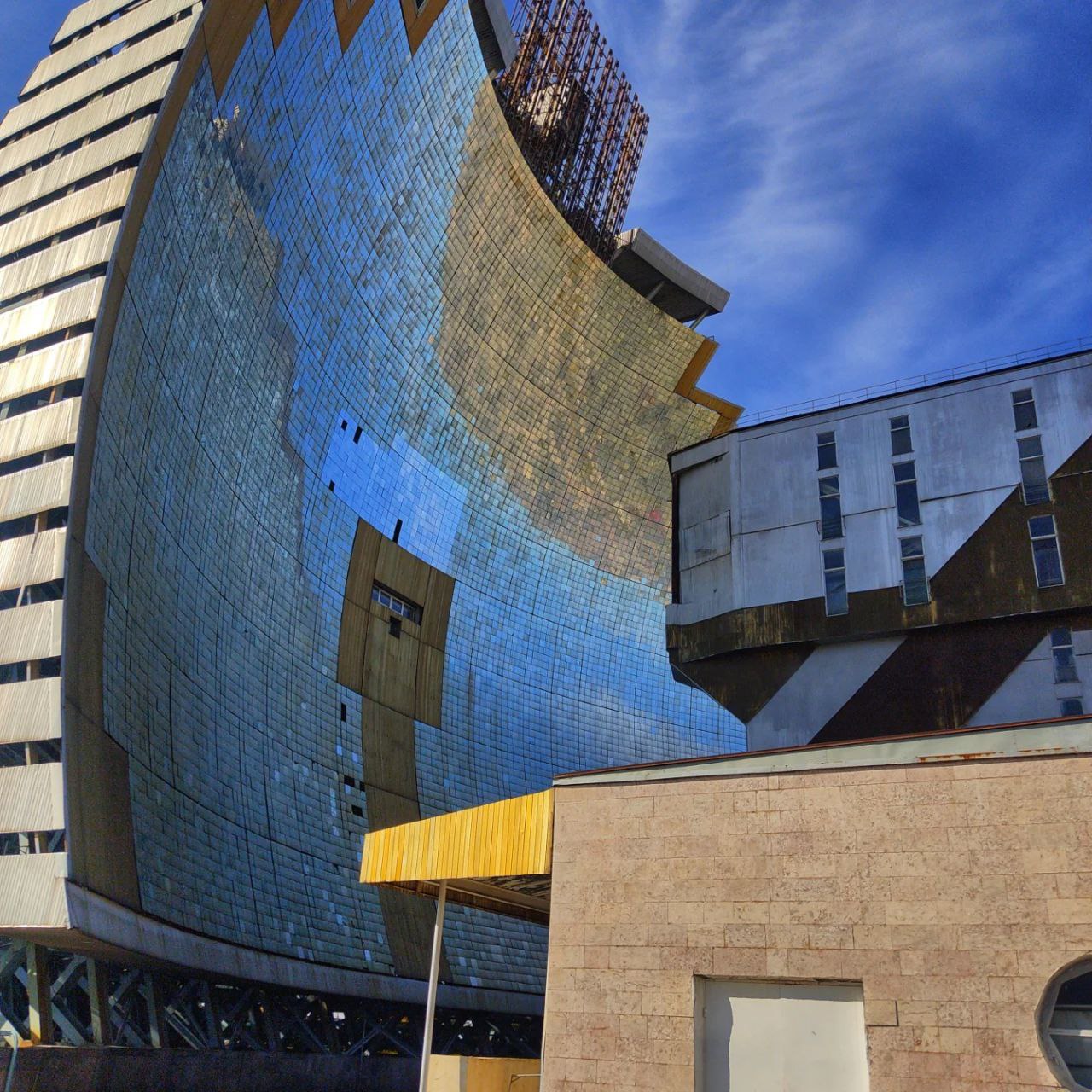
- Sun Heliocomplex, Tashkent Region, 1981-1987
All ten are already open on Archiroutes. Nine were here before; the entry for the Sun Heliocomplex we created today, right after the committee's decision, so that the whole nomination would be on the platform.
Interest in twentieth-century Uzbek architecture has been building for a long time, and largely from outside. Back in 2016 Philipp Meuser published "Seismic Modernism" with DOM publishers, a book about how the earthquake set off a wave of structural invention. For years the heritage has been documented and defended by researchers, and it is hard to do without the name of Boris Chukhovich here: the Alerte Heritage observatory, which spoke up on one demolition after another, is essentially his. In 2025 the Garage Museum's publishing house also brought out his guide "Tashkent: Soviet Modernist Architecture, 1955-1991", written with Olga Kazakova, covering some fifty buildings.
The turning point came when the Art and Culture Development Foundation of Uzbekistan took up the subject. In 2021 the foundation launched the research project Tashkent Modernism XX/XXI, which produced two books in 2025: "Tashkent Modernism XX/XXI" from Lars Muller, edited by Boris Chukhovich, Davide Del Curto and Ekaterina Golovatyuk, and "Tashkent: A Modernist Capital" from Rizzoli. In that same year Uzbekistan showed the material to a wide public for the first time at the 19th Architecture Biennale in Venice: the pavilion in the Arsenale was called "A Matter of Radiance", curated by Ekaterina Golovatyuk and Giacomo Cantoni of GRACE.
 1987
1987Sun Heliocomplex "Solntse" (Big Solar Furnace)
The pavilion was devoted to the Sun Heliocomplex, the solar furnace near Parkent, one of the last great scientific structures built in the USSR. The very one that became a World Heritage property the day before yesterday. A year ago it was shown to Venice as a curiosity on the edge of science and architecture; now it is on the same list as the Taj Mahal.Parkent · NPO «Fizika-Solntse», Academy of Sciences of the UzSSR (design team not established)
What the status actually does
It does not bring money. The World Heritage Fund distributes about three million dollars a year for the entire world, and only on a state's application for a specific piece of work. No line for the upkeep of a property arrives from Paris.
What arrives instead of money is obligations. The state must have a management plan for each property, report on its condition, and allow monitoring. If a property is threatened, UNESCO can move it to the List of World Heritage in Danger, and that is a loud international story no country wants attached to its name.
 1976
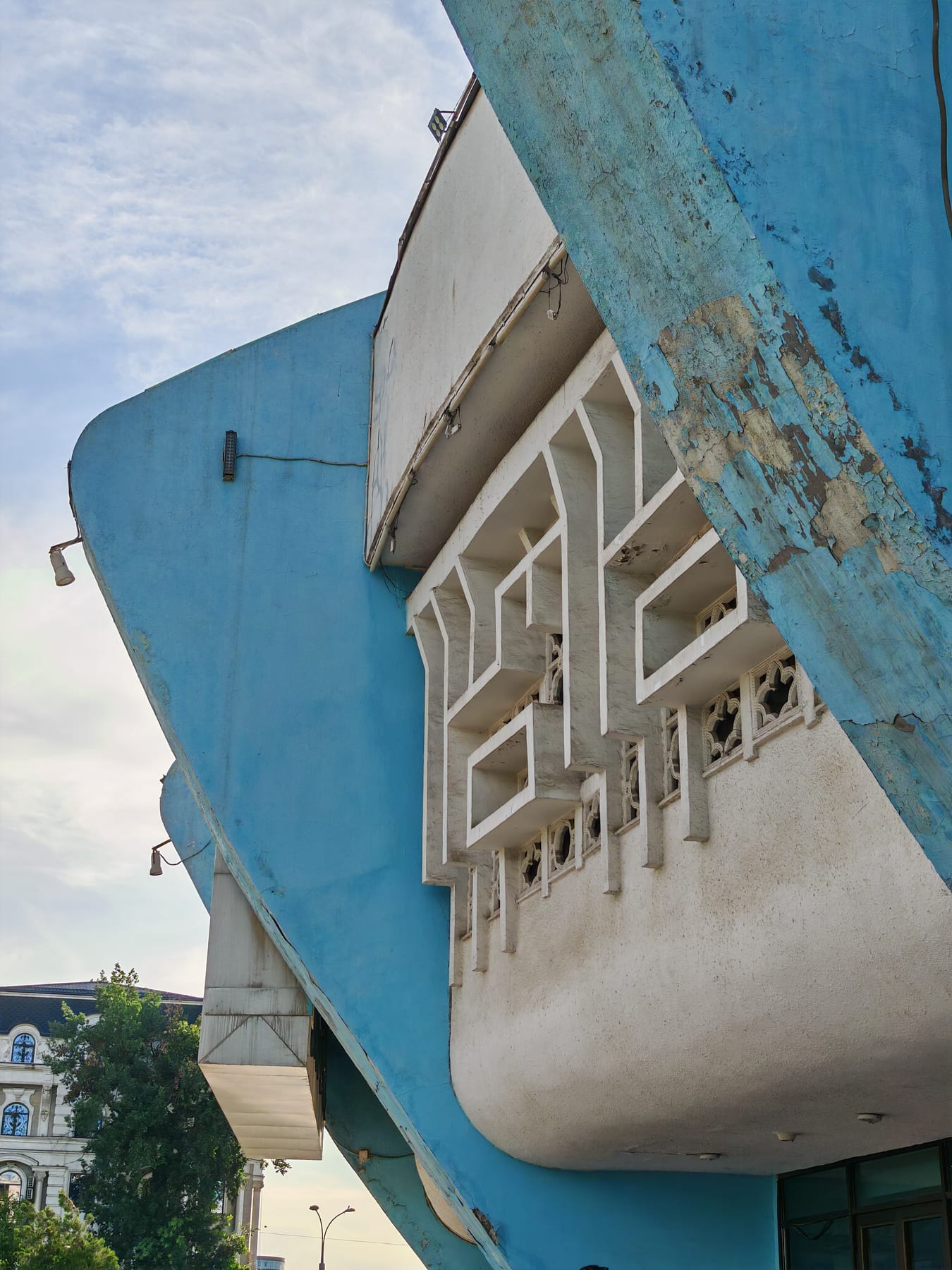
1976Circus
Honestly, I do not think the life of these buildings changes tomorrow. I was at the circus three months ago and its condition is poor: World Heritage status does not repair a roof by itself. But each of the ten now has an argument it did not have before, and that argument has landed with the side that usually loses: the people asking that a building be left alone.Tashkent · Henrikh Aleksandrovich
And the thanks here have an address. Without the initiative of the Art and Culture Development Foundation of Uzbekistan none of it would exist: no research, no books, no Venice, no nomination. This is one of those cases where you can see exactly what one organisation did.
What we have already lost
This subject is close to me. Archiroutes grew out of something simple: while gathering material for a dissertation on the Tashkent mahalla, I kept finding documents, drawings and photographs, and kept realising they could disappear along with the buildings they describe. The platform began as an attempt to hold what I found somewhere it would be seen.
There were many reasons. One of them was the House of Cinema, demolished in Tashkent in December 2017.
The building went up in 1982 for the Tashkent Film Festival of Asian, African and Latin American countries, designed by Rafael Khairutdinov and Viktor Breusenko of Tashgiprogor. Inside were Bakhodir Djalalov's fresco "Messengers of Eternity", stained glass and light fittings by the Gan family of artists, and brass film reels by Robert Avakyan. Demolition began on 2 December 2017 to clear the site for the Tashkent City business district. More than seventy architects, filmmakers and artists signed an appeal to the president asking that the building be worked into the new plan instead of being torn down. The appeal never reached him; it was stopped at the level of the state construction and architecture committee.
And here is the knot of the whole story. The Tashkent Modernism XX/XXI project, which produced the books, the Venice pavilion and ultimately the UNESCO decision of the day before yesterday, was launched by the foundation precisely after the House of Cinema came down. Tashkent's World Heritage was born out of a loss.
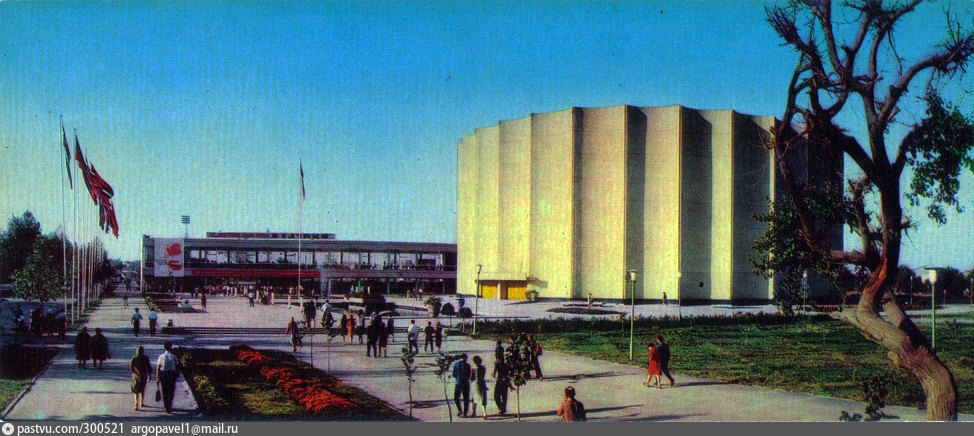 1964
1964“Panoramic” Movie Theater.
That symmetry has a smaller sequel, and a telling one. The Gans, whose stained glass was in the House of Cinema, also worked on the interiors of the Panoramic. One building was demolished; the other was inscribed on the World Heritage List the day before yesterday.Tashkent · Vladimir Berezin, Yuri Khaldeev, Sergo Sutyagin, Dmitry Shuvaev
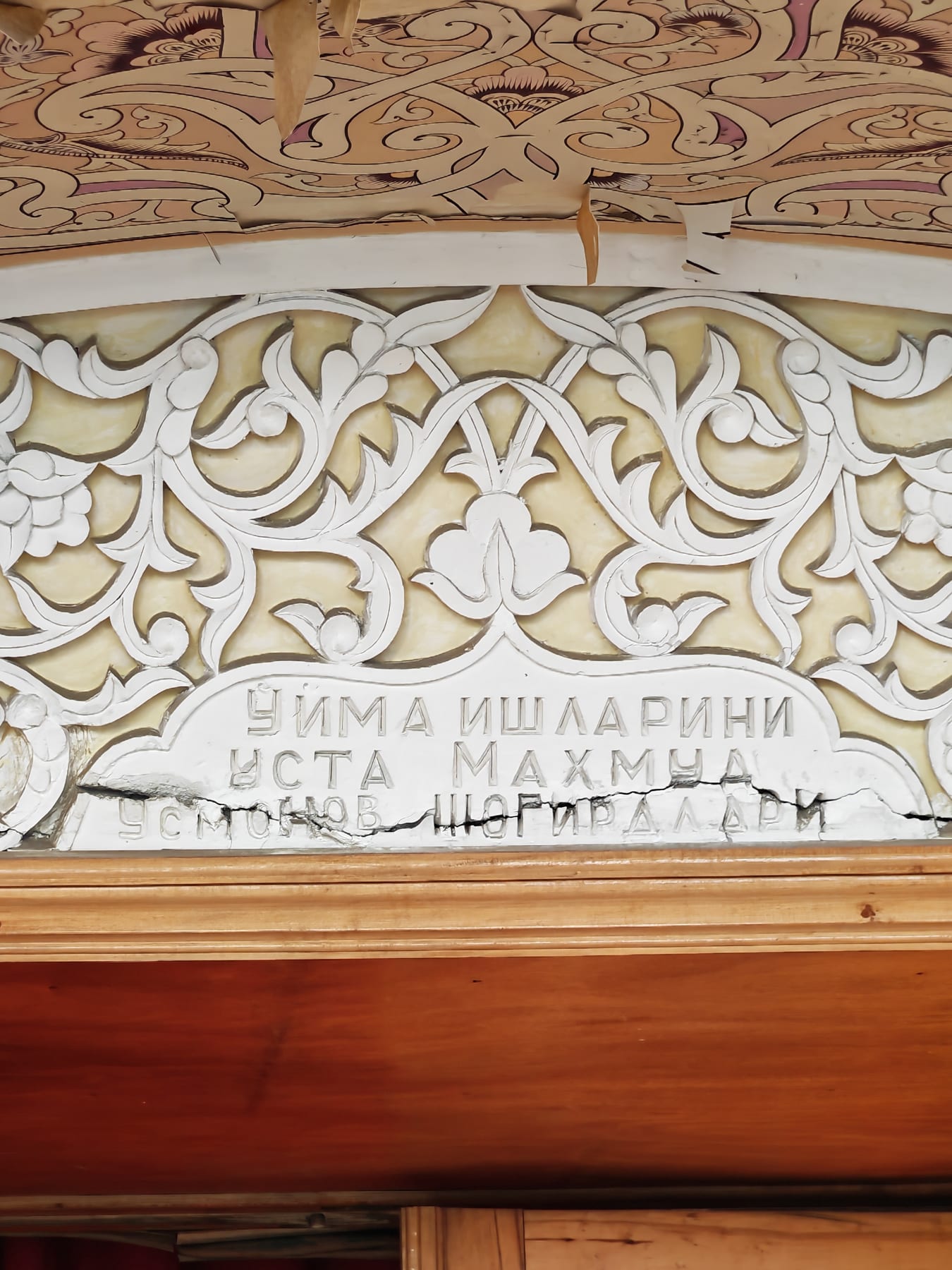
The losses did not stop in 2017. In February 2024 demolition began in the centre of Bukhara for the "Boqiy Buxoro" tourist centre: 29 properties across 32.6 hectares, a budget of roughly 470 million dollars. Among them were the khokimiyat buildings, that is the city and regional administration: a 1970 block and a block from the second half of the 1980s, designed by Richard Bleze and one of the few surviving works of his. This was happening exactly while the country was preparing its modernist programme for Venice.
A separate and almost invisible line of losses is not demolition but renovation. Through the 1990s and 2010s, refurbishing and reconstructing buildings of the 1960s to 1980s, architects reworked their predecessors' buildings to suit new clients. Cladding, glazing and details changed. The building stayed where it was and stopped being itself.
Anyone who walks through central Tashkent has their own list. The horizontal block of the former Council of Ministers, today the Cabinet of Ministers. The Ministries tower with the Iskra cinema attached to it, now marked on maps as the Ministry of Culture. TSUM. On TSUM the Chukhovich and Kazakova guide is blunt: in the independence years it was caught by the general fashion for alucobond and tinted glass. But the same page says something hopeful: those alterations are not fatal, the original cladding and glazing could be restored if anyone wanted to, and inside, the staircases, the floor and the balustrades survive. A building put in new clothes, unlike a demolished one, can still be undressed again.
What follows from this
The ten properties now have one more reason to be left alone. Not a guarantee, not money and not a repair, but a reason and international visibility, and against the record of the past ten years that is noticeably more than nothing.
I would like to believe that conclusions have been drawn from past decisions. And that the next House of Cinema will not have to be remembered in the past tense.
All ten properties of the nomination are open on Archiroutes: come in, read the entries, and build a route through them.