
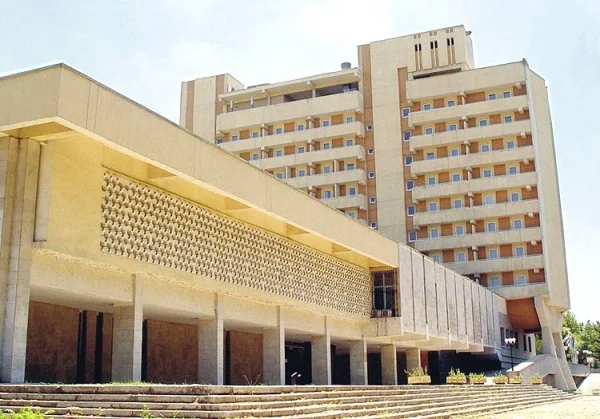
House of Youth (Ilkhom Theatre)
About the Object
Richard Blese; engineer E. Patlis (TashNIIPIgenplan)
1975
Modernism
Улица Пахтакорская, 5, Ташкент
Public Building
Gallery (1)

House of Youth: a hundred-seat hall from which Ilkhom grew
You are on Pakhtakorskaya Street, in front of a long concrete building with panjara grilles on the facade and a canopied terrace on the roof. This is the House of Youth, built in 1975 according to the design of architect Richard Blezé and engineer E. Patlis. German researchers of Tashkent architecture write about it quite directly: a modernist idiom reminiscent of Le Corbusier's buildings, and immediately note the sunbreakers made following local patterns. It was conceived on a grand scale that is hard to imagine today. Three blocks around two inner courtyards, connected in such a way that they formed an entire internal street. In the first block - a hotel with three hundred and fifty beds and a summer cafe right on the roof. In the second - club spaces, a restaurant for two hundred and fifty people, an eighteen-by-thirty-six-meter gym, a swimming pool, an art studio, a record library, a disco, a creative youth club with a bar, and a technical youth club. In the third - a hall for seven hundred and fifty seats, a ballroom, a summer film lecture hall, and a chaikhana attached to it. And in the list of premises of the second block, between the art studio and the restaurant, there was a theatrical studio with a hall for one hundred spectators. A single line in the inventory, one of two dozen. Ilkhom emerged from this single line. In 1976, director Mark Weil and graduates of the Tashkent Theatre and Art Institute founded the Experimental Studio of Creative Youth here. The first performance was "Maskharaboz-76", played in the spirit of street theater. Ilkhom became one of the first professional non-state theaters in the entire territory of the Soviet Union - a theater that answered to no culture department and lived on its own terms, in the basement of a building constructed for the Komsomol. Weil led it for thirty-one years, until the night of September 7, 2007: he was returning home from a dress rehearsal of "The Oresteia" and was killed in the entrance hall of his own apartment building. The theater is still operating today and bears Weil's name. So, standing here, you are looking at a rare thing: a building that has outlived both the country for which it was built and its main person, and continues to do precisely what was assigned to it by one modest line in the project.
AI translation · 🇬🇧 EN
Rate this review:
Nearby and related
By the same architect
Close by in Tashkent
About the Object
Richard Blese; engineer E. Patlis (TashNIIPIgenplan)
1975
Modernism
Улица Пахтакорская, 5, Ташкент
Public Building