
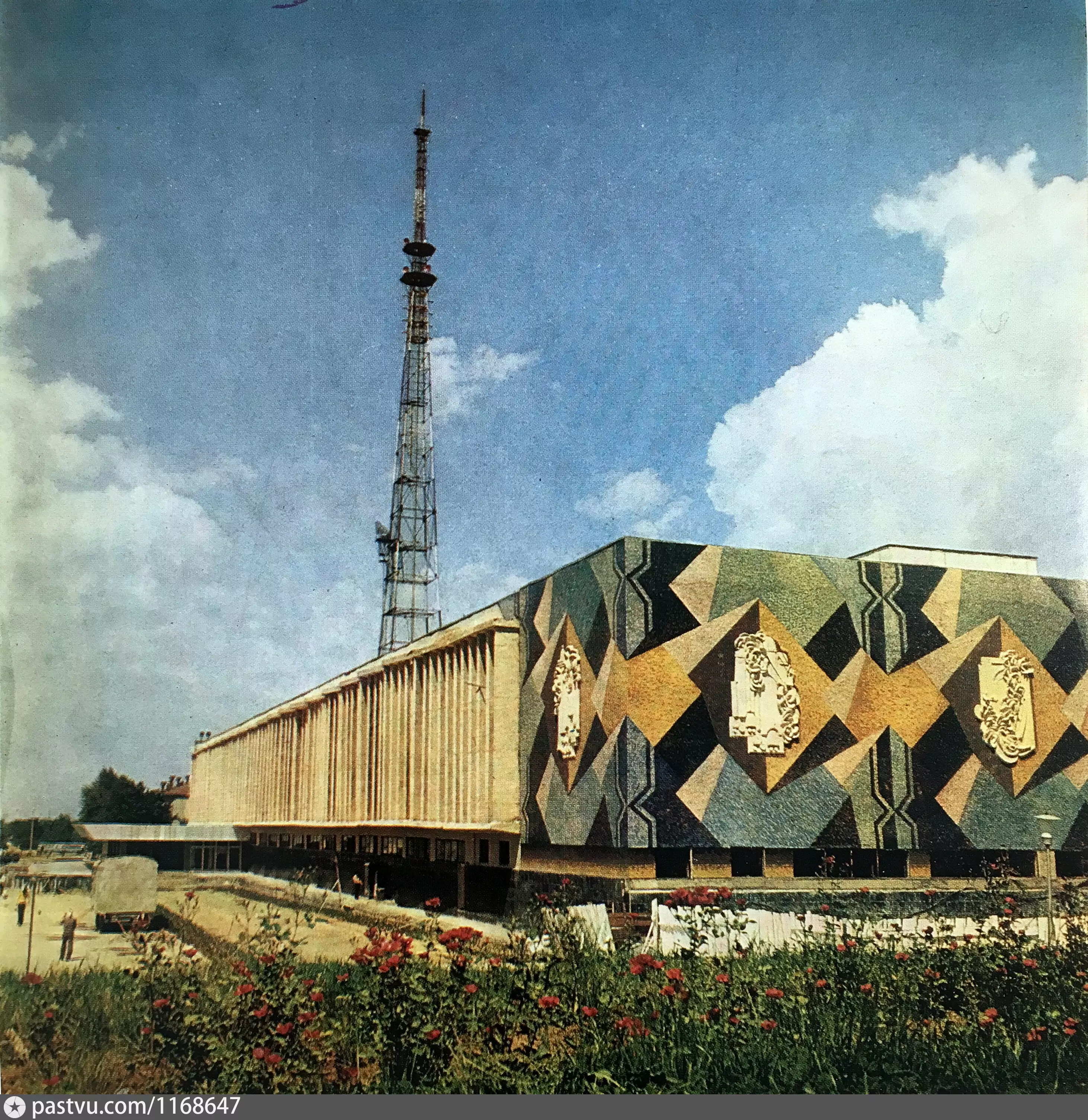
New Television Centre (Broadcast Complex)
About the Object
K. Nikuradze; engineers G. Filatov (chief), G. Berdichevsky, A. Reshetnikova (GSPI, Moscow)
1977
Modernism
Улица Алишера Навои, 69а, Ташкент
Public Building
Gallery (1)

Telecentre: 2,500 meters of mosaic featuring not a single leader
You are standing in front of a long, three-storey building with almost no windows - roughly one hundred by one hundred and thirty metres. The blank walls here are not negligence, but a requirement: inside are studios where daylight is not needed at all. On the southern side, where there are windows after all, they are shielded by angled sun protection elements. And now look at the eastern façade. It is entirely covered with a mosaic spanning more than two and a half thousand square metres - almost entirely abstract. It was created by Moscow artist Yevgeny Ablin. German researchers compiling the compendium of Tashkent architecture call it one of the largest wall mosaics in the world, and add something that sounds almost unbelievable for Soviet 1977: it carries no ideological burden whatsoever. No leaders, no banners, no workers with sheaf-binders. Abstract forms, and among them flower petals, musicians, and a butterfly. But abstraction does not mean emptiness. Reliefs and narrative panels are built into the general field of the mosaic, and one of them is "Prometheus Bringing Fire to People". The choice is telling: for a building from which television signals go out into homes, the Titan who brought fire to people is an almost direct metaphor. Ablin created the same subject a few years before Tashkent, in 1968, for the Proletary cinema in Voronezh. This also explains why German researchers speak of the absence of ideology, even though there are subjects here: Prometheus is not a leader or a banner, but a Greek myth. The work took six years, from 1972 to 1978. The building was commissioned in 1977, meaning Ablin spent the final year finishing the façade of a telecentre that was already operational. The mosaic on the staircase pylon in the lobby, on the contrary, was ready before anything else - it is dated 1972. The history of the building begins with an earthquake. In 1966, the old telecentre built in the mid-fifties was damaged, and this accelerated the decision to build a new one. The design was commissioned in Moscow, at the State Allied Design Institute of the Ministry of Communications, and as early as November of that same 1966, architect Kim Nikuradze's team sent a proposal to Tashkent. In the documents, the building was called dryly: the hardware and studio complex. It was built for eleven years and finished in 1977. Getting inside is difficult, but it is worth knowing what is there. Three large studios, three hundred and six hundred square metres each. A narrow inner courtyard on the northern side, the walls and parapets of which are covered with ganch ornamentation featuring floral and geometric motifs. And the lobby, for the sake of which this building is worth remembering: a staircase whose steps are flat concrete slabs fixed only by their narrow side, making it seem as though they are hanging in mid-air. The pylon next to it is also entirely covered with Ablin's mosaic. Wooden slabs hang from the ceiling in a zigzag pattern. Wood, ganch, and colored mosaic in a single interior - a combination that is nowhere else repeated in Tashkent on such a scale.
AI translation · 🇬🇧 EN
Rate this review:
Nearby and related
Close by in Tashkent
About the Object
K. Nikuradze; engineers G. Filatov (chief), G. Berdichevsky, A. Reshetnikova (GSPI, Moscow)
1977
Modernism
Улица Алишера Навои, 69а, Ташкент
Public Building