
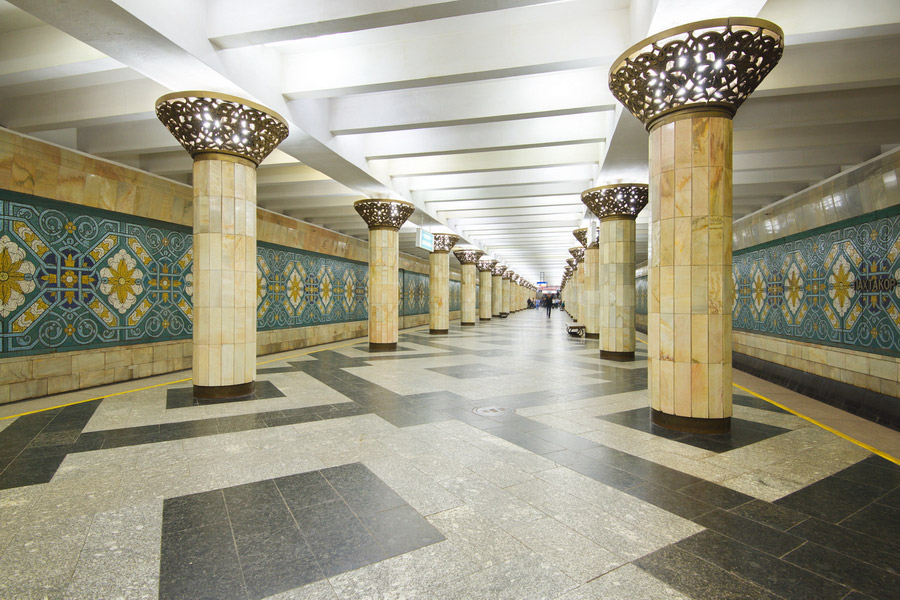
“Pakhtakor” Metro Station
About the Object
F. Tursunov, A. Sadykov, T. Sadykov (TashNIIPIgenplan); artist P. Zharsky (ceramics), V. Burmakin (smalt panels); engineer N. Dubrovsky
1977
Modernism
Pakhtakor, Sheriyat Bogi Street, Shaykhantahur District, Tashkent, 100000, Uzbekistan
Railway Station
Gallery (2)

Pakhtakor Metro Station
Welcome to the first line of the Tashkent Metro. Pakhtakor Station was opened in 1977 as part of the very first operational section. It was designed by architects S. Adylov, F. Tursunov, and A. Sadykov. The authors (in particular, sculptor P. Zharsky) faced a complex conceptual task. The word “Pakhtakor” translates as “cotton grower.” However, the station is located in a park area right next to the eponymous stadium. Therefore, the design needed to organically interweave two completely different themes: cotton harvesting as the main wealth of the republic and “Sporting Uzbekistan.” This is a column-type station with a monolithic reinforced concrete ceiling. To make the columns look elegant and not clutter the space, engineer N. Dubrovsky applied an unconventional solution: strong metal pipes became their main load-bearing structure. During the tunneling from Pakhtakor to the next station, builders for the first time used an innovative excavation method. This allowed for saving 69 tons of cement, 183 tons of sand, and significantly reducing the work time. Look at the columns; they are clad in white Nurata marble, and their upper parts (capitals) are adorned with cast aluminum grilles featuring a national ornament. Fluorescent lamps are hidden inside these capitals, making it seem as if torches are burning under the ceiling. The track walls of the platform are covered with colored ceramics by P. Zharsky, featuring an intertwining ornament. And if you ascend to the spacious vestibule, you will see colored smalt panels by artist V. Burmakin, dedicated to sports themes.
AI translation · 🇬🇧 EN
📷 https://ru.wikipedia.org/wiki/%D0%9F%D0%B0%D1%85%D1%82%D0%B0%D0%BA%D0%BE%D1%80_(%D1%81%D1%82%D0%B0%D0%BD%D1%86%D0%B8%D1%8F_%D0%BC%D0%B5%D1%82%D1%80%D0%BE)#/media/%D0%A4%D0%B0%D0%B9%D0%BB:Paxtakor_Station_Wall_Plate.JPG
Rate this review:
A transfer planned seven years in advance
When Pakhtakor opened in November 1977, the second line of the Tashkent metro existed only on paper. But the transfer to it had already been built. The magazine Construction and Architecture of Uzbekistan described the station in the month it was launched and concluded directly: in the future Pakhtakor will be a transfer station, the north-west to south-east metro line will come here, and the transfer transition is provided for right now, in the underground lobby. The spacious lobby, faced with marble and coquina, was built with a margin - not for the passenger traffic of that time, but for the one that would appear when the second line arrived. It arrived seven years later. In 1984, under Abay Street, at the intersection with the axis of the Central Park of Culture and Recreation, the Alisher Navoi station opened - and the transfer began to work exactly as it was conceived: at the ticket hall level, through the underground lobby of Pakhtakor into one of the underground lobbies of Navoi, from where three escalator belts go down to the platform. This is how the magazine described it back in 1982, when Navoi was only being built. At the same time, the idea of where the second line would go also changed. In 1977, it was called the north-west to south-east diameter. The built Uzbekistan Line runs differently: from the western outskirts near Karakamysh through the old city to the center, further to the railway station and to the east, to the factories. The direction was preserved only in general terms. The site for the station was chosen long before that. Back in December 1971, when Moscow's Metrogiprotrans was issuing the first working drawings of the first line, a TASS correspondent listed what was around the future Pakhtakor: not only the stadium, where tens of thousands of sports fans rush on match days, but also the busy Navoi Street, and on it the Palace of Arts, theaters, recreation areas, numerous institutions and shops. The station was conceived not as a stop near the stadium, but as an entrance to a whole piece of the city - and that is why it got the network hub. Today Pakhtakor and Alisher Navoi are still the only transfer between the two Soviet-era lines. The two stations stand one hundred and thirty meters apart.
AI translation · 🇬🇧 EN
Rate this review:
Eleventh Place
In December 1987, Tashkent architects were asked to evaluate the beauty of the metro stations, and Pakhtakor took eleventh place out of nineteen. The survey was conducted seriously. An anonymous questionnaire indicating age, gender, and profession, a list of nineteen stations, and an evaluation using the usual school four-point system: excellent, good, satisfactory, poor. The respondents were teachers and students of the architectural faculty of the Polytechnic Institute, architects and engineers of Tashgiprogor, UzNIIP Gradostroitelstva, and TashZNIIEP, as well as historians, archaeologists, and journalists - a total of 255 questionnaires. The results were published by the magazine Architecture and Construction of Uzbekistan in early 1988, dedicating the entire issue to the metro. Pakhtakor was evaluated by 248 people. Forty gave it "excellent", one hundred and three "good", seventy-three "satisfactory", and thirty-two "poor". The average score was 3.609. What is interesting here is not the place itself, but the spread. Thirty-two "poor" marks is more than any station in the upper half of the table; for comparison, the winning station Prospekt Kosmonavtov did not have a single such rating, and Ploshchad Lenina had three. The author of the survey directly named Pakhtakor among the five most controversial stations - along with Alisher Navoi, Chilanzar, Tashkent, and Uzbekistanskaya: they have many excellent ratings, but the final places do not correspond to this. Simply put, professionals could not agree. Why - neighboring articles in the same issue explained, although not about Pakhtakor. Stations built in 1977-1984 were reproached there for excessive decorativeness, verbosity, and a desire for unnecessary pomposity. The argument was as follows: a metro station is not a museum or an exhibition pavilion, a person is there for a very short time and cannot examine the decoration, so metro architecture should be perceived quickly, on the go, and not require careful examination. By this yardstick, Pakhtakor with its double theme - cotton and sports, with the ceramics of the interlocking ornament on the track walls andsmalt panels in the lobby, was vulnerable. It is worth remembering who answered: almost entirely people from architecture and construction. The author of the survey himself noted this - architects evaluate the work of colleagues strictly, sometimes harshly - and was going to ask workers and employees of two plants near the new stations as a next step. That second survey never appeared in the magazine.
AI translation · 🇬🇧 EN
Rate this review:
Nearby and related
By the same architect
Close by in Tashkent
About the Object
F. Tursunov, A. Sadykov, T. Sadykov (TashNIIPIgenplan); artist P. Zharsky (ceramics), V. Burmakin (smalt panels); engineer N. Dubrovsky
1977
Modernism
Pakhtakor, Sheriyat Bogi Street, Shaykhantahur District, Tashkent, 100000, Uzbekistan
Railway Station
Visitor Information
$ 0,2
after lunch