
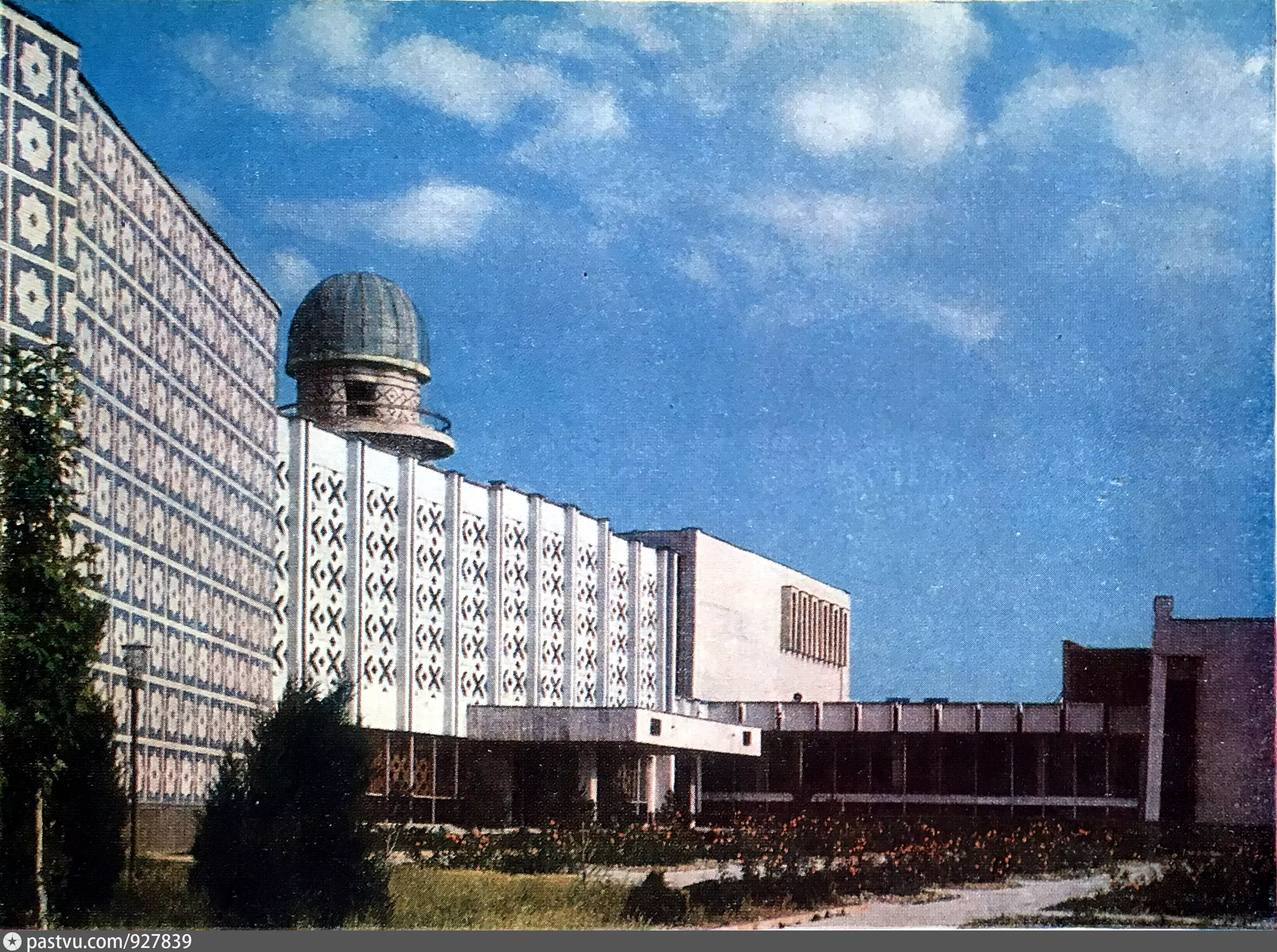
Republican Palace of Pioneers named after V. I. Lenin
УтраченоAbout the Object
F. Tursunov (lead), A. Sadykov, T. Sadykov, Z. Rakhimova, N. Zaidov, A. Liss, V. Vanyushin, E. Kurnikov; engineers E. Platsman, N. Zapletin, V. Baydo, Sh. Abdullaeva
1980
Modernism
Улица Фурката, Ташкент (ныне территория «Ташкент-Сити»)
Public Building
Gallery (1)

Palace of Pioneers: what they managed to build and what they did not
There is nothing here. In its place stands the Tashkent City business center, and until 2018 the Lenin Republican Palace of Pioneers stood here. The original concept was much grander than what was actually built. In 1979, while construction was still underway, the magazine Architecture and Construction of Uzbekistan described the future like this: the designated area would house a green theater, a summer recreation camp, the Pioneer children's tourist hotel, a young pioneers stadium, a sports complex with swimming pools and competition halls, a greenhouse, and an area for pioneer campfires. The building itself was supposed to consist of two volumes - a club activities block and a theater and entertainment block, connected by elevated walkways and forming two inner courtyards. It was designed to accommodate a thousand people simultaneously in the club rooms and more than two thousand if counting the entertainment and play areas. Out of all this, only one block was built - the club block. The entertainment building never appeared: by the late seventies, the money ran out. There was not enough even for basic everyday amenities: the palace administration later complained about the lack of air conditioning, which made it hard for children to study in the heat, and low ceilings in the classrooms. Thus, the club building simply came to be called the Palace of Pioneers. It opened in 1980, and there was plenty of activity inside. Two dozen laboratories - ship modeling, aircraft modeling, chemistry, electronics, and automation. Two hundred and forty clubs. A film studio, a recording studio, a drama studio, a choreography hall, a career guidance office, and a museum of the history of the Pioneer organization of Uzbekistan. More than two thousand children studied here every year. The compositional center of the club block was the observatory tower - a logical feature for a children's palace: observatories at clubs had been built since the twenties, and for the sixties generation, Gagarin's flight was the defining event of the era. Architectural historian Olga Kazakova drew attention to what happened to this tower later. In the earliest known version of the project, preserved as a photograph of a model in a 1973 newspaper, the tower is free of any national decor. Yet by the following year's publication, it can be seen acquiring muqarnas shells under the dome, starting to look like the Kalyan minaret in Bukhara. The astronomical tower, as Kazakova observed, acquired an appearance directly opposite to the meaning originally intended for it. The building survived for less than thirty years. In 2018, it was demolished to make way for Tashkent City - a year after the House of Cinema, located a few blocks away, was demolished.
AI translation · 🇬🇧 EN
Rate this review:
Nearby and related
By the same architect
Close by in Tashkent
About the Object
F. Tursunov (lead), A. Sadykov, T. Sadykov, Z. Rakhimova, N. Zaidov, A. Liss, V. Vanyushin, E. Kurnikov; engineers E. Platsman, N. Zapletin, V. Baydo, Sh. Abdullaeva
1980
Modernism
Улица Фурката, Ташкент (ныне территория «Ташкент-Сити»)
Public Building