
Alisher Navoi Metro Station
About the Object
Architects S. Adylov (head), Ya. Mansurov, A. Tabibov, F. Muzaffarova, R. Fayzullaev (chief project architect), Tashmetroproekt; artists R. Mukhamedzhanov, A. Rakhimov, V. Dudin, I. Ablaev (dome ceramics), Ch. Akhmarov, I. Kayumov (compositions); sculptor I. Shanmardanov (high relief of the poet)
1984
National Style
55, Almazar Street, Hadra (C-14), Shaykhantahur District, Tashkent, 100000, Uzbekistan
Railway Station
Gallery (3)

Станция метро «Алишер Навои
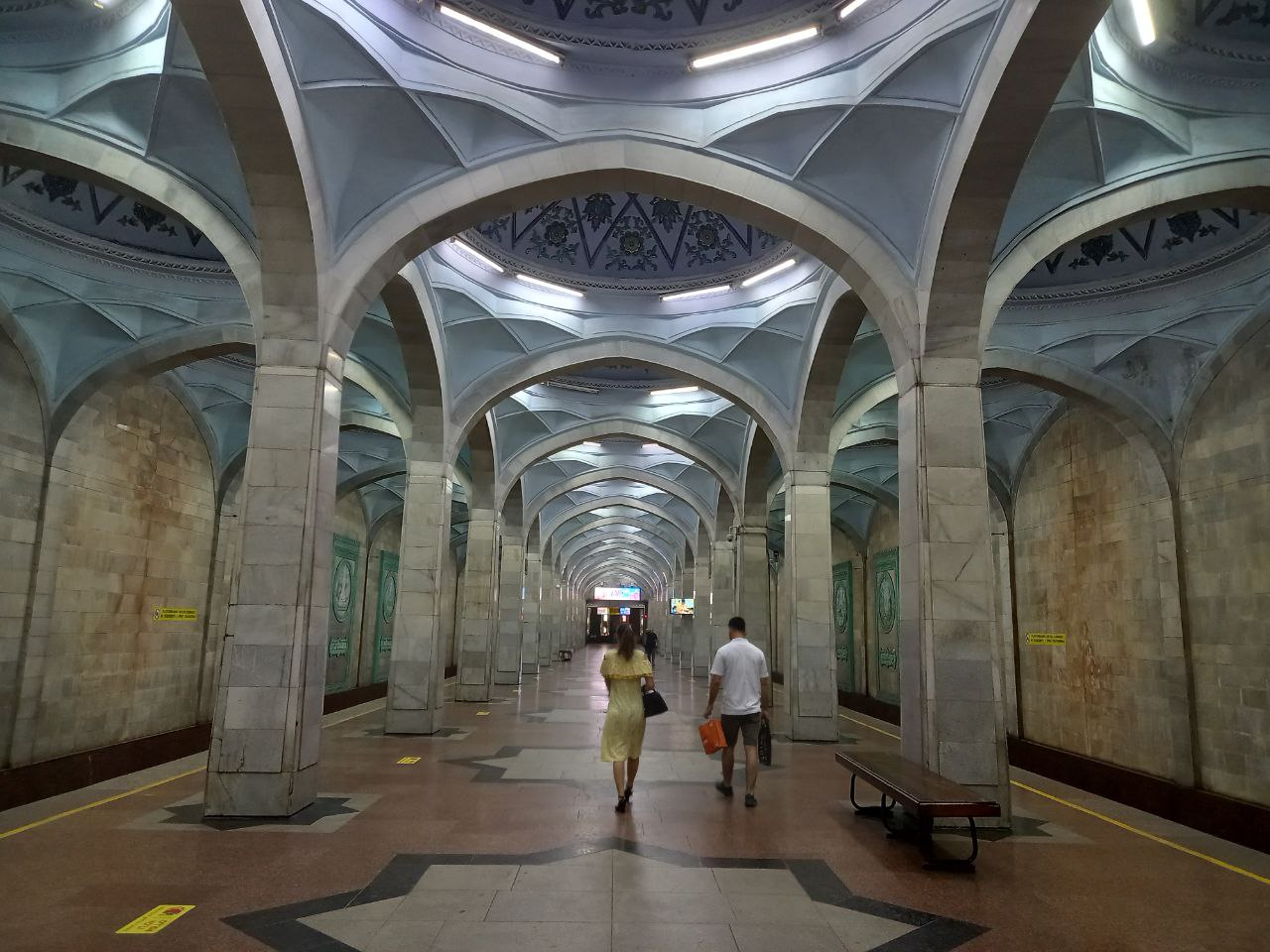
А теперь давайте перейдем на Узбекистанскую линию. Этот переход интересен сам по себе: станция «Алишер Навои» проектировалась в начале 1980-х годов институтом «Ташметропроект», и она является сложным инженерным узлом, так как связана с подземным вестибюлем «Пахтакора». Оказавшись на платформе «Алишер Навои», вы сразу почувствуете разницу в масштабе. Здесь архитектура строго подчинена классическим традициям зодчества Узбекистана, а облик посвящен великому поэту Алишеру Навои. Это станция колонного типа с островной платформой, рассчитанной на пять вагонов. Главная особенность зала, это увеличенная высота. Опоры из белого мрамора плавно переходят в стрельчатые арки, на которых, в свою очередь, покоятся купола. Светильники здесь не бросаются в глаза: они аккуратно интегрированы в резной карниз, опоясывающий эти купола. В отделке использованы гранит с национальным рисунком, розовый и белый мрамор, шамот и голубая керамика. Роспись куполов поливной керамикой — это сложнейшая ручная работа художников Р. Мухамеджанова, А. Рахимова, В. Дудина и И. Аблаева. Но главная гордость станции — это панно на путевых стенах. Их автор — выдающийся народный художник Узбекистана Чингиз Ахмаров (о котором мы уже вспоминали у здания Музея литературы). На стенах платформы размещены 4 монументальные композиции по мотивам великих поэм Навои: «Лейли и Меджнун», «Фархад и Ширин», «Стена Искандера» и «Семь планет». Еще 12 композиций и горельеф самого поэта (работы скульптора И. Шанмарданова) находятся в пересадочном вестибюле. Признание: Эта станция считается одним из шедевров ташкентского метро. В декабре 1987 года, в ходе анонимного опроса 250 экспертов-архитекторов, она заняла призовые места по красоте. Профессионалы отмечали редкое достижение: национальный колорит здесь передан не просто «наклеенным» декором, а самой формой и архитектурой несущих конструкций.
📷 https://ru.wikipedia.org/wiki/%D0%90%D0%BB%D0%B8%D1%88%D0%B5%D1%80%D0%B0_%D0%9D%D0%B0%D0%B2%D0%BE%D0%B8_(%D1%81%D1%82%D0%B0%D0%BD%D1%86%D0%B8%D1%8F_%D0%BC%D0%B5%D1%82%D1%80%D0%BE)#/media/%D0%A4%D0%B0%D0%B9%D0%BB:Tashkent_Metro_station_3.JPG
📷 https://ru.wikipedia.org/wiki/%D0%90%D0%BB%D0%B8%D1%88%D0%B5%D1%80%D0%B0_%D0%9D%D0%B0%D0%B2%D0%BE%D0%B8_(%D1%81%D1%82%D0%B0%D0%BD%D1%86%D0%B8%D1%8F_%D0%BC%D0%B5%D1%82%D1%80%D0%BE)#/media/%D0%A4%D0%B0%D0%B9%D0%BB:Metrostation_Alisher_Navoiy_in_Taschkent_2.jpg
Rate this review:
A station painted two years before its opening
The fifth issue of the magazine "Architecture and Construction of Uzbekistan" for 1982 contains a review of the entire second line under construction, broken down by station, with author teams in the footnotes. "Alisher Navoi" is analyzed there in detail, and it is worth reading this description keeping in mind that the station does not yet exist, everything is stated in the future tense, and opening day is two years away. Location: under Abai Street, at the intersection with the axis of the Central Park of Culture and Recreation. Task: besides boarding and alighting passengers, transfer from the first line to the second and back. Interior: a three-span columned hall of standard dimensions with an island platform for a five-car train. And then the magazine explains where the appearance came from. The architectural and monumental-artistic solutions, it writes, were largely determined by the classical forms of architecture and fine arts of the republic. White marble columns transition upward into arches supporting domes faced with glazed ceramics and girded with a stalactite cornice featuring lighting fixtures. The ornament of the dome ceramics echoes four monumental-artistic compositions on the track walls in the center of the platform - and the compositions are named by name, even before being painted: "Layli and Majnun", "Farhad and Shirin", "Iskander's Wall", "Seven Planets". At the edges of the hall, they were to be completed by heraldic compositions. In the transfer lobby - twelve compositions on the theme of Navoi's lyrics, culminating in a high relief of the poet. The station was built with a stated goal: to make it, as the magazine says, a kind of monument to the great founder of Uzbek poetry. This is a rare case when a metro station is spoken of in such terms in advance, in a production text, rather than in hindsight. And one more thing from the same review, explaining why there is so much ceramics on the Uzbekistan line. The magazine writes directly: when deciding the appearance of the stations, an important role, given the lack of a natural light source, is assigned to the color solution. Glass, metal, chamotte, porcelain, and especially ceramics combined with marble and granite became the source for embodying monumental and applied arts. And it adds: ceramics is a traditional material of the architects of Uzbekistan, as evidenced by the historical monuments of Samarkand, Khiva, Bukhara, and other cities of Central Asia, and in recent years it has received a second birth - in this case in the decoration of metro stations. The same argument in the same 1982 was heard at the union level: the magazine "Architecture of the USSR" wrote that extensive experience in the synthesis of monumental art and architecture has been accumulated in Tashkent precisely in connection with the construction of metro stations.
AI translation · 🇬🇧 EN
Rate this review:
Three thousandths of a point
In December 1987, Tashkent architects filled out questionnaires: nineteen metro stations, a four-point scale, excellent - good - satisfactory - poor. Two hundred and fifty-five questionnaires, the results printed in the magazine as a table. Alisher Navoi was rated by 242 people. One hundred and twenty-one gave it an excellent, seventy good, forty-four satisfactory, seven poor. The average score was 4.260, fourth place. Third place was held by Pushkinskaya with a score of 4.263. The difference is three thousandths, and the author of the survey, who participated in it himself, wrote in the text of the article that the ratings of these two stations are practically identical. This is reflected literally in the table: Pushkinskaya has III-IV in the place column, and Alisher Navoi has IV-III. There was essentially no third and fourth place - there was one shared place. Only two stations turned out higher: Prospekt Kosmonavtov and Ploshchad Lenina. And here is what unites them with Navoi: all three are of the column type, and in all three the hall height is higher than usual. The author of the survey noted this separately and was surprised. He expected vaulted stations to win - a single solid space, it seemed to him, better serves the function of a station. Vaulted ones took the middle of the table, and columned ones took the entire top. The same issue of the magazine explains what exactly Navoi was valued for. An article about the metro states that the architecture of the station is associated with the poet's time and that this is additionally emphasized by sculptural portraits of the heroes of his poems. In other words, the national character here is conveyed not by a superimposed pattern, but by the form itself - arches, domes, height. This was the main argument at the time: in the same issue, stations built in 1977-1984 were criticized for excessive decorativeness and verbosity, and Navoi was not subject to this criticism. But it also fell into another list. The author named five stations as the most controversial: A. Navoi, Chilanzar, Pakhtakor, Tashkent and Uzbekistanskaya. They have many excellent ratings, but the final places do not quite correspond to this. Navoi actually has one hundred and twenty-one excellents - exactly half of the raters - and at the same time forty-four satisfactory grades. For comparison, Ploshchad Lenina was given the highest rating by seventy percent. The station was not so much disliked; it was rated very high or people shrugged, and there was no unanimity, unlike the first two places.
AI translation · 🇬🇧 EN
Rate this review:
Nearby and related
By the same architect
Close by in Tashkent
About the Object
Architects S. Adylov (head), Ya. Mansurov, A. Tabibov, F. Muzaffarova, R. Fayzullaev (chief project architect), Tashmetroproekt; artists R. Mukhamedzhanov, A. Rakhimov, V. Dudin, I. Ablaev (dome ceramics), Ch. Akhmarov, I. Kayumov (compositions); sculptor I. Shanmardanov (high relief of the poet)
1984
National Style
55, Almazar Street, Hadra (C-14), Shaykhantahur District, Tashkent, 100000, Uzbekistan
Railway Station
Visitor Information
$ 0,2
after lunch