
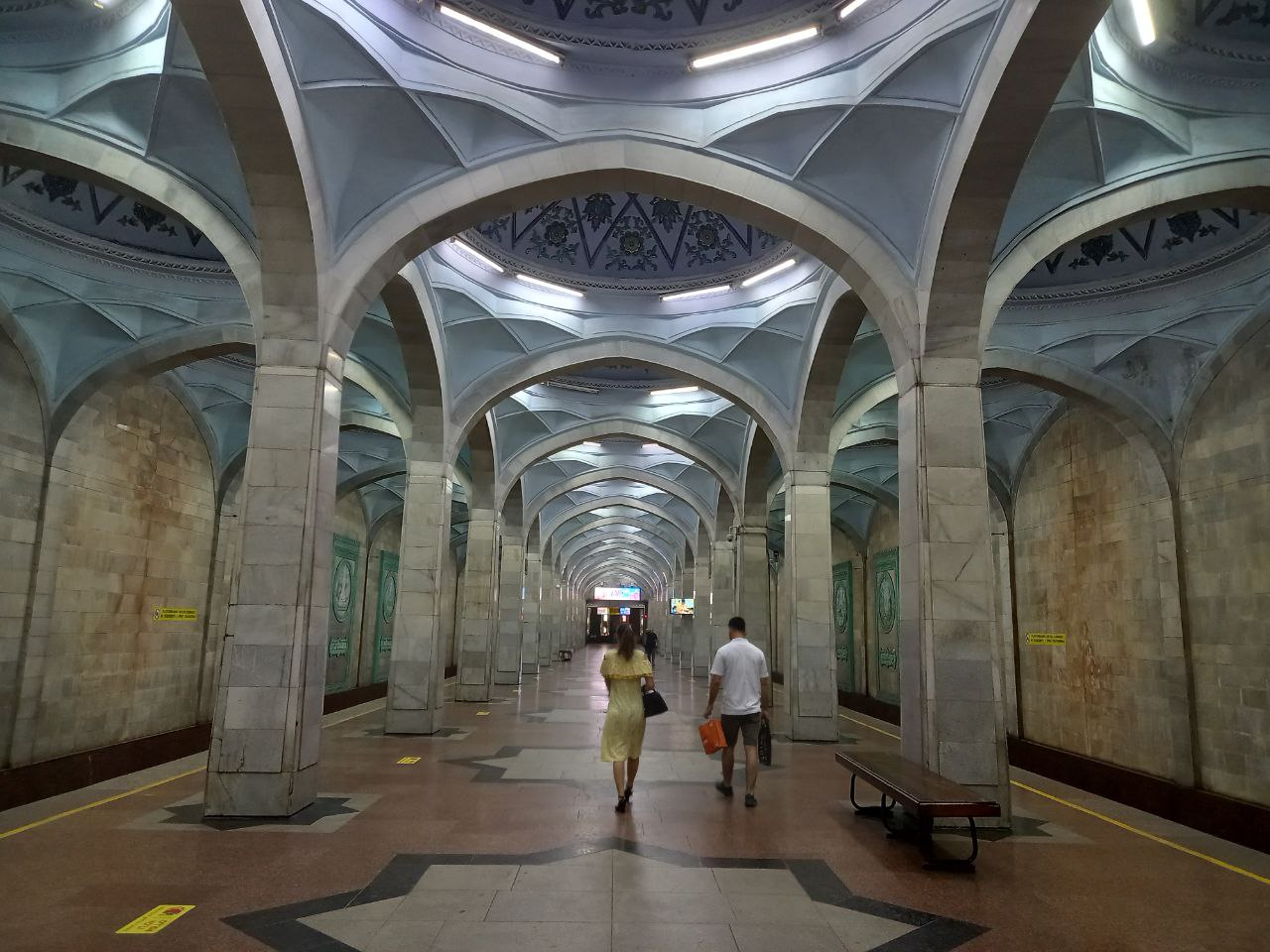
Metro-Station "Alischer Nawoi"
About the Object
Architekten S. Adylow (Leiter), Ja. Mansurow, A. Tabibow, F. Musaffarowa, R. Fajzullajew (Chef-Projektarchitekt), Taschmetroproekt; Künstler R. Muchammedschanow, A. Rachimow, W. Dudin, I. Ablajew (Kuppelkeramik), Tsch. Achmarow, I. Kajumow (Kompositionen); Bildhauer I. Schanmardanow (Relief des Dichters)
1984
National Style
55, Almazar Street, Hadra (C-14), Shaykhantahur District, Tashkent, 100000, Uzbekistan
Railway Station
Gallery (3)

U-Bahn-Station „Alisher Navoi“
Und nun wechseln wir zur Usbekistan-Linie. Dieser Übergang ist an sich schon interessant: Die Station „Alisher Navoi“ wurde Anfang der 1980er Jahre vom Institut „Tashmetoproekt“ entworfen und ist ein komplexer Ingenieurknotenpunkt, da sie mit dem unterirdischen Vestibül von „Pakhtakor“ verbunden ist. Sobald Sie sich auf dem Bahnsteig von „Alisher Navoi“ befinden, werden Sie sofort den Unterschied im Maßstab spüren. Hier ist die Architektur streng den klassischen Traditionen der usbekischen Baukunst untergeordnet, und ihr Erscheinungsbild ist dem großen Dichter Alisher Navoi gewidmet. Dies ist eine Säulenstation mit einem Inselbahnsteig, der für fünf Waggons ausgelegt ist. Das Hauptmerkmal des Saals ist die erhöhte Höhe. Stützen aus weißem Marmor gehen fließend in Spitzbögen über, auf denen wiederum die Kuppeln ruhen. Die Leuchten fallen hier nicht ins Auge: Sie sind sauber in das geschnitzte Gesims integriert, das diese Kuppeln umgibt. Für die Verkleidung wurden Granit mit nationalem Muster, rosa und weißer Marmor, Schamott und blaue Keramik verwendet. Die Bemalung der Kuppeln mit glasierter Keramik ist die äußerst komplexe Handarbeit der Künstler R. Mukhamedzhanov, A. Rakhimov, V. Dudin und I. Ablayev. Doch der größte Stolz der Station sind die Wandbilder an den Gleiswänden. Ihr Autor ist der herausragende Volkskünstler Usbekistans Chingiz Akhmarov (an den wir bereits beim Gebäude des Literaturmuseums erinnert haben). An den Bahnsteigwänden befinden sich 4 monumentale Kompositionen nach Motiven der großen Gedichte Navois: „Layli und Madschnun“, „Farhad und Schirin“, „Die Mauer Iskanders“ und „Die sieben Planeten“. Weitere 12 Kompositionen und ein Hochrelief des Dichters selbst (Werke des Bildhauers I. Shanmardanov) befinden sich im Umsteigevestibül. Annerkennung: Diese Station gilt als eines der Meisterwerke der Taschkenter Metro. Im Dezember 1987 belegte sie im Rahmen einer anonymen Umfrage unter 250 Architekten-Experten Spitzenplätze in puncto Schönheit. Fachleute hoben eine seltene Errungenschaft hervor: Der nationale Kolorit wird hier nicht einfach durch „aufgeklebten“ Dekor vermittelt, sondern durch die Form und Architektur der tragenden Konstruktionen selbst.
AI translation · 🇩🇪 DE
📷 https://ru.wikipedia.org/wiki/%D0%90%D0%BB%D0%B8%D1%88%D0%B5%D1%80%D0%B0_%D0%9D%D0%B0%D0%B2%D0%BE%D0%B8_(%D1%81%D1%82%D0%B0%D0%BD%D1%86%D0%B8%D1%8F_%D0%BC%D0%B5%D1%82%D1%80%D0%BE)#/media/%D0%A4%D0%B0%D0%B9%D0%BB:Tashkent_Metro_station_3.JPG
📷 https://ru.wikipedia.org/wiki/%D0%90%D0%BB%D0%B8%D1%88%D0%B5%D1%80%D0%B0_%D0%9D%D0%B0%D0%B2%D0%BE%D0%B8_(%D1%81%D1%82%D0%B0%D0%BD%D1%86%D0%B8%D1%8F_%D0%BC%D0%B5%D1%82%D1%80%D0%BE)#/media/%D0%A4%D0%B0%D0%B9%D0%BB:Metrostation_Alisher_Navoiy_in_Taschkent_2.jpg
Rate this review:
Eine Station, beschrieben zwei Jahre vor der Eröffnung
Die fünfte Ausgabe der Zeitschrift „Architektur und Bauwesen Usbekistans“ aus dem Jahr 1982 enthält eine Übersicht über die gesamte im Bau befindliche zweite Linie, aufgeteilt nach Stationen mit den Autorenkollektiven in den Fußnoten. „Alischer Nawoi“ wird dort detailliert analysiert, und es lohnt sich, diese Beschreibung mit dem Bewusstsein zu lesen, dass die Station noch nicht existiert, alles im Futur formuliert ist und noch zwei Jahre bis zur Eröffnung verbleiben. Standort: unter der Abai-Straße, an der Kreuzung mit der Achse des Zentralen Kultur- und Erholungsparks. Aufgabe: neben dem Ein- und Aussteigen der Passagiere auch das Umsteigen von der ersten Linie zur zweiten und zurück. Innenraum: eine dreischiffige Säulenhalle mit Standardabmessungen und einem Mittelbahnsteig für einen Fünf-Wagen-Zug. Und weiter erklärt die Zeitschrift, woher das Aussehen stammt. Die architektonischen und monumental-künstlerischen Lösungen, so schreibt sie, wurden hauptsächlich durch die klassischen Formen der Architektur und der bildenden Künste der Republik bestimmt. Säulen aus weißem Marmor gehen nach oben in Bögen über, auf denen Kuppeln ruhen, die mit Glasurkeramik verkleidet und von einem Stalaktitengesims mit Leuchten umgeben sind. Das Ornament der Kuppelkeramik korrespondiert mit vier monumental-künstlerischen Kompositionen an den Gleiswänden in der Mitte des Bahnsteigs, und die Kompositionen werden namentlich genannt, noch bevor sie gemalt wurden: „Leila und Medschnun“, „Farhad und Schirin“, „Die Mauer Iskandars“, „Sieben Planeten“. An den Rändern der Halle sollten sie durch heraldische Kompositionen vervollständigt werden. Im Umsteigevestibül befinden sich zwölf Kompositionen zum Thema der Lyrik Nawois, die in einem Hochrelief des Dichters gipfeln. Die Station wurde mit dem erklärten Ziel gebaut, sie, wie es in der Zeitschrift heißt, zu einem einzigartigen Denkmal für den großen Begründer der usbekischen Poesie zu machen. Dies ist ein seltenes Beispiel dafür, dass von einer Metrostation in einem solchen Ton im Voraus gesprochen wird, in einem Produktionstext und nicht im Nachhinein. Und noch etwas aus derselben Übersicht, das erklärt, warum es auf der Usbekistan-Linie so viel Keramik gibt. Die Zeitschrift schreibt direkt: Bei der Festlegung des Erscheinungsbildes der Stationen wird der Farblösung unter Berücksichtigung des Fehlens einer natürlichen Lichtquelle eine wichtige Rolle zugewiesen. Glas, Metall, Schamott, Porzellan und insbesondere Keramik in Kombination mit Marmor und Granit wurden zu einer Quelle für die Verkörperung monumentaler und angewandter Künste. Und sie fügt hinzu: Keramik ist ein traditionelles Material der Baumeister Usbekistans, wie die historischen Denkmäler von Samarkand, Chiwa, Buchara und anderen Städten Zentralasiens belegen, und in den letzten Jahren hat sie eine zweite Geburt erlebt, in diesem Fall bei der Gestaltung der Metrostationen. Dasselbe Argument wurde im selben Jahr 1982 auch auf gesamtunioneller Ebene geäußert: Die Zeitschrift „Architektur der UdSSR“ schrieb, dass in Taschkent gerade im Zusammenhang mit dem Bau von Metrostationen reiche Erfahrungen bei der Synthese von monumentaler Kunst und Architektur gesammelt wurden.
AI translation · 🇩🇪 DE
Rate this review:
Drei Tausendstel eines Punktes
Im Dezember 1987 füllten Architekten aus Taschkent Fragebögen aus: neunzehn U-Bahn-Stationen, ein Vier-Punkte-System, ausgezeichnet - gut - befriedigend - schlecht. Zweihundertfünfundfünfzig Fragebögen, die Ergebnisse wurden im Magazin als Tabelle abgedruckt. Alischer Nawoi wurde von 242 Personen bewertet. Einhunderteinundzwanzig vergaben ausgezeichnet, siebzig gut, vierundvierzig befriedigend, sieben schlecht. Die Durchschnittspunktzahl betrug 4,260, der vierte Platz. Den dritten Platz belegte Puschkinskaja mit einer Punktzahl von 4,263. Der Unterschied beträgt drei Tausendstel, und der Autor der Umfrage, der selbst daran teilnahm, schrieb im Text des Artikels, dass die Bewertungen dieser beiden Stationen praktisch identisch sind. Dies spiegelt sich buchstäblich in der Tabelle wider: Puschkinskaja hat in der Spalte Platz III-IV, Alischer Nawoi IV-III. Einen dritten und vierten Platz gab es im Wesentlichen nicht - es gab einen gemeinsamen Platz. Höher platziert waren nur zwei Stationen: Prospekt Kosmonawtow und Ploschtschad Lenina. Und das ist es, was sie mit Nawoi verbindet: Alle drei sind Säulenbahnhöfe, und bei allen drei ist die Hallenhöhe höher als gewöhnlich. Der Autor der Umfrage hat dies separat vermerkt und war überrascht. Er hatte erwartet, dass gewölbte Stationen gewinnen würden - ein einheitlicher, solroter Raum, so schien es ihm, entspricht besser der Funktion eines Bahnhofs. Die gewölbten belegten die Mitte der Tabelle, und die Säulenbahnhöfe beanspruchten die gesamte Spitze. Dieselbe Ausgabe des Magazins erklärt, wofür Nawoi genau geschätzt wurde. In einem Artikel über die U-Bahn heißt es, dass die Architektur der Station mit der Zeit des Dichters assoziiert wird und dass dies zusätzlich durch skulpturale Porträts der Helden seiner Gedichte unterstrichen wird. Mit anderen Worten, der nationale Charakter wird hier nicht durch ein aufgesetztes Muster vermittelt, sondern durch die Form selbst - Bögen, Kuppeln, Höhe. Das war damals das Hauptargument: In derselben Ausgabe wurden Stationen aus den Jahren 1977-1984 wegen übertriebener Ornamentik und Wortreichweite kritisiert, und Nawoi war dieser Kritik nicht ausgesetzt. Aber sie landete auch auf einer anderen Liste. Der Autor nannte fünf Stationen als die umstrittensten: A. Nawoi, Tschilanzar, Pachtakor, Taschkent und Usbekistanisaja. Sie haben viele hervorragende Bewertungen, aber die endgültigen Plätze entsprechen dem nicht ganz. Nawoi hat tatsächlich einhunderteinundzwanzig Mal ausgezeichnet - genau die Hälfte der Beurteiler -, und gleichzeitig vierundvierzig Mal befriedigend. Zum Vergleich: Bei Ploschtschad Lenina gaben siebzig Prozent die Höchstnote. Die Station war nicht so sehr unbeliebt; sie wurde sehr hoch bewertet oder die Leute zuckten mit den Schultern, und Einmütigkeit gab es im Gegensatz zu den ersten beiden Plätzen nicht.
AI translation · 🇩🇪 DE
Rate this review:
Nearby and related
By the same architect
Close by in Tashkent
About the Object
Architekten S. Adylow (Leiter), Ja. Mansurow, A. Tabibow, F. Musaffarowa, R. Fajzullajew (Chef-Projektarchitekt), Taschmetroproekt; Künstler R. Muchammedschanow, A. Rachimow, W. Dudin, I. Ablajew (Kuppelkeramik), Tsch. Achmarow, I. Kajumow (Kompositionen); Bildhauer I. Schanmardanow (Relief des Dichters)
1984
National Style
55, Almazar Street, Hadra (C-14), Shaykhantahur District, Tashkent, 100000, Uzbekistan
Railway Station
Visitor Information
$ 0,2
after lunch