
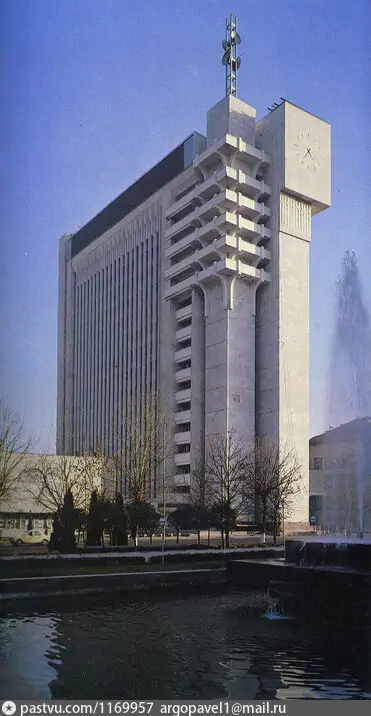
«Sharq» Publishing House (Editorial Building)
Частично утраченоAbout the Object
R. Blese (lead), N. Gorbenko, L. Khristich; engineers E. Patlis (chief), M. Ryzhavsky, F. Ganeev, Z. Shutyaeva, N. Balev
1974
Modernism
Улица Буюк Турон, 28, Ташкент
Public Building
Gallery (1)

"Shark": How the City's Best Building is Being Lost
Sixteen floors on Buyuk Turon, formerly Lenin Street. Built in 1974 as the editorial building for the publishing house of the Central Committee of the Communist Party of Uzbekistan. The project was led by Richard Blezat, who headed one of the workshops at Uzgoshproekt, the same author as the Youth Palace where the Ilkhom Theater resides, and the chief engineer here and there was the same, Patlis. To understand what made this tower stand out, one must know what was being built around it. Tashkent buildings of the sixties generally dominated their environment, placed in such a way as to subordinate the square or street to themselves. "Shark" was done differently - it fit into the urban layer cake accumulated here from the forties to the seventies without overpowering it. It carries a lot of the Thaw spirit, and even of the architectural experiments of the twenties. Colleagues appreciated this. In the early eighties, Iosif Notkin and Shukur Askarov conducted a survey of the Tashkent architectural community, and Blezat's building received extremely high marks. Specialists from UzNIIPgradostroitelstvo put it in second place, right behind the Palace of Arts, while Tashgiprogor architects placed it first. That same survey, by the way, put Kosinsky's hammam bathhouse in last place. One questionnaire, two extremes. The building was clad in Gazgan marble. And this is where the part they usually do not talk about begins: the marble was ruined not by independence or fashion, but by the quality of the work. As early as the mid-eighties, the tiles began to crack and fall off the planes of the stair and elevator shaft. This did not happen to the Lenin Museum or the Uzbekistan Hotel, because they were built by military construction crews. Then the building lost itself piece by piece. The 2012 renovation took away, among other things, the decorative belt under the clock. The walls were clad with ceramic tiles and Alucobond, and the subtle proportions found by Blezat drifted away. The clock got special treatment: the hands, which previously lay freely on the wall plane, were first enclosed in a black frame, and then numbers were added to the dial, leaving nothing of the former elegance. Since the early twenties, the interiors have been completely redone. Yet some authentic elements are still present on the facades and are worth spotting: the balconies with semi-circular supports on the north and northwest sides, and the antenna at the top. The teletype antenna is operational and at the same time crafted in such a way that it can easily be considered a work of monumental art. And in 2023, when the building was about to be put up for sale, the Cultural Heritage Agency banned privatization: "Shark" is included in the National Registry. Germans who measured Tashkent structures classify it in a rare category where new facades have grown over the old ones while the structures beneath survived, meaning the original appearance can be restored if desired. The city's best building, according to its own architects, was first clad haphazardly, then redressed, and then put under protection. In that exact order.
AI translation · 🇬🇧 EN
Rate this review:
Nearby and related
By the same architect
Close by in Tashkent
About the Object
R. Blese (lead), N. Gorbenko, L. Khristich; engineers E. Patlis (chief), M. Ryzhavsky, F. Ganeev, Z. Shutyaeva, N. Balev
1974
Modernism
Улица Буюк Турон, 28, Ташкент
Public Building