
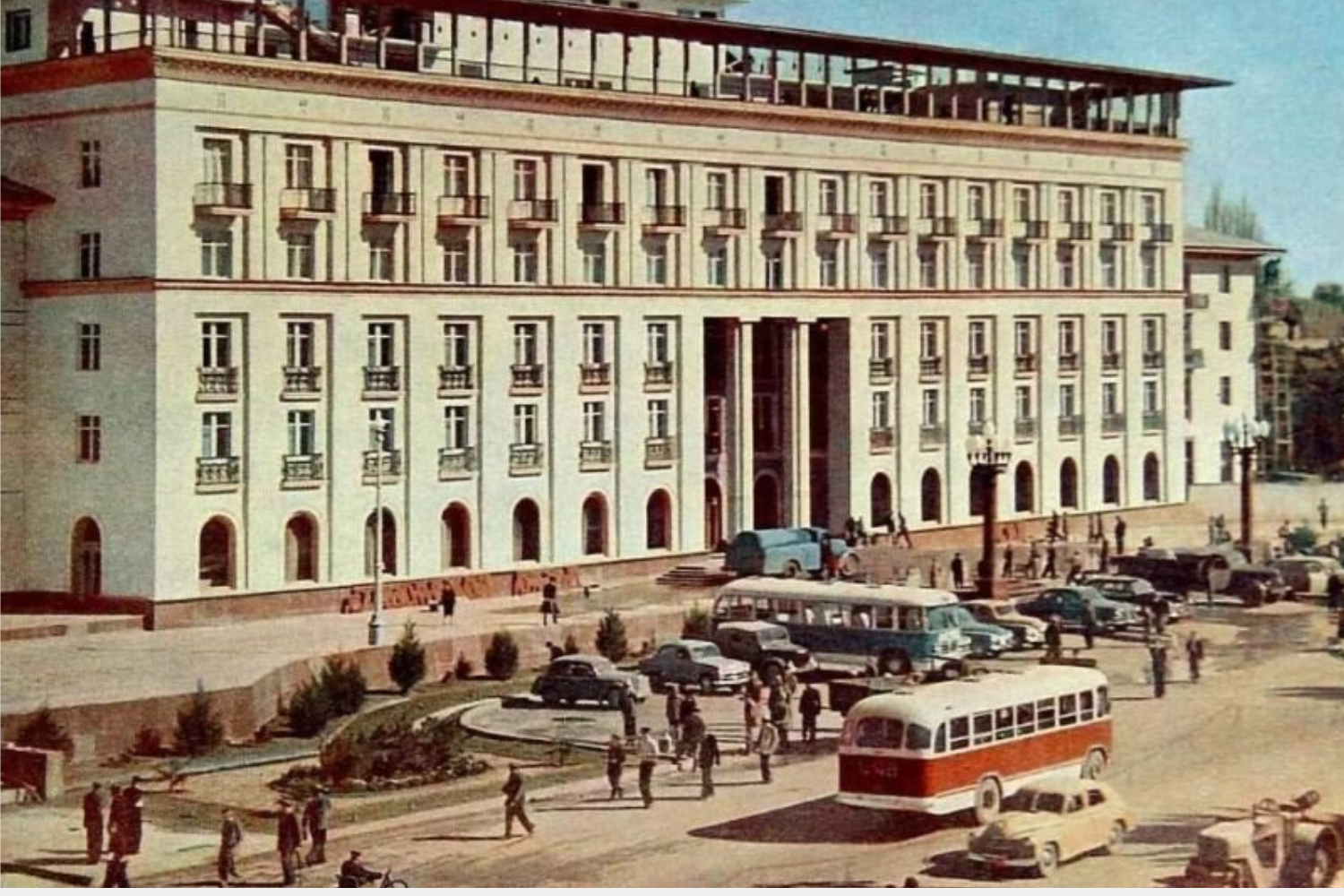
Lotte City Hotel Tashkent Palace (formerly Hotel "Tashkent")
About the Object
M. Bulatov, L. Karash, N. Rybnikov, V. Shevchenko
1959
National Style
Lotte City Hotel Tashkent Palace, 56, Sharof Rashidov Street, Mirabad District, Tashkent, 100029, Uzbekistan
Architectural Monument
Gallery (1)

The Tashkent Hotel
We are standing in the very heart of Theater Square, and before us stands the building that completed its architectural ensemble. The Tashkent Hotel, built in the late 1950s, rose on the site of the bustling Voskresensky Bazaar and the old shopping arcades of the merchant Tezikov. Notice how the hotel is positioned in relation to the Navoi Theater. They stand directly opposite each other, forming a classic paired ensemble, known in Eastern architecture as a “kosh.” This was a deliberate dialogue between two masters: architect Mithat Bulatov sought not to overshadow Alexei Shchusev’s grandiose creation, but to tactfully highlight it. This is precisely why the hotel features slender proportions and a monumental yet restrained vertical composition in the Art Deco style. The building has a complex shape, with the central five-story main body smoothly transitioning into four-story side wings. If you look inside, you’ll discover a spacious courtyard. During the Soviet era, it served as a cozy retreat, hidden from the city’s noise, while all utility services-restaurant kitchens and storage areas-were concealed in the basement via a special underground passage to preserve the square’s aesthetic. From a technical standpoint, the “Tashkent” was a true breakthrough. For the first time in Uzbekistan’s history, an automatic air conditioning system was installed here-an incredible luxury for that time. To ensure the building’s safety in a high-seismic zone, engineers employed innovative thin-walled reinforced concrete structures. This allowed them to eliminate heavy brick walls inside, creating a lighter floor plan. The hotel’s architecture is imbued with a “southern flair.” Instead of ornate decoration, the forms themselves do the work: deep loggia-style aivans at the entrance create natural shade, and on the flat roof of the central section, a summer café once operated beneath a light gallery. An observant viewer will also notice the bright accents: the entrances to the building and the restaurant are highlighted with vibrant majolica tiles in turquoise, blue, and white. Even the shade canopy on the roof was adorned with decorative murals. The Tashkent Hotel (today the Lotte City Hotel) is a rare example of how architecture can “listen” to its neighbors. It has brilliantly stood the test of time, remaining a model of urban planning sensitivity and respect for tradition.
Rate this review:
Unfinished Floors
In December 1953, Pravda Vostoka published a feuilleton that begins at the railway station. A visitor gets into a taxi and asks to be taken to a hotel. He is dropped off at the best one in the city, and there they tell him: "There are no vacancies." At the second one, it is the same, at the third one too. And then the driver offers his own solution: "I know someone here... She will provide you with a corner and a cot for ten rubles." The feuilleton was actually titled "No Vacancies". The numbers in it are simple: for the whole of Tashkent, there are four hotels, with a total of 434 beds. The best of them was already called "Tashkent" back then, but that was a different, former hotel. The new one on Theater Square was mentioned in passing that day as "planned construction", and with the reservation that even it would not resolve the "crisis". In June 1956, the foundation for a "five-story building" had already been laid on the square opposite the Navoi Theater. The project was designed by Tashgiprotrans, architects Mithat Bulatov and L. Karash with engineer V. N. Levchenko. The ground floor was allocated for a "Gastronom" store, a restaurant, a post office, a telegraph office, and a savings bank. Marble, granite, ceramics, and colored plaster were promised for the finish. The colored ceramics on the facade have their own story. They were made by an experimental plant "sheltered on the outskirts of Tashkent, behind the textile mill." Special kilns for ceramics and colored majolica were set up there, and by 1958 the products of these kilns were already "decorating the new Tashkent Hotel." A year later, the chief engineer of the plant, Rahmatulla Jabbarov, a polytechnic graduate just a year prior, talked about his tiles: "You can see them in the cladding of the Tashkent Hotel facade." The clay for them was hauled from quarries near Darbaza. In September 1958, photojournalist A. Palekhov called the hotel "the largest building in Tashkent." It had 273 rooms, a restaurant, three cafes, and an underground service yard. "For the first time in Tashkent, an air conditioning installation is being equipped, regulating the temperature in the rooms." The cornices are "painted with oil paints." They were rushing for a specific date. In October 1958, the Conference of Writers of Asian and African Countries opened in Tashkent, and the first phase of the hotel was delivered for it. Conference participants were photographed "in the bright lobby of the Tashkent Hotel." Three years later, describing a summer evening on the square, people recalled that "in the autumn of 1958, the 'spirit of Tashkent' was born right in our city." And on that evening, people came out onto the hotel's "openwork hanging balconies." In November 1959, the "Gastronom" opened on the ground floor, "the largest in the republic." It employed 120 salespeople and took grocery orders by phone. And the hotel was still not finished. Construction began in 1956 and was scheduled for two years. By September 1960, four years had passed, and the left wing, 87 rooms out of 273, still stood unfinished. The furniture had already been delivered. The contractor had transferred the finishers to another project. The article about this was aptly titled "Unfinished Floors." The math was the same as in the feuilleton from seven years ago. There were now six hotels in the city, with 1100 beds. But more than sixty percent of them were kept reserved for delegations and congresses. Ordinary visitors were left with no more than four hundred beds. About two hundred people were turned away daily, and the construction pace was called "tortoise-like." In January 1962, they showed what would happen next on the square. They were going to build a new hotel nearby, and the authors were Bulatov and Karash again. "Two glass residential blocks of the hotel complex will rise above the square like two 13-story icebergs." From the twelfth floor, Tashkent residents were promised a view of the city in August 1965. On the map of the square published by the magazine "Architecture and Construction of Uzbekistan" in 1977, the glass towers are gone. In the same article, the assessment of the theater also changed. The author, S. Blagov, writes: "In the center is the theater, heavy by today's aesthetic standards. Such an imposing island." The contrast to it is now made by the "light structures" of the new buildings, and the "Tashkent" hotel is named among them. The building, which was conceived as a modest neighbor to Shchusev's theater, was already counted among the modern ones three years after its completion.
AI translation · 🇬🇧 EN
Rate this review:
Nearby and related
By the same architect
Close by in Tashkent
About the Object
M. Bulatov, L. Karash, N. Rybnikov, V. Shevchenko
1959
National Style
Lotte City Hotel Tashkent Palace, 56, Sharof Rashidov Street, Mirabad District, Tashkent, 100029, Uzbekistan
Architectural Monument
Visitor Information
Metro "Mustaqillik maydoni"