
Voskresensky Bazaar
УтраченоAbout the Object
1860
Other
Sharaf Rashidov, Mirabad District, Tashkent, 100000, Uzbekistan
Memorial Place
Gallery (1)

Voskresensky Bazaar
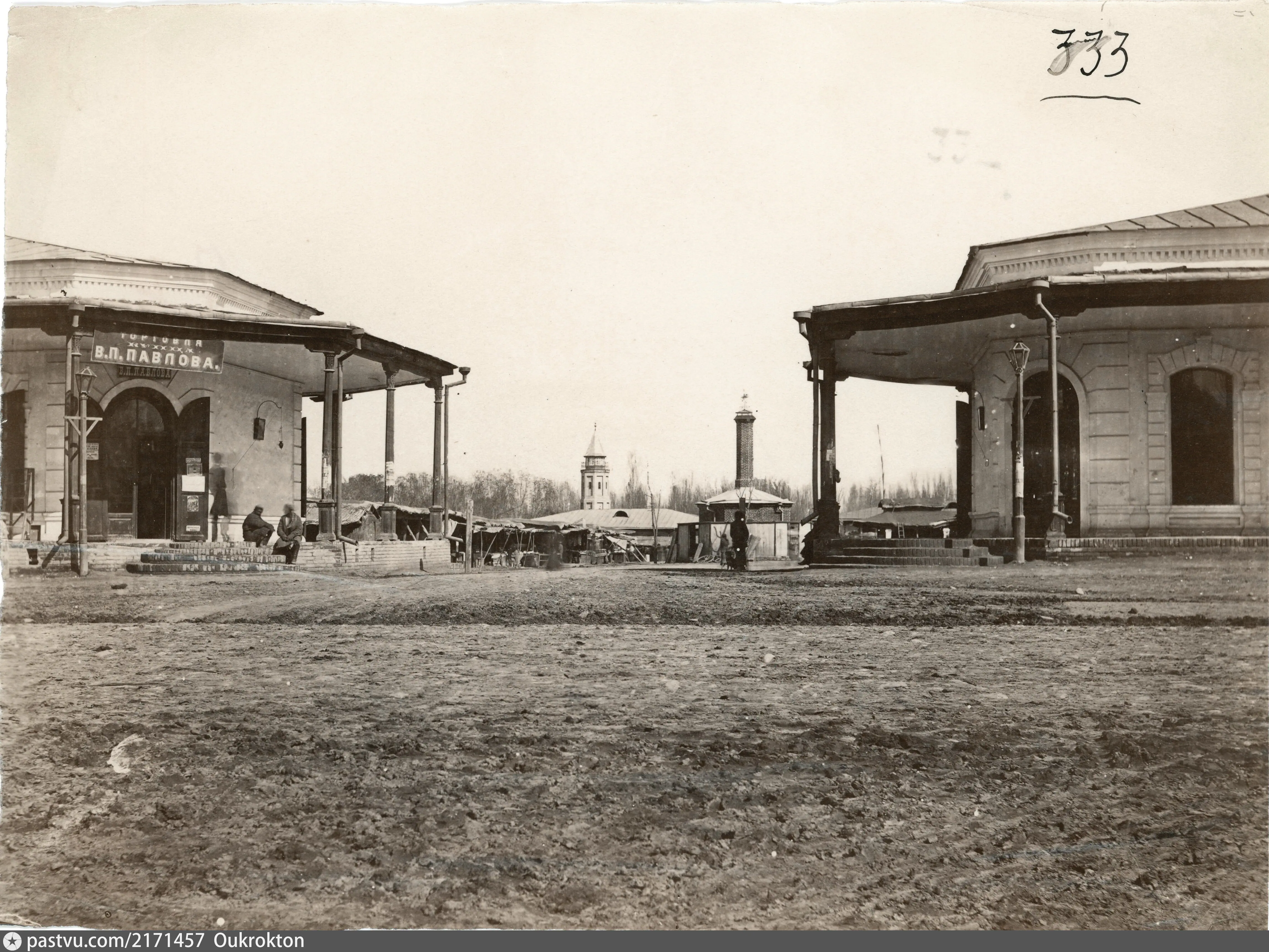
Standing on the modern and austere Teatralnaya Square, it's hard to imagine that just over a hundred years ago, a completely different life was bustling here. It was on this very spot that the main trading point of the Russian part of Tashkent was located, known as Voskresensky Bazaar. The market arose spontaneously in the 1860s. Initially, the colonial authorities conceived it as a clean and orderly European alternative to the usual Asian markets. However, reality turned out differently. The square very quickly became overgrown with small shops and drinking establishments. Suffice it to say that fourteen of the forty-four taverns in new Tashkent were located right here. Among the people, this place acquired the apt name "Drunken Bazaar." Instead of an exemplary trading space, it became a criminalized district in the very center of the city. In 1880, the authorities attempted to restore order. According to the project of architect Lekhanov, new trading buildings were erected around the perimeter on a brick plinth with shaded galleries for displaying goods. By the end of the nineteenth century, the bazaar's territory was clearly divided into two zones. The western part was more developed: textiles, shoes, and products from Russia were sold there. It was there that the large merchant Tezikhov's Gostiny Dvor was located. The eastern part was more modest and retained the format of traditional Eastern shops. A mosque was even built there specifically for Muslim traders. Merchant passages, workshops, offices, and banks grew up in a dense ring around the market. One of the main witnesses of that era has miraculously survived to this day. Pay attention to the corner two-story building with an inner courtyard. This is the Yaushev Merchants' Passage. Today, it uniquely closes off the southern side of Teatralnaya Square, recalling the pre-revolutionary merchant past of this area. The fate of the Voskresensky Bazaar itself was decided by the land question and a change in political course. In the 1920s, during the NEP, the market was still surrounded by private shops. But the Soviet government began a fierce struggle against private trade. Moreover, the city center, with its dense single-story development, desperately lacked land for large architectural projects. In 1933, the bazaar's activities were completely curtailed. Four years later, the square was finally cleared of spontaneous market buildings, preparing the site for the grandiose construction of the opera and ballet theater. Thus ended the history of the "Drunken Bazaar" and a new chapter began in the architecture of Tashkent.
AI translation · 🇬🇧 EN
Rate this review:
Six blocks and fourteen
The bazaar began as a drawing. The 1875 master plan allocated a 180 by 125 meter plot, 2.24 hectares, and proposed enclosing the perimeter with six wide passage-type blocks, with six entrances to the inner courtyard dedicated to the market. This description was left by architect M. A. Kayumova in the 1977 journal Architecture and Construction of Uzbekistan. It was built differently: "instead of six large blocks, fourteen small ones were built." The reason is stated directly and without softening: "The fragmentation of the development objects and the increase in the number of blocks were caused by the interests and capabilities of the clients rather than the improvement of the development composition." It was more profitable for the merchants to have fourteen shops than six blocks, and the city got what it got. Location of the bazaar was precise: the block formed by Irdzharskaya, Dzhizakskaya, Romanovsky streets, and Makhramsky Avenue, connected to Samarkandskaya by Bazarhny Lane. On the 1890 master plan, next to it are marked the cathedral mosque, a two-story passage, a post station, and the merchants' passage standing on the southern side of the square: retail premises below, housing above. What it looked like was described in 1986 by Shukur Askarov, referring to Dobrosmyslov: after the restructuring of 1882-1883, the main buildings of the bazaar "consisted of separate blocks, including four semicircular ones, surrounded by a covered gallery that served as protection of the premises from the sun's rays." In the center stood small rows: fruits, dairy, bread, dried fruits, haberdashery, clothes, books. And separately - "soda water vendors who had their trays hanging around their necks - buckets of ice and siphons with soda water." Private individuals rebuilt the bazaar: 48 shops made of fired brick and 75 from adobe. Paving the square began only in 1910. From 1912, construction began around the market: the outer sides of the streets were built up with commercial passage-type buildings, and the bazaar, as Kayumova writes, "becomes a major trading center for those times." In 1914, a large two-story passage-type building rose along Dzhizakskaya Street, and a year later next to it - a residential building with shops on the ground floor. The end came not from dilapidation, but from lack of space. "Since 1934, in connection with the construction of the theater in Tashkent, the Voskresensky market is being demolished," writes Kayumova. "The choice of territory is not accidental: the city center in this period with dense low-rise development had no free territory for the construction of the theater." In the same year of 1934, an all-Union competition for the theater project was held: Shchusev, Petelin, Skornyakov, Fridman participated, Shchusev's project was taken as the basis. The 45 by 104 meter theater was placed in the depths of a rectangular square with sides of 195 by 325. But the name survived the market. In September 1935, Pravda Vostoka published an announcement: "from September 17, 1935, in Tashkent, at the corner of Pravda Vostoka and Lenin streets (former Voskresensky Bazaar), an exemplary-demonstration store for the trade in building materials is open." Next is a list of what the city lacked: plywood, window glass, roofing felt, stove fittings, nails, linseed oil, joiner's glue, chalk, cement, door hinges, bolts. In the November announcement of the same year, the address is written even more detailed: "former Voskresensky Bazaar, block no. 1." This means the blocks stood and operated, only it was no longer merchants trading in them, but Uzbektorg. In September, the newspaper reproached Gorpotrebsoyuz for the fact that the meat department in the grocery store at the Voskresensky Bazaar was being equipped too slowly, and in another note a citizen complained that the tram to the Voskresensky Bazaar took exactly an hour. There is no note about the demolition itself in the newspaper. The market disappears from it silently: first it is "former", then only the address remains, then the address disappears too. The name surfaces for the last time twenty-two years later. In September 1957, on a page dedicated to the fiftieth anniversary of the Tashkent tram, locksmith Ch. Mirzabaev recalls 1905: "Went to work as a coupler on the horse-drawn tram. At that time, the Belgian Society laid rails from the station to the so-called Pyan-Bazar, where the Alisher Navoi Theater now towers, and into the old city." From five in the morning to midnight, he hooked up the third horse on the slope and received four rubles a month. For him, this was not a place of the market, but a place of the slope where the horses did not have enough strength.
AI translation · 🇬🇧 EN
Rate this review:
Nearby and related
Close by in Tashkent
About the Object
1860
Other
Sharaf Rashidov, Mirabad District, Tashkent, 100000, Uzbekistan
Memorial Place